Héloïse and Abelard
See onthe map
Philosopher and theologian.
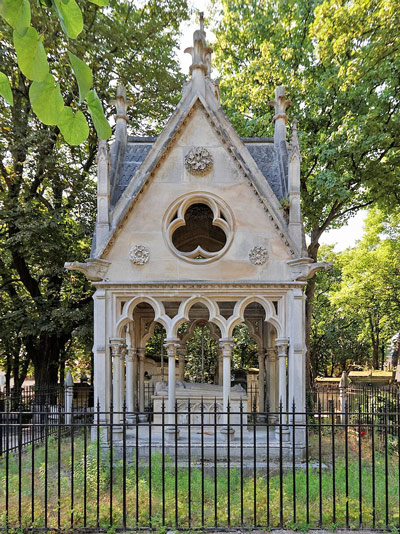
The twelfth-century philosopher and the pupil who became his secret wife lie together beneath a Gothic canopy erected in 1817 by Alexandre Lenoir, with authentic medieval bas-reliefs. Louis XVIII wanted to draw Parisians into an almost empty cemetery: the crowds came at once. Nothing proves, however, that the bones are theirs.
The story
In the early twelfth century Peter Abelard taught logic on the Montagne Sainte-Geneviève and drew scholars from every corner of Europe. Canon Fulbert put his niece Héloïse, a young woman of extraordinary learning, into his care. Master and pupil fell in love, a child was born, and they married in secret.
The uncle's revenge was terrible: around 1117 Abelard was seized and castrated. He became a monk; she became a nun and then abbess of the Paraclete, the abbey he had founded, and nothing was left to them but the letters — the finest the Middle Ages left behind. Abelard died on 21 April 1142, at sixty-three; Héloïse outlived him by twenty-two years.
Their remains travelled for seven centuries. In 1817 the City of Paris arranged their translation to Père-Lachaise, to give a cemetery Parisians were shunning the prestige it lacked. The calculation was sound: this grave brought the whole city out.
The monument is the work of Alexandre Lenoir, the man who had saved the royal tombs of Saint-Denis from revolutionary destruction. He assembled a canopy in the gothic taste out of genuine medieval reliefs, torn from demolished buildings, and had it brought over from the courtyard of the École des Beaux-Arts. It is a pastiche made of true stones.
The Friends of the cemetery put it bluntly: nothing proves the bones are theirs, since both were buried centuries earlier in communal monastic ground. That discourages nobody. Flowers and letters are still laid at the foot of the monument, and the path that runs alongside it carries both their names.
The grave
A Gothic canopy of 1817 assembled by Alexandre Lenoir, unsigned, brought from the courtyard of the École des Beaux-Arts. Its bas-reliefs are authentic medieval stones salvaged during the Revolution: one of them, depicting the funeral of Louis of France, eldest son of Saint Louis, who died around 1260, was moved to the Musée Carnavalet during a recent restoration and replaced on site by a copy. Beneath the canopy, two recumbent figures with joined hands pray with their faces turned to the sky — they do not look at each other. The inscription reads: “The remains of Abelard and Héloïse were transferred to this place in the year 1819”, two years after the real date. The plot is maintained free of charge by the City of Paris.
On site, do not miss
Step back a few paces along the path: the whole can only be read from a distance, and you then see that it is taller than it is wide — a miniature chapel. Up close, look for the differences in grain and wear between the blocks; they are not the same age.
Visitors' questions
Where is the tomb of Héloïse and Abélard?
In Division 7, a few minutes from the main entrance on Boulevard de Ménilmontant. It is one of the first graves visitors come across as they climb the main avenue.
Fernand ArbelotAre Héloïse and Abélard really buried there?
Their remains were transferred to Père-Lachaise in 1817 from the Musée des monuments français. Some historians dispute the full authenticity of the bones, but the official transfer itself is documented.
Sophie BlanchardWhy is this tomb so often visited?
Because it has become the monument of thwarted love: since the nineteenth century, visitors have left flowers and letters there, and tradition holds that it brings couples good luck.
Georges RodenbachWho were Héloïse and Abélard?
Pierre Abélard, the most famous philosopher of the twelfth century, and Héloïse, his pupil of exceptional learning, who became his secret wife. Their correspondence, written after their forced separation, ranks among the finest letters in the French language.
The Countess of CastiglioneAudio guide to Père Lachaise: the best unusual guided tour!
Discover the secrets of the most astonishing tombs
the audio guidefrom€6.99