Étienne-Gaspard Robert, known as Robertson, a physicist from Liège and inventor of the phantascope, terrorised Directory-era Paris by projecting the ghosts of Marat and Danton before petrified audiences. Robertson's grave in Division 8 of Père-Lachaise is a four-metre-high spectacle in stone.
In Division 8 of Père-Lachaise, on Avenue Casimir-Périer, a monument four metres high stops every passer-by. A sarcophagus in the antique style, topped with a canopy and flanked by skeletal skulls and bat wings, crowns a massive plinth carved with two marble bas-reliefs. The first shows skeletons looming over a panicked crowd — a mother shielding her child's eyes. The second shows a balloon rising under the astonished gaze of onlookers. The name carved in the stone belongs to an unknown man: Robertson. Tourists, intrigued by the most spectacular tomb in the division, often walk away without knowing they have just come across one of the forerunners of cinema.
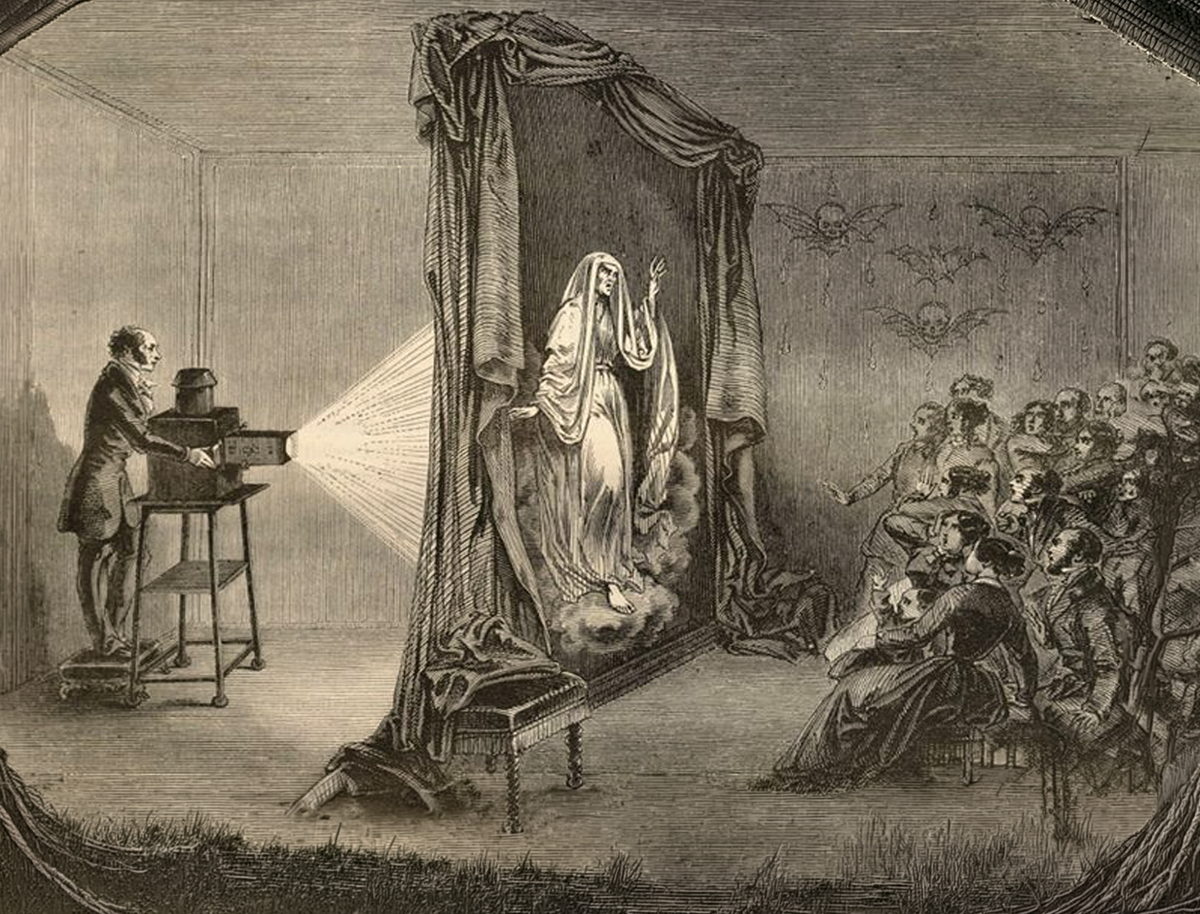
Étienne-Gaspard Robert, born in Liège in 1763, was physicist, balloonist and showman all at once. A physics teacher, an assistant to Volta, the unsuccessful inventor of a flamethrower, Robert turned to optics and perfected the “fantascope” — an improved magic lantern able to project moving, ghostly images through a gauze curtain. Under the stage name Robertson, the physicist opened a phantasmagoria show at the Nouveau Tivoli hall, at 88 Rue de Clichy. The principle was simple: in a room plunged into darkness, Robertson projected the ghosts of Marat, Robespierre and Danton before an audience still traumatised by the Terror. The audience screamed. Robertson took the money. The Directory was fascinated by this science that played on the nerves. Robertson's phantasmagoria was the first show of projected images before a paying audience — a direct forerunner of cinema.
Robertson projected through a screen the spectres of Marat, Robespierre and Danton before audiences still traumatised by the Terror. The crowd screamed. Robertson took the money. Phantasmagoria was the horror cinema of the Directory.
Robertson was also a balloonist, credited with fifty-nine ascents across Europe and in China. He lived comfortably off the combination of his two passions — science and showmanship. Charles Dickens described him as “an honourable and well-educated showman”. Robertson died at Batignolles on 2 July 1837 and rests in Division 8 of Père-Lachaise, in a tomb he had wanted, in his lifetime, as a monument with a message. The architect Guillard designed the structure in three parts: a massive plinth containing the vault door, a central block bearing the name and two bas-reliefs by the sculptor François Hardouin — the phantasmagoria and the balloon ascent — and, at the top, the sarcophagus framed by macabre figures. The tomb, rising to four metres, is unabashed self-aggrandisement: Robertson had decided that posterity would know who he was.
Robertson's tomb, in Division 8, is one of the most photographed monuments at Père-Lachaise — and one of the least understood. Visitors stop for the skulls and the bat wings, photograph Hardouin's bas-reliefs, then move on without identifying the man. Robertson features in no mainstream tourist guide. Yet the phantasmagoria bas-relief, with its panicked crowd before the projected skeletons, is the oldest surviving depiction of a projected-image show kept in a cemetery. The tomb is at once a work of funerary art, a document in the history of technology, and the testament of a man who understood, two centuries before the digital age, that fear is the first spectacle.
Who was Robertson, the phantasmagoria showman of Père-Lachaise?
Étienne-Gaspard Robert, known as Robertson (1763-1837), was a physicist from Liège and inventor of the phantascope, a pioneer of the phantasmagoria. Robertson projected the ghosts of Marat and Danton before Directory-era audiences. Robertson rests in Division 8 at Père-Lachaise.
The phantasmagoria was a show of projected images invented in the late eighteenth century. Robertson used the phantascope, an improved magic lantern, to project ghostly figures onto a gauze screen in a darkened room. The phantasmagoria was a forerunner of cinema.
What are the most spectacular tombs at Père-Lachaise?
Among the most spectacular tombs at Père-Lachaise are Robertson's monument in Division 8, 4 metres tall with phantasmagoria reliefs, the Demidoff mausoleum in Division 19, with 10 Doric columns, and Oscar Wilde's sphinx in Division 89.
Robertson's grave lies in Division 8 at Père-Lachaise, on Avenue Casimir-Périer, front row. The 4-metre showpiece tomb is recognisable by the skulls and bat wings carved at the top of the monument.
 Figures