What the Ground at Père-Lachaise Has Not Forgotten
The subsoil of Père-Lachaise conceals remains that predate the cemetery. During works carried out between 1849 and 1875, labourers uncovered ancient bones and foundations, a reminder that the Charonne hill was inhabited centuries before the first burial in 1804.
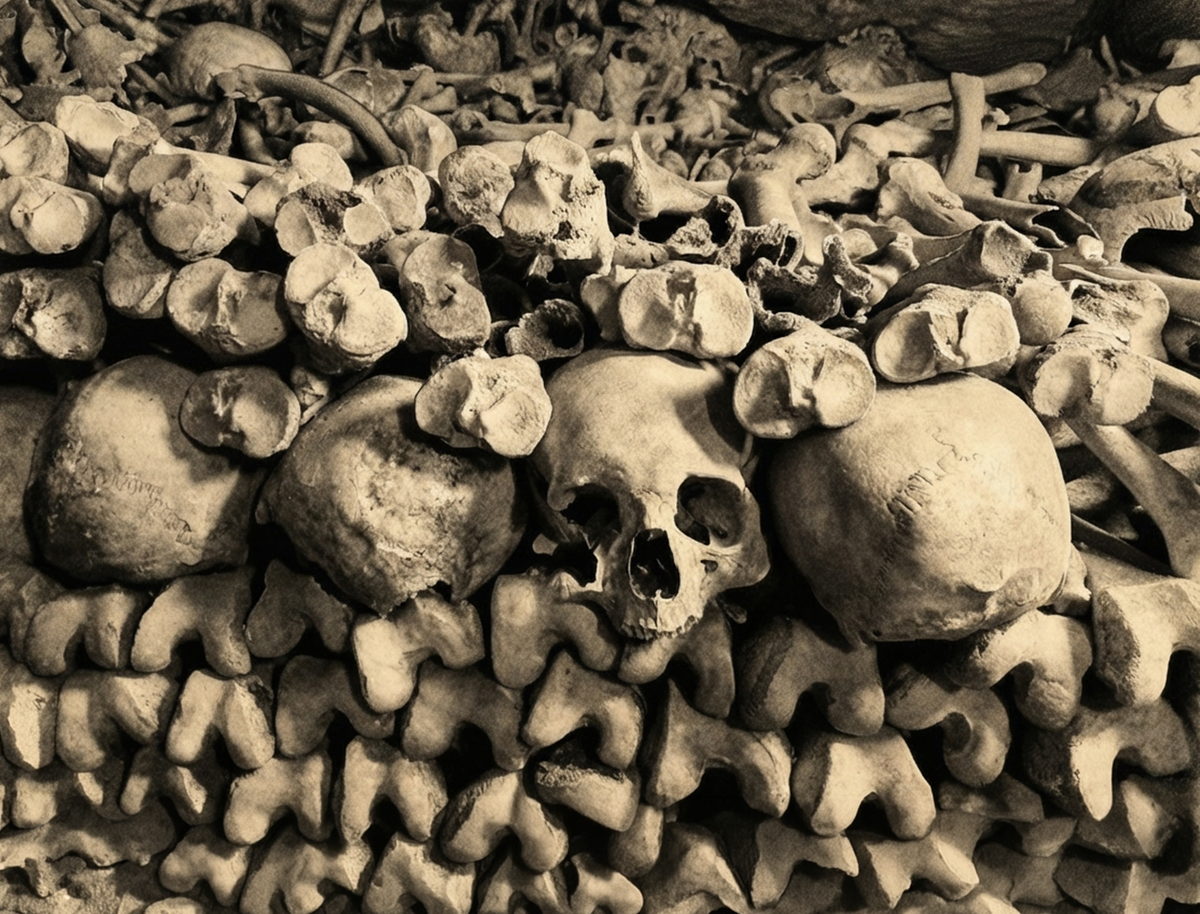
When a Père-Lachaise gravedigger sinks a spade into the ground on the hill at Charonne, he cuts through more than soil: he cuts through centuries. The cemetery grounds, lying between one hundred and four and one hundred and twenty-eight metres above sea level, look out over eastern Paris from a rise that had been occupied, farmed and built upon long before Napoleon signed the Decree of 23 Prairial Year XII (12 June 1804). During the five expansions of Père-Lachaise between 1824 and 1850, and above all during the major earthworks and road-building between 1849 and 1875, workers unearthed remains that had nothing to do with the cemetery's own graves: old bones, building foundations, fragments of walls belonging to earlier periods. The hill of Père-Lachaise holds a buried memory that the cemetery has covered over without erasing.
The Père-Lachaise grounds have been known as “Mont-Louis” since 1626, when the Jesuits of Paris acquired the property and named it in honour of Louis XIII. Father François d'Aix de La Chaise, confessor to Louis XIV, frequented the estate from 1675 and helped to embellish it: terraces laid out with French-style flowerbeds, ponds with fountains fed by pipes running down from the heights of Ménilmontant, straight avenues, groves, an orangery, an ornamental kitchen garden. In 1762, when the Jesuits were expelled, the estate was sold and broken up. By 1804, when the cemetery opened, the French-style gardens had almost vanished: Mont-Louis had become a large orchard surrounded by cultivated plots. But beneath the orchard and the Jesuit avenues, the ground still held traces of older occupation. The slope at Charonne, on the right bank of the Seine, is a site of settlement attested since antiquity.
Before it was a cemetery, Mont-Louis was a Jesuit estate. Before the Jesuits, cultivated slopes. Before the crops, an inhabited hill. The gravediggers of Père-Lachaise dig through layers of the past.
The expansion and earthworks at Père-Lachaise, concentrated between 1849 and 1875, brought to light remains from various periods. Workers digging the new avenues and new divisions found the foundations of walls belonging to the old buildings of the Jesuit estate — the pipe network that had fed the fountains, the bases of the terraces, the remains of the orangery. Deeper down, old bones, predating both the cemetery and the Jesuit estate, were unearthed. The Charonne plateau, between Ménilmontant and Bagnolet, had been a place of burial and rural settlement for centuries before the Jesuits arrived. Historical sources mention these finds without always documenting them with the rigour modern archaeology would require: in the nineteenth century, earthworks were not scientific excavations, and remains were often moved or destroyed without record.
The ground beneath Père-Lachaise has never been the subject of systematic archaeological excavation. The cemetery is a listed site, in continuous use for more than two centuries, where any intervention in the soil is governed by strict regulatory constraints. Present-day gravediggers, when digging in the oldest divisions, still sometimes come across structures — foundations, pipes, paving — that belong not to the cemetery but to the pre-1804 Mont-Louis. Père-Lachaise is thus a palimpsest: beneath its forty-four hectares of graves, the ground holds traces of the seventeenth-century Jesuit estate, of eighteenth-century cultivation, and of even earlier occupation of the Charonne slope. A visitor walking the avenues is treading on at least three centuries of buried past — and the cemetery, for all its two hundred and twenty years of existence, is only the most recent layer.
Before the cemetery opened in 1804, the land was the Jesuit estate of Mont-Louis, acquired in 1626: French-style terraces, ponds and an orangery. After the Jesuits' expulsion in 1762, the estate was divided into cultivated plots. The Charonne hillside had been inhabited since antiquity.
Yes. Groundworks carried out between 1849 and 1875 uncovered bones predating the cemetery, foundations from the Jesuit estate and traces of earlier settlement on the Charonne hillside. These finds were not documented with the rigour of modern archaeology.
Père-Lachaise takes its name from Father François d'Aix de La Chaise (1624-1709), confessor to Louis XIV, who frequented the Jesuit estate of Mont-Louis. The estate became a cemetery in 1804, but the confessor's popular name outlived the site's religious past.
Has Père-Lachaise ever been archaeologically excavated?
No. Père-Lachaise, a listed site and an active cemetery, has never undergone systematic archaeological excavation. The remains uncovered during nineteenth-century works were not recorded to modern scientific standards.
 Heritage