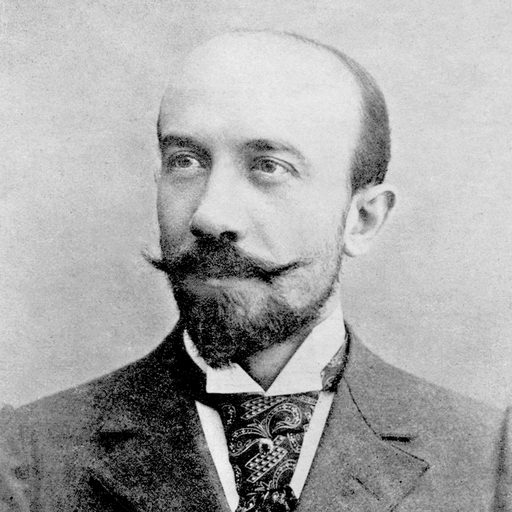
The Lumière brothers had advised him against going into the business. An illusionist turned film-maker, he shot more than five hundred films and invented, often by accident, superimposition and the dissolve. Ruined, his negatives sold by weight and melted down, he ended up selling toys on the concourse of the Gare Montparnasse.
The story
In 1888 Méliès bought the théâtre Robert-Houdin to put on magic shows and grand illusions. He was a conjuror, not an engineer: cinema would interest him as one more trick.
In 1896 the Lumière brothers talked him out of it — the invention had no future, they said. He took no notice: he bought a projector in London, founded the Star Film company, and in 1897 built, on his property at Montreuil, a studio entirely of glass so that he could film his actors by daylight.
Le Voyage dans la Lune, in 1902, was his first great success: a carnival of photographic illusion and technical invention, whose shell planted in the Moon's eye became the founding image of fiction cinema. He would shoot more than five hundred films.
The war and the big studios ruined him. His negatives were destroyed, melted down for the silver in the stock, or turned into shoe heels. He turned up selling toys and sweets on the platform at the gare Montparnasse.
In 1931 he was made a chevalier of the Legion of Honour, and Henri Langlois set about saving what was left of his films. He died on 21 January 1938 and lies with his wife Charlotte Faes, the actress Jehanne d'Alcy, who died in 1956. Since 1946 the Méliès prize has been awarded each year to a French film.
The grave
The plot is not his own: it is the grave of the Genin family, that of his second wife, where four women's names precede his — Delphine Genin, Agathe Windoz, Madame Genin, Marie Thomas. The bronze bust that depicts him is by Renato Carvillani and dates from 1954: it was added sixteen years after his death. The inscription gives him a title he would no doubt have claimed: “creator of the cinematographic spectacle”.
On site, do not miss
Read the stone from top to bottom: you have to pass four names before reaching his, and it is the last. Then look for the date of the bust — it is sixteen years later than his death.
Visitors' questions
Where is Georges Méliès's grave?
In Division 64, in the eastern part of the cemetery, close to the great circular paths.
Patrice ChéreauWhy does Méliès matter so much?
He invented most of the grammar of cinematic trick effects — double exposure, the fade, the sudden appearance — and turned cinema into an art of fiction rather than mere recording.
Pierre DesprogesWhy did Méliès end up ruined?
Industrial competition swept his studio away: his negatives were sold by weight, melted down to recover the silver in the film stock, or turned into shoe heels. He ended up running a toy stall at the Gare Montparnasse.
François-Joseph TalmaWhat is Méliès's most famous film?
A Trip to the Moon, shot in 1902. Its shell lodged in the Moon's eye became the founding image of narrative cinema.
Marcel MarceauAudio guide to Père Lachaise: the best unusual guided tour!
Discover the secrets of the most astonishing tombs
the audio guidefrom€6.99