Paul-Albert Bartholémé was a painter. The day sculpture took hold of him, he burned his canvases in an open field. Twelve years later, on 1 November 1899, ninety-eight thousand people came to see his Monument to the Dead at Père-Lachaise.
At the end of Père-Lachaise's main avenue, in Division 4, a cliff of white stone blocks the view. Two limestone wings frame a dark doorway opening onto nothing. On either side, some twenty larger-than-life figures grieve, pray, console one another or turn their faces away. A kneeling girl clasps her hands. A standing man buries his head in his hands. A mother, bent double with grief, forgets the child she carries. Below, a mysterious figure lifts a tomb slab, and a resurrected couple — the man and the woman, made young again, leaning on one another — step towards the gaping door. This Monument to the Dead, unveiled on 1 November 1899, is the largest sculpture at Père-Lachaise. It is also the least understood. Visitors walk past it, taking it for architectural decoration. It is, in fact, the work of a single man, a former painter turned sculptor by grief.
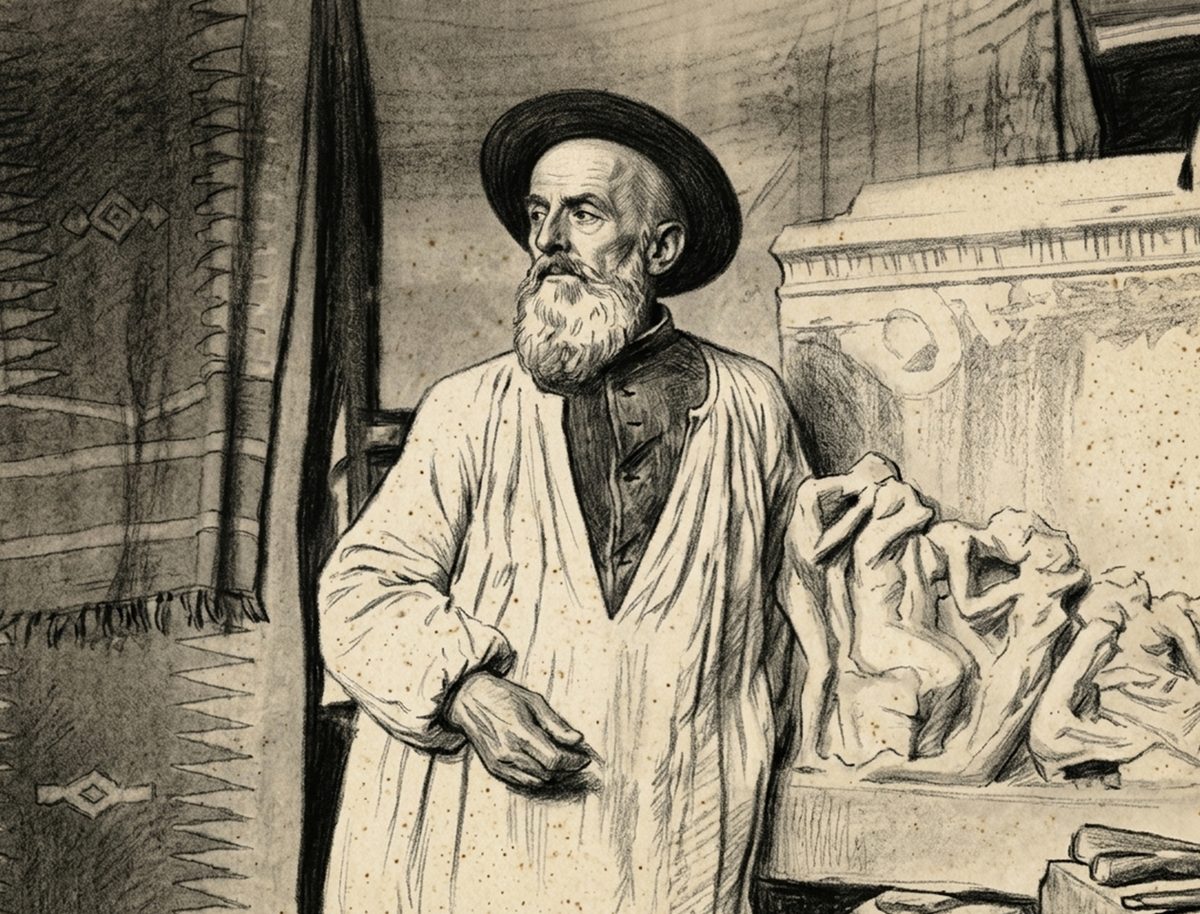
Paul-Albert Bartholémé was born in 1848 at Thiverval, in the Yvelines. He was a painter — a good one, noticed by Huysmans for his scenes of Parisian tramps and girls playing in schoolyards. But his wife's death broke him. He turned to sculpture with the obsession of a man seeking in matter what words could not say. His friend Edgar Degas encouraged him. One day, Bartholémé loaded most of his paintings onto a cart, took them out of Paris, and burned them in an open field. The break was total. For twelve years, from 1887 to 1899, he worked on a single piece: a monument dedicated to all the dead, without distinction of religion, rank or era. Not a commemorative monument, not a tribute to some general or poet — a monument to death itself, to the grief of the living, and to the hope of an afterlife.
The scale of the undertaking defies belief. Bartholémé modelled more than a hundred figures in clay before settling on around twenty. Each was exhibited separately at the Salons du Champ-de-Mars, adjusted, moved, reworked. Then came the carving in stone. Bartholémé turned quarryman, scouring the quarries of eastern France and Burgundy for the purest blocks. Whenever a block was roughed out and a vein of mineral or a hollow appeared, he started again. Four thousand four hundred days of work, twelve to fourteen hours a day, often by lamplight — Le Figaro reported on 31 October 1899 that for four years Bartholémé had not slept in a bed, making do with five or six hours' sleep in an armchair. All the while, he had to convince the City and the State to accept an unprecedented monument — neither religious nor military, dedicated to no particular death. He was offered a spot behind the Trocadéro. Bartholémé refused. He threatened to destroy the work rather than see it badly placed.
Four thousand four hundred days of twelve to fourteen hours, often by lamplight. For four years Bartholémé did not sleep in a bed — he made do with five or six hours' sleep in an armchair, in the middle of his studio.
On 1 November 1899, All Saints' Day, the monument was unveiled with no official ceremony. No speeches, no ribbon cutting, no dais. The whiteness of the stone melted into the trees of Division 4. Ninety-eight thousand visitors filed past the monument in a single day — an unprecedented figure for a public artwork in Paris. Controversy followed: the nudity of the figures caused offence. A nude couple steps towards the dark doorway; a female figure lifts a slab, baring her body. Yet the public was struck. Le Figaro reported that “simple people will look, and understand far better.” In 1900, Bartholémé received the Grand Prix for sculpture at the Exposition Universelle. The Monument to the Dead is recognised as one of the major works of late nineteenth-century French sculpture. A cast of its central section is kept at the Musée d'Orsay.
Bartholémé died in 1928, at eighty. His grave lies opposite the monument, on the other side of the avenue, in a medieval-style tomb with a recumbent effigy. The sculptor rests beneath the gaze of his own stone figures — the mourners, the comforters, the resurrected couple. Behind the monument, invisible from the avenue, the ossuary of Père-Lachaise was fitted out in 1953 in underground galleries. Bartholémé's sculpture conceals the entrance to this place where abandoned plots come to their end. The Monument to the Dead has become, without the artist ever intending it, the façade of an underground world where perpetuity comes to a close. Three million visitors pass this cliff of white stone every year. Most photograph it without knowing Bartholémé's name, without knowing that a painter burned his canvases to sculpt it, or that he slept four years in an armchair to finish it.
Who sculpted the Monument to the Dead at Père-Lachaise?
Paul-Albert Bartholomé (1848–1928), a painter who turned to sculpture after his wife's death, spent twelve years on the Monument to the Dead at Père-Lachaise. Unveiled on 1 November 1899, it won the Grand Prix for sculpture at the 1900 Universal Exhibition.
Where is the Monument to the Dead at Père-Lachaise?
Bartholomé's Monument to the Dead stands in Division 4, at the end of Père-Lachaise's main avenue. This white stone sculpture, several metres tall, shows some twenty larger-than-life figures embodying the grief of the living and the hope of resurrection.
Why did the Monument to the Dead at Père-Lachaise cause a scandal?
The nudity of the sculpted figures shocked the public at its unveiling on 1 November 1899. A nude couple steps towards a dark doorway symbolising the passage into the afterlife. Despite the outcry, 98,000 visitors filed past on All Saints' Day.
What lies hidden behind the Monument to the Dead at Père-Lachaise?
Behind Bartholomé's Monument to the Dead lies the central ossuary of the Paris cemeteries, built in 1953. Underground galleries hold bones exhumed from reclaimed plots across the seventeen Paris cemeteries. The ossuary is closed to the public.
 Heritage