In 1985, Père-Lachaise opened France's first garden of remembrance: a lawn in Division 77 where ashes are scattered with no grave, no plaque, no visible trace. More than thirteen hundred families choose this option each year.
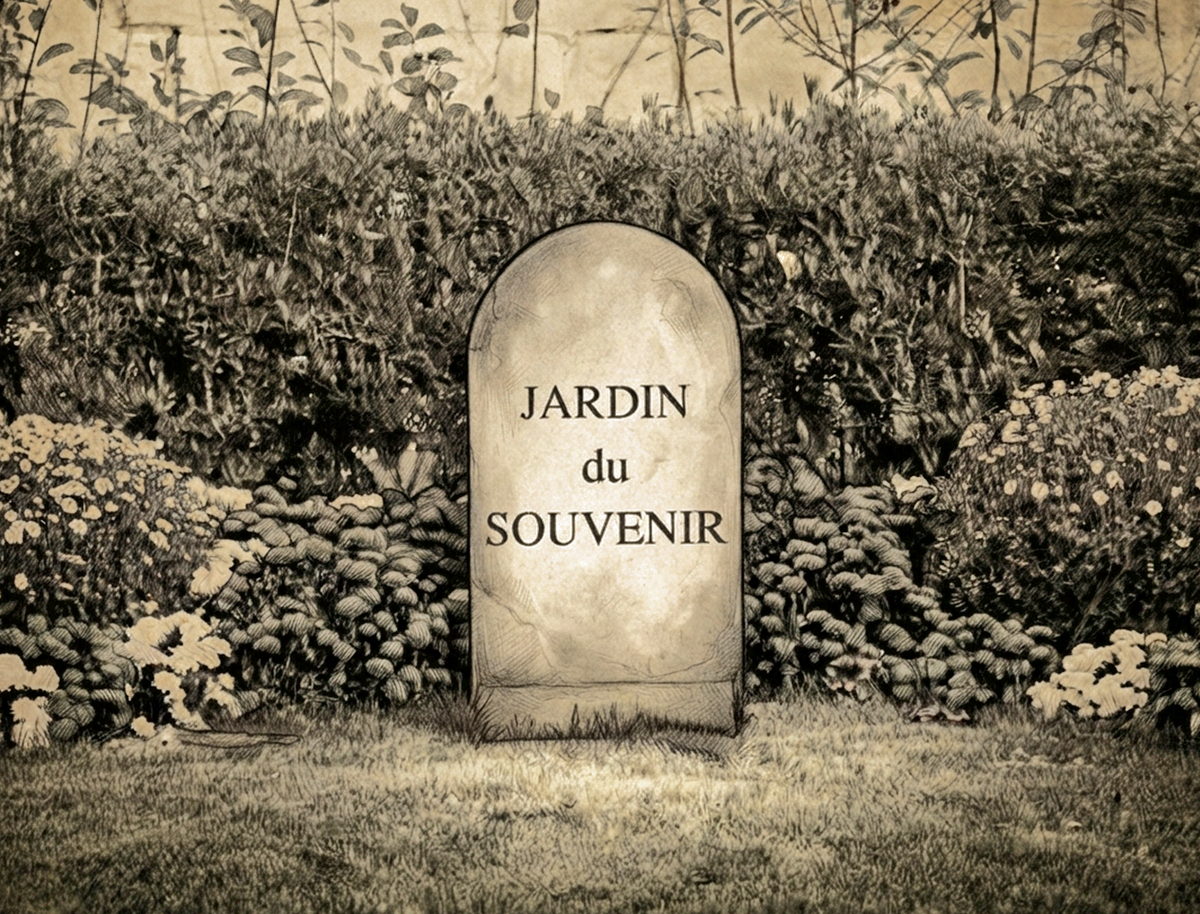
In Division 77, along the Rue des Rondeaux, a lawn edged with shrubs stretches out with no monument, no inscription. No engraved name, no slab, no vase of flowers. Only cut natural flowers are laid at its edge — they will be removed once they wilt. This is the garden of remembrance at Père-Lachaise, opened in 1985 by the City of Paris: the first ash-scattering ground created in France. Every year, more than thirteen hundred scattering ceremonies take place here, at families' request and with administrative authorisation. The ashes are spread over the grass, mixed with the soil, absorbed into the ground. The name of the deceased appears on no stone, no plaque, no monument. A computer terminal installed at the garden's entrance lets visitors consult the list of those whose ashes have been scattered there — the only record, the only link between a name and this rectangle of lawn.
The garden of remembrance grew out of a cultural and demographic shift. Since the 1970s, cremation has gained ground in France. In 1980, it accounted for only one per cent of deaths. By 2020, the rate in Paris exceeded forty per cent. The Père-Lachaise crematorium, France's first since 1889, has kept pace with this shift: not every family choosing cremation wants a niche in the columbarium or an urn in a vault. Some prefer scattering — a final gesture, leaving no material trace, requiring no upkeep, no plot to renew. The garden of remembrance meets this demand by offering a public, regulated place, distinct from the scattering in open countryside the law also allows but which is often experienced as an abandonment. The garden gives grief a place without giving the dead a grave.
No grave, no plaque, no potted flowers. The garden of remembrance is the only place at Père-Lachaise where the dead leave no visible trace — and where a computer terminal replaces the gravestone.
Scattering at the Père-Lachaise garden of remembrance is subject to strict conditions. The deceased must have lived in Paris, died in Paris, or held a grave plot in a Parisian cemetery. As an exception, those cremated at the Père-Lachaise crematorium may be scattered there — provided the urn has not left the crematorium between the cremation and the scattering. If the urn has been handed over to the family, scattering at Père-Lachaise is no longer permitted. The garden is not a funerary plot: it is a collective space that families cannot claim as their own. No named plaque, no ornament, no potted flowers are allowed. Only cut natural flowers may be left at the edge of the lawn, and cemetery staff remove them once they wilt. The garden of remembrance is the one place at Père-Lachaise where personal grief gives way to the collective nature of death.
The garden of remembrance stands as the exact opposite of the model on which Père-Lachaise was founded. In 1804, Frochot and Brongniart invented the perpetual plot: land bought for eternity, a monument of stone, a name carved in marble. Two centuries later, thirteen hundred families a year choose to scatter their dead's ashes over an anonymous lawn, with no stone, no date, no inscription. This shift from perpetuity to scattering reflects a deep change in how the French relate to death and memory. The individual grave, which dominated funerary culture for two centuries, is no longer the only conceivable form of burial. The columbarium, opened in 1896, had already reduced death to a thirty-centimetre niche. The garden of remembrance does away even with the niche.
A visitor walking along the Avenue Circulaire, in Division 77, passes the garden of remembrance without noticing it. Nothing sets it apart from an ordinary lawn. No wall, no gate, no monument. Unlike the columbarium, where every niche bears a name and sometimes a face in a medallion, the garden displays nothing at all. The computer terminal is the only way to trace a name — a kind of digital grave, modest and functional, that loved ones consult in silence before leaving a rose at the edge of the grass. Père-Lachaise, which brings together across forty-four hectares the most varied forms of burial in Europe — neo-Gothic chapels, neoclassical steles, Art Deco tombs, Oriental mausoleums, the concrete niches of the columbarium — also holds the most radical form of all: the absence of a grave. The garden of remembrance is not a place of memory in the usual sense. It is a place of consent to being forgotten.
What is the garden of remembrance at Père-Lachaise?
The garden of remembrance is a lawn in Division 77 of Père-Lachaise, opened in 1985, where ashes are scattered without any grave or plaque. The first of its kind in France, this shared space holds over 1,300 scatterings a year. A digital terminal there lists the names of the dead.
Yes, provided the deceased lived or died in Paris, held a plot in a Paris cemetery, or was cremated at the Père-Lachaise crematorium. In the last case, the urn must not have left the crematorium between the cremation and the scattering.
How much does a scattering cost at the Père-Lachaise garden of remembrance?
Scattering ashes at the Père-Lachaise garden of remembrance is free. The garden is not a funerary plot but a shared space run by the cemetery's conservation office. No plaques, ornaments or potted flowers are allowed on the lawn.
Where is the garden of remembrance at Père-Lachaise?
The garden of remembrance lies in Division 77 of Père-Lachaise, along Rue des Rondeaux and Avenue Circulaire. It is a lawn bordered by shrubs, with no monument or visible inscription. A digital terminal at the entrance lists the names of the dead.
 Society