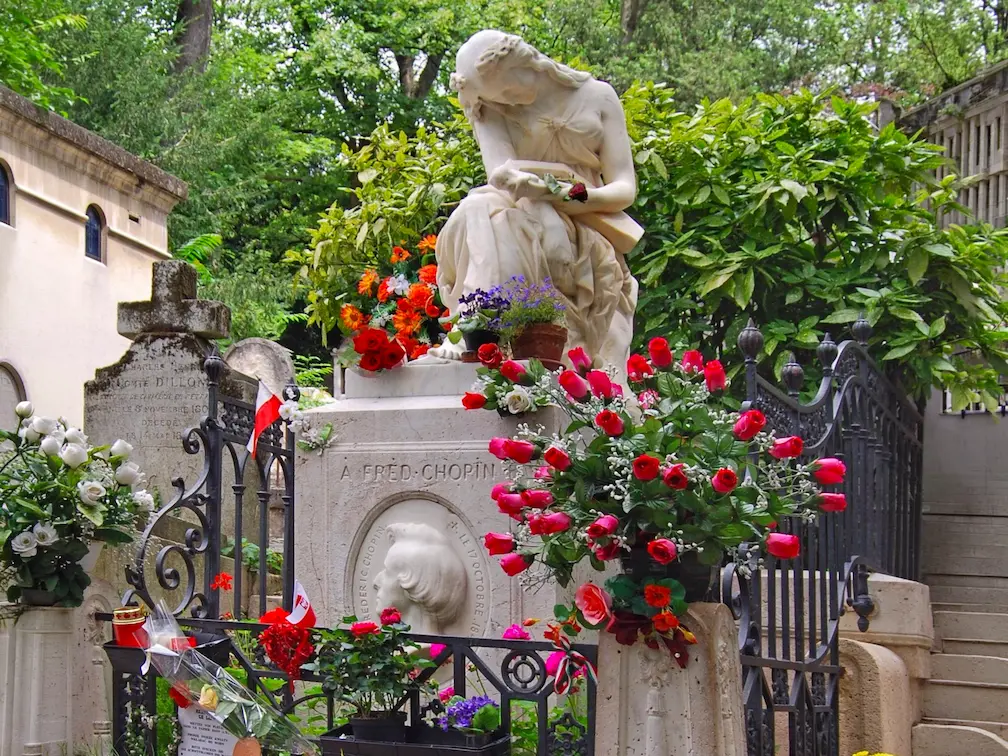
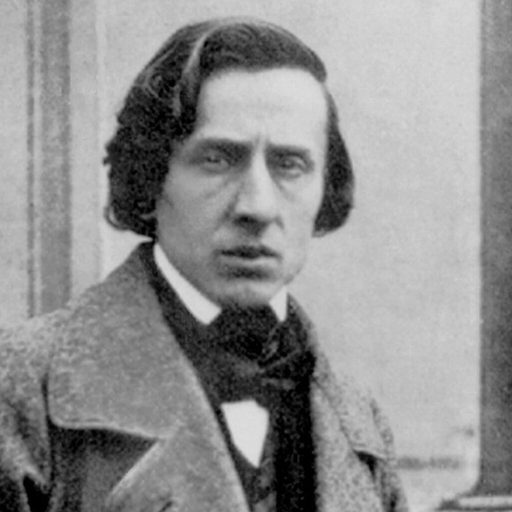
At seven, Frédéric Chopin played in public in Warsaw at a charity concert, and the city had its prodigy. Rather than present himself at the Russian embassy, he took French papers in 1835: Poland was closed to him for ever. His liaison with George Sand gave him his most expansive pages and his worst winter, the one in Majorca. He died at thirty-nine, and it was George Sand's son-in-law who carved the weeping muse on his grave.
The story
At seven Chopin played in public for the first time in Warsaw, at a charity concert given in the theatre of the Radziwiłł Palace; the papers compared him to Mozart and the aristocratic salons fought over him. In 1831, while Russia was crushing the Warsaw rising, he was stranded in Stuttgart. His diary still holds the cries of rage he set down there: out of those weeks came the first Scherzo and the Études op. 10.
In 1834 his father pressed him to put his papers in order at the Russian embassy, so as not to be classed among the political refugees. He never went, and in 1835 he took French papers: the act of a political émigré. He never saw Poland again.
From 1838 to 1847 his affair with George Sand gave his work its largest pages — the Heroic Polonaise, the fourth Ballade, the Barcarolle, all written at Nohant — and gave his health its hardest blow: in the very first winter, that of 1838, the freezing charterhouse of Valldemossa on Majorca.
He died of tuberculosis on 17 October 1849, on the place Vendôme, at thirty-nine. His funeral did not take place for another thirteen days: his friends wanted Mozart's Requiem, which calls for women's voices, and the Madeleine did not admit them. A dispensation had to be obtained. On 30 October, Pauline Viardot and Jeanne-Anaïs Castellan sang from behind a black curtain.
Chopin dreaded being buried alive and asked that his body be opened after his death. His sister Ludwika carried his heart to Poland the following year, hidden, it is said, under her clothes to get it past the Russian border; it is sealed inside a pillar of the Church of the Holy Cross in Warsaw. His body stayed in Division 11, under a grave that Polish visitors keep covered in flowers and small red-and-white flags.
The grave
A weeping Euterpe, muse of music, watches over the grave: white marble, signed “J. Clésinger, 1850”. Auguste Clésinger was George Sand's son-in-law; he himself lies a few rows further on, along the chemin Denon, in Division 10. An unsigned marble medallion gives the composer's profile, with this single mention: “Frédéric Chopin + 17 October 1849”. Beneath the statue, an inscription recalls Chopin's double origin: “born in Poland, at Zélazowa-Wola, near Warsaw, son of a French émigré”. The dedication is brief — “To Fred. Chopin, his friends”. Those close to him brought Polish soil and scattered it over the coffin.
On site, do not miss
Look for the signature at the foot of the statue: “J. Clésinger, 1850”. Then look at the muse's hands — the lyre she holds is broken, which cannot be seen from a distance. The sculptor himself lies a few rows away, in Division 10.
Visitors' questions
Is Chopin's heart at Père-Lachaise?
No. His sister Ludwika carried it back to Warsaw, where it is sealed inside a pillar of the Holy Cross Church. Only his body rests in Division 11.
Daniel-François-Esprit AuberWhere is Chopin's grave?
In Division 11, on the Chemin Denon, in the older, lower part of the cemetery, about ten minutes from the main entrance. The grave can be spotted from a distance: it is the one under the flowers.
Tony AubinWhy was his heart removed?
Chopin dreaded being buried alive and asked that his body be opened after his death. His sister Ludwika then carried the heart to Poland, the country he had not seen for nineteen years.
François BazinWhat does the statue on Chopin's grave depict?
Euterpe, the muse of music, weeping over a broken lyre. Auguste Clésinger carved her in 1850; a marble medallion beneath the statue gives Chopin in profile. The grave is in Division 11.
Vincenzo BelliniAudio guide to Père Lachaise: the best unusual guided tour!
Discover the secrets of the most astonishing tombs
the audio guidefrom€6.99