Behind Bartholémé's Monument to the Dead, underground galleries have received, since 1953, the exhumed bones from reclaimed plots across Paris's seventeen cemeteries. This ossuary is where perpetuity comes to an end — and where hundreds of names have slipped into oblivion.
Behind the Monument to the Dead by Albert Bartholomé, unveiled in 1899 at the far end of Père-Lachaise's main avenue, a staircase leads down to a door the public never crosses. This door opens onto the central ossuary of the Paris cemeteries. Underground galleries extend on either side of the monument, with two side entrances invisible from the avenue. Inside, numbered crypts each correspond to a Parisian cemetery: Montmartre, Montparnasse, Belleville, Charonne, Batignolles, Passy, Saint-Vincent, La Villette and nine others. In these crypts, boxes of bones are lined up on concrete shelves. When a crypt is full, it is sealed with a stone slab bearing the names of those whose remains lie within. The ossuary at Père-Lachaise is not a mass grave: it is an archive of the forgotten dead, the place where a perpetual plot ends up once no one comes anymore.
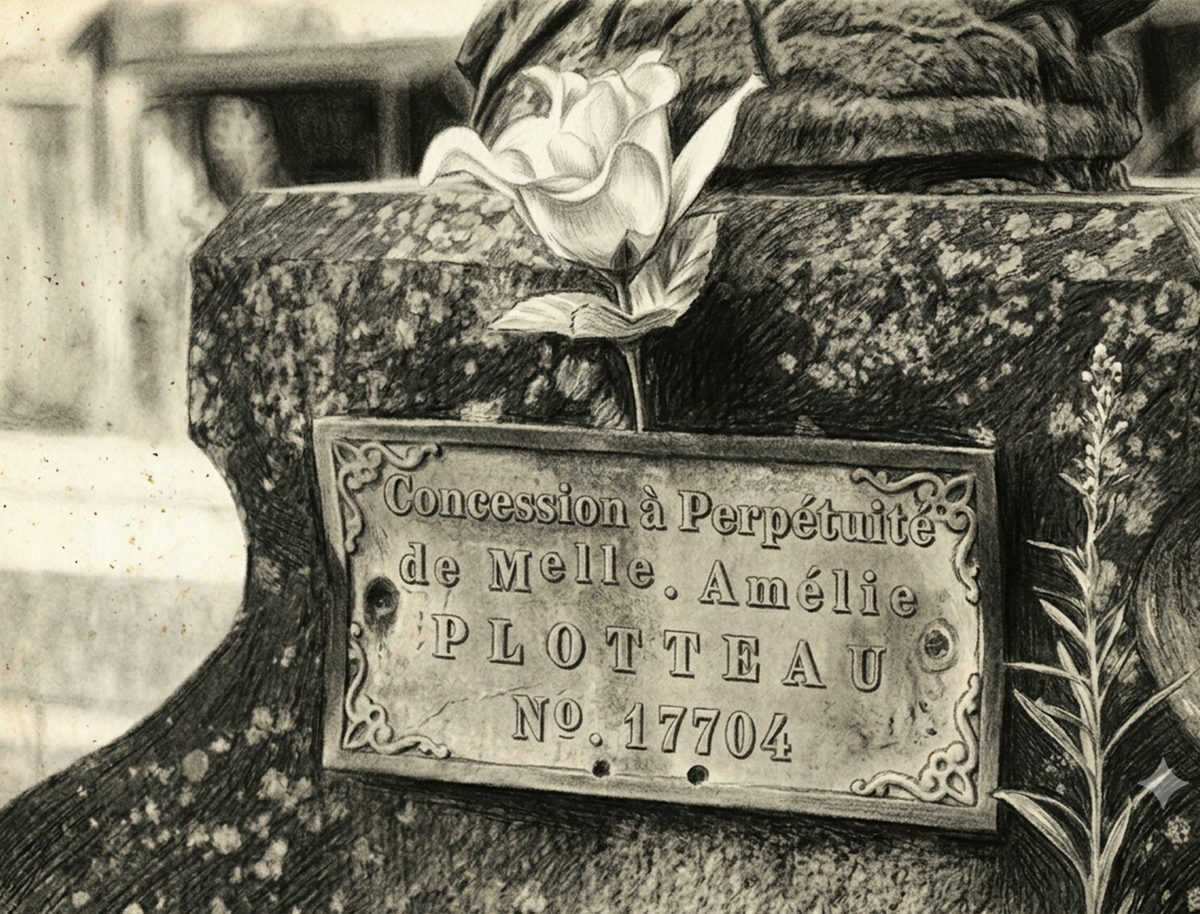
The ossuary is the product of a law and a paradox. The law of 3 January 1924 allowed municipalities to reclaim abandoned perpetual or hundred-year plots — a measure made necessary by the saturation of cemeteries after the First World War. Before 1924, perpetuity was absolute: once paid for, a plot could not be challenged, whatever state the grave was in. The law changed the rule: if a grave had been neglected for more than thirty years — collapsed tomb, torn-out fencing, invasive vegetation — the City could begin reclamation proceedings after a three-year inquiry. But what to do with the exhumed bones? The decrees of 25 April 1924, 18 April 1931 and 12 March 1945 required the creation of special ossuaries to hold the remains in perpetuity. Here lies the paradox: the perpetuity of the plot was abolished, but the perpetuity of the bones was guaranteed. The family lost its ground, but the remains were not destroyed.
Paris's largest ossuary hides behind the cemetery's most photographed monument. Thousands of visitors stop before Bartholémé's bronze figures without knowing what lies on the other side of the wall.
On 21 November 1946, a decree authorised the City of Paris to create a single ossuary at Père-Lachaise for all seventeen Parisian cemeteries. On 29 December 1947, the Municipal Council voted the necessary loan and entrusted the design to the architect Jules Formigé. The site chosen lay behind Bartholomé's Monument to the Dead, at the very heart of the cemetery — both monumental and discreet, since visitors stop before the bronze figures without ever looking behind them. The ossuary came into service on 1 January 1953. The first reliquaries came from reclamations carried out in the Montmartre and Montparnasse cemeteries. It was not until 10 January 1963 — ten years after opening — that the first boxes of bones from reclamations at Père-Lachaise itself were placed in the galleries. Each crypt receives the remains of a single cemetery of origin, and each sealed slab bears the engraved names of the transferred dead.
The APPL — the Friends and Enthusiasts of Père-Lachaise — have documented two hundred and forty-six notable figures whose graves were reclaimed and whose remains were either transferred to the ossuary or lost in the process. The list is dizzying. Joseph Ignace Guillotin, the physician whose name remains attached to the guillotine, was buried at Père-Lachaise on 28 March 1814: his grave has vanished. Siméon Denis Poisson, the mathematician who gave his name to the Poisson probability distribution, entered the cemetery on 30 April 1840: his grave has vanished. Félicité de Lamennais, the priest who sought to reconcile Catholicism and democracy, was buried on 1 March 1854 in a common grave, in keeping with his last wishes. Eileen Gray, the Irish architect and designer who pioneered the modernist movement, was cremated on 2 November 1976: her columbarium niche was reclaimed in 1998. Philippe Astley, the founder of the modern circus, lies somewhere beneath the galleries since his plot was reclaimed. Painters, generals, composers, members of parliament, sculptors: the APPL's list is Père-Lachaise's counter-directory, the catalogue of those the cemetery has forgotten.
The ossuary is not open to the public. The few photographs that circulate show narrow galleries, neon lighting, metal shelves loaded with zinc or wooden boxes. The sealed slabs bear names that no one comes to read anymore. The place is functional, unadorned, the opposite of the funerary splendour that reigns above ground. Yet it is the mechanism that keeps the cemetery running: without the reclamation of abandoned plots — between one hundred and fifty and three hundred a year — Père-Lachaise could no longer take in a single burial. The ossuary is the hidden face of perpetuity: the place where one understands that “forever” means “for as long as someone remembers.” The three million visitors who come each year walk past Bartholomé's Monument to the Dead admiring its bronze figures. No sign points to what lies behind it.
Yes. The central ossuary of the Paris cemeteries lies behind Bartholomé's Monument to the Dead, at the heart of Père-Lachaise. In use since 1 January 1953, its underground galleries hold bones exhumed from reclaimed plots across the seventeen Paris cemeteries.
What happens to a reclaimed grave at Père-Lachaise?
The bones are exhumed and placed in boxes stored in the central ossuary, in a crypt matching their cemetery of origin. Once a crypt is full, a slab bearing the names of the dead seals it for good. The City reclaims between 150 and 300 plots each year.
Which famous figures have vanished from Père-Lachaise?
Joseph Ignace Guillotin (buried 1814), Siméon Denis Poisson (1840), Philippe Astley, founder of the modern circus (1814), and the architect Eileen Gray (1976) are among 246 notable figures whose Père-Lachaise graves have been reclaimed or lost.
No. The central ossuary of the Paris cemeteries, behind Bartholomé's Monument to the Dead, is closed to the public. Its underground galleries are a working facility run by the City of Paris's plot-reclamation service, accessible only to cemetery staff.
 Heritage