The first prefect of the Seine appointed by Bonaparte in 1800, Nicolas Frochot bought the Mont-Louis estate for 180,000 francs and founded Père-Lachaise cemetery — before being buried there himself, in Division 37.
In Division 37, on the Avenue des Acacias, a white stone funerary chapel bears a plain inscription: “Grave of the Frochot family.” Two statues by Nicolas Bernard Raggi, one representing female grief, the other male grief, flank the entrance. Nothing indicates that the man resting here is the cemetery's own founder. Nicolas Frochot, the first prefect of the Seine, bought this hill for a hundred and eighty thousand francs on behalf of the City of Paris on 10 January 1804. Twenty-four years later, he was buried in it.
Frochot was born on 20 March 1761 in Dijon, into a family of Burgundian lawyers. Elected a deputy of the Third Estate to the Estates-General in March 1789, he drafted his province's cahiers de doléances and became a close friend of Mirabeau, whose executor he would later be. The Terror imprisoned him; Robespierre's fall set him free. In December 1799, he was elected deputy for the Côte-d'Or. Three months later, on 22 March 1800, Bonaparte appointed him prefect of the Seine — the first to hold that title. Frochot was thirty-nine, and Paris had no cemeteries worthy of the name: the dead were still buried in parish cemeteries within the city, among the living.
Bonaparte appointed him prefect of the Seine on 22 March 1800. Frochot was thirty-nine, and Paris had no cemeteries worthy of the name.
The imperial decree of 23 Prairial, Year XII — 12 June 1804 — banned burial within towns and required cemeteries to be created outside their boundaries. But Frochot had not waited for the decree: as early as 10 January, he had acquired the Mont-Louis estate, a former Jesuit property on the Charonne hill, to found the Eastern Cemetery there. Three more would follow: Montmartre to the north, Montparnasse to the south, Passy to the west. He entrusted the design of Mont-Louis to the architect Alexandre-Théodore Brongniart, who conceived an English-style funerary park, hilly and wooded, breaking with the tradition of the walled parish cemetery. At the same time, Frochot was reshaping Paris — numbering buildings, opening streets, building bridges — and commissioned from Pierre-Paul Prud'hon the painting Justice and Divine Vengeance Pursuing Crime, now in the Louvre.
The opening of the Eastern Cemetery, on 21 May 1804, was a quiet fiasco: thirteen graves in the first year. Parisians refused this distant hill, with neither church nor tradition. Frochot persevered. In 1805, he created the perpetual plot, an administrative innovation allowing families to put down lasting roots in this new place. In 1806, Napoleon ordered the transfer of the remains of Louise de Lorraine and Admiral Bruix: the imperial seal of approval had been given. Perpetual plots rose from forty-nine in 1806 to eight hundred and thirty-three by 1812. The once-shunned cemetery had become fashionable.
In October 1812, General Malet attempted a coup by announcing Napoleon's death in Russia. Frochot, caught off guard, did not oppose it quickly enough. The furious Emperor forced him into retirement. An honorary councillor of state under the Restoration, he nonetheless rallied to Napoleon during the Hundred Days and was given the prefecture of the Bouches-du-Rhône. The Empire's final collapse sent him back to his estate at Rouvres-sur-Aube, in the Haute-Marne, where he died on 29 July 1828 at sixty-seven. His funerary chapel, decorated with sculptures by Raggi, sets two allegories of grief on either side of the entrance, in Division 37. The founder of Père-Lachaise rests within his own creation, but few visitors ever stop before his grave.
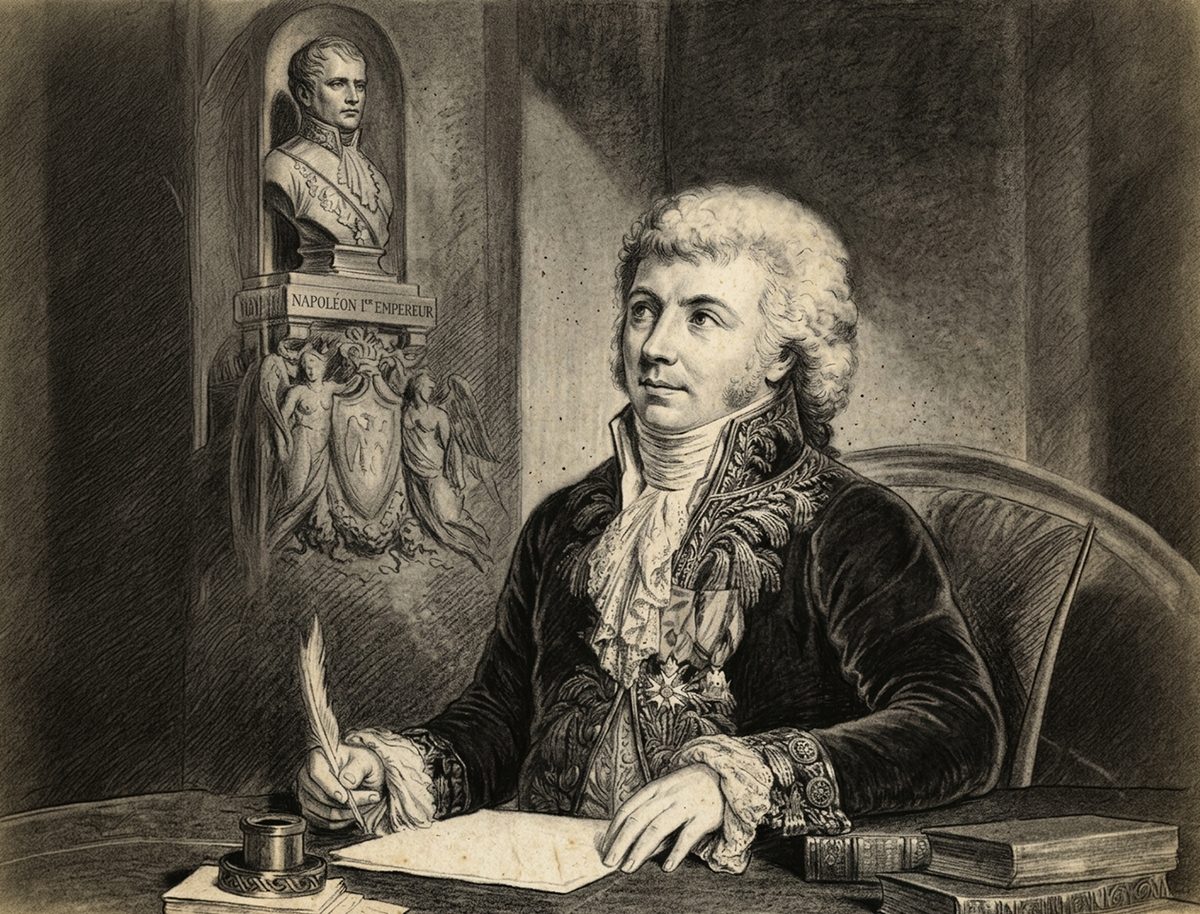
Nicolas Frochot, the first prefect of the Seine, appointed by Bonaparte on 22 March 1800. Frochot bought the Mont-Louis estate on 10 January 1804 for 180,000 francs and entrusted its layout to the architect Brongniart.
Where is Nicolas Frochot's grave at Père-Lachaise?
Nicolas Frochot's grave lies in Division 37, on Avenue des Acacias, front row. His 1828 funerary chapel, adorned with sculptures by Nicolas Bernard Raggi, shows two allegories of grief, one female, one male.
Because of General Malet's conspiracy in October 1812. Malet falsely announced Napoleon's death in Russia. Frochot failed to move against the plot quickly enough. The furious Emperor forced him into retirement.
How many cemeteries did Nicolas Frochot create in Paris?
Nicolas Frochot created four cemeteries outside the city walls: Père-Lachaise (east), Montmartre (north), Montparnasse (south) and Passy (west), following the imperial decree of 12 June 1804 banning burials within towns.
 History