Twelve listed monuments, thirty thousand graves recorded on the register of historic monuments: Père-Lachaise is France's largest open-air sculpture museum. Three million visitors come each year — most of them for a single grave.
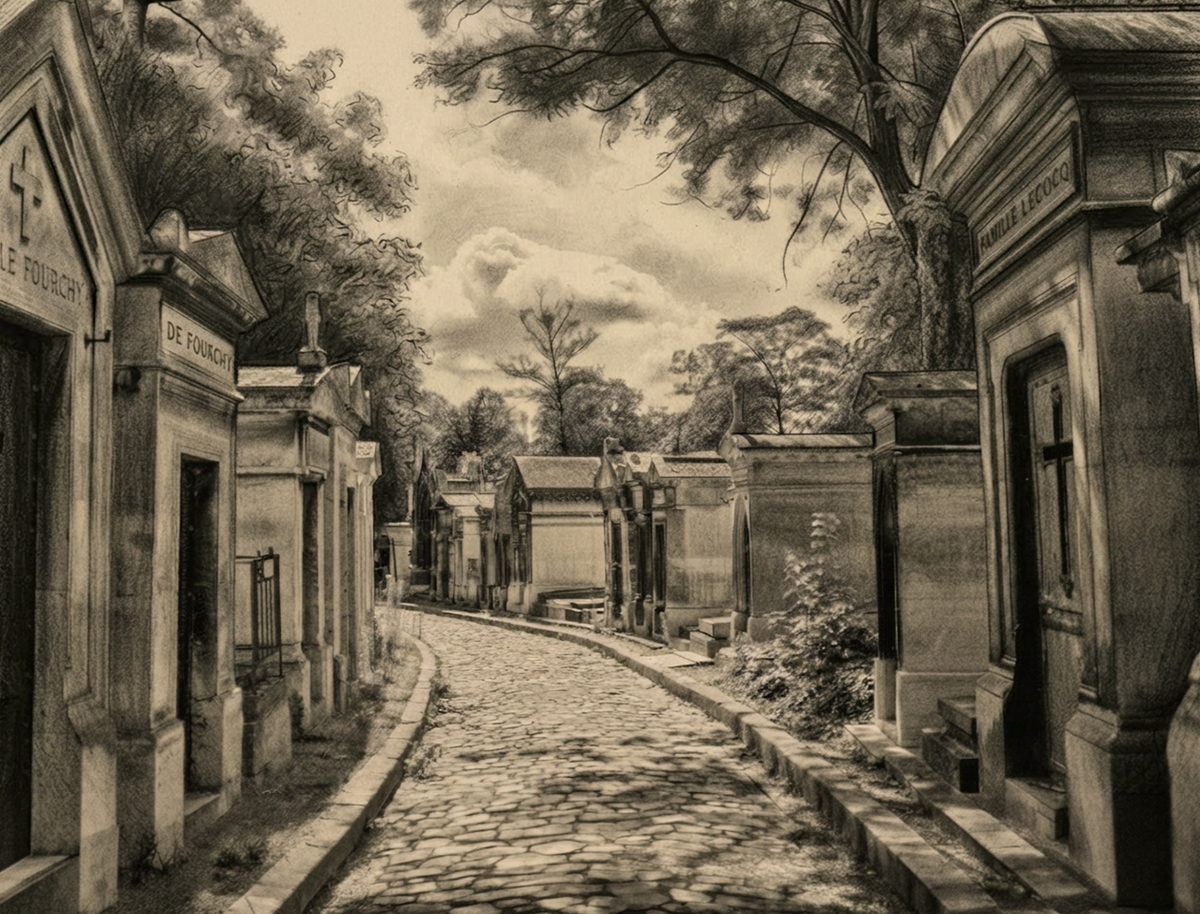
Three million visitors walk the alleys of Père-Lachaise every year. Most are looking for Jim Morrison, Oscar Wilde, Édith Piaf or Frédéric Chopin — a handful of names among 70,000 graves. Almost none of them know that the cemetery they are crossing has been a listed site since 1962, that 30,000 of its graves have been on the supplementary inventory of historic monuments since 1983, and that twelve monuments there are listed as historic monuments — the highest level of protection in French heritage law. Neither the Louvre nor the Musée d'Orsay holds as much open-air sculpture. Yet Père-Lachaise has no ticket booth, no marked trail, no official audio guide. It is a museum that does not know it is one — or rather, one its visitors do not know they are visiting.
The story of Père-Lachaise's protection began on 17 December 1962, when a ministerial order listed the cemetery as a natural site. The zone covers the romantic sector — Divisions 10 to 39, the historic heart laid out by Brongniart — and extends across some forty further divisions, from Division 4 to Division 80. In 1983, a second order placed every funerary monument built before 1900 within those divisions on the inventory of historic monuments. The stroke of the pen was sweeping: a single order brought some 30,000 graves under protection. None was chosen for its fame or its beauty: the criterion was the date, and the date alone. Any grave built before 1900 within the listed zone is now an inscribed historic monument, whether it bears the signature of a great architect or is collapsing under ivy.
Of these 30,000 inscribed graves, twelve monuments are listed as historic monuments — the strongest protection, forbidding any alteration without the approval of the Ministry of Culture. The first eight were listed on 14 November 1983: the entrance gate and chapel by Étienne-Hippolyte Godde, the Communards' Wall, the Monument to the Dead by Bartholomé, the cenotaph of Héloïse and Abelard in Division 7, the monument to Molière and La Fontaine in Division 25, the monument known as Delille's in Division 11, and the Dragon Tomb in Division 29 — the cemetery's first military monument, erected in 1808. In 1990, the Cartellier-Heim grave, a masterwork of neoclassical sculpture in Division 53, joined the list. In 1995, Oscar Wilde's funerary monument, a sculpture by Jacob Epstein in Division 89, was listed. That same year, the grave of the architect Georges Guët, in Division 19, built in reinforced concrete between 1905 and 1907, was listed for its architectural interest. The most recent listing dates from 1 April 2008: the grave of Frédéric Chopin, in Division 11.
When a ministerial order protects thirty thousand graves with a single stroke of the pen, it turns a cemetery into a museum — with no tickets, no attendants, no labels. France's largest open-air sculpture museum is a place where people are still being buried.
Père-Lachaise's paradox comes down to one figure: 30,000 protected graves, three million visitors, and not a single information panel. The listed historic monuments have no explanatory plaque, no directional sign, no dedicated arrows. Godde's gate, a listed historic monument, is the door through which everyone enters — no one looks at it. Delille's monument, in Division 11, listed for its importance in the history of early-nineteenth-century funerary sculpture, appears on none of the maps handed out at the entrance. The Dragon Tomb, the cemetery's first military monument, is invisible from the main alleys. Only Oscar Wilde's grave draws the crowds — but for its lipstick kisses, not for the Epstein listing. Père-Lachaise is a museum whose works are seen without being looked at, crossed without being understood, photographed without being identified.
Formigé's columbarium and crematorium, added to the inventory in 1995, complete the protected ensemble. Across 44 hectares, Père-Lachaise thus holds the largest collection of funerary sculpture in France — neoclassical steles from the 1810s, neo-Gothic chapels from the 1860s, bronze busts from the Second Empire, Art Nouveau graves from the 1900s, modernist monuments from between the wars. Each division is a museum room, each alley a corridor. But this museum remains a working cemetery: ten thousand ceremonies a year, between 150 and 300 plot reclamations, families who come to lay flowers on a Sunday. Historic-monument protection guarantees that graves built before 1900 will be neither destroyed nor altered — it does not guarantee that anyone will look at them. The largest open-air sculpture museum in France is still waiting for its visitors.
How many monuments are listed as historic monuments at Père-Lachaise?
Twelve monuments at Père-Lachaise are listed as historic monuments, including Godde's gateway (1822), the chapel, the Communards' Wall, Bartholomé's Monument to the Dead, and the graves of Oscar Wilde, Chopin and Molière-La Fontaine. Around 30,000 graves feature in the supplementary inventory.
Yes. Père-Lachaise has been a listed site since 1962. In 1983, every funerary monument predating 1900 within the protected Divisions was added to the supplementary inventory of historic monuments — around 30,000 graves. Twelve monuments hold the highest level of protection.
Why is Chopin's grave listed as a historic monument?
Frédéric Chopin's grave, in Division 11, was listed as a historic monument on 1 April 2008. The listing protects the grave from any alteration and recognises its heritage importance within France's largest museum of funerary sculpture.
Yes. At 44 hectares with around 70,000 graves, Père-Lachaise is the largest cemetery within Paris and the capital's largest green space. It is also the most visited, with 3 million visitors a year, and the most protected, with 30,000 graves listed as historic monuments.
 Heritage