Three million visitors pass through the main gate of Père-Lachaise each year without looking up. Two Latin inscriptions, two winged hourglasses and two stone torches have been carved there since 1822 — remnants of a funerary scheme designed by the architect Étienne-Hippolyte Godde.
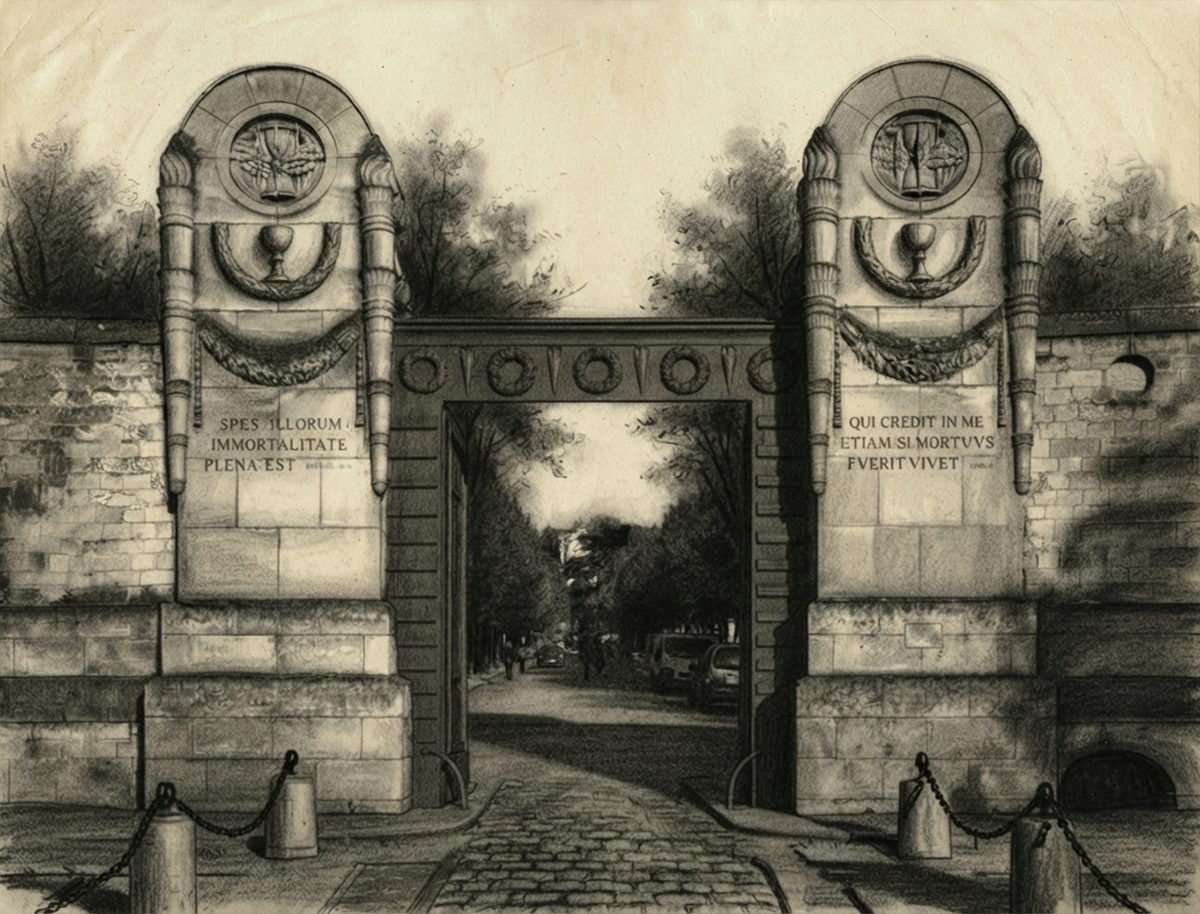
The main gate of Père-Lachaise opens onto the Boulevard de Ménilmontant, facing the former barrière de la Roquette. Every day, thousands of visitors pass through it, push open the two wooden doors and step into the main avenue. Almost none of them stop. Yet one need only look up to read a text two centuries old. On the right-hand pilaster, Latin letters carved into the stone quote the Gospel of John: Qui credit in me, etiam si mortuus fuerit, vivet — “He who believes in me, though he were dead, yet shall he live.” On the left-hand pilaster, the Book of Wisdom answers: Spes illorum immortalitate plena est — “Their hope is full of immortality.” Between the two pilasters, at the top, two round medallions show an hourglass flanked by two pigeon wings — a non-religious symbol of the passage of time. Below, flaming torch bundles support a stone garland. The gate of Père-Lachaise is a complete iconographic programme, designed to prepare the visitor for the passage from the world of the living to that of the dead. It was unveiled in 1822.
The architect was Étienne-Hippolyte Godde. Born at Breteuil, in the Oise, in 1781, he entered the École des Beaux-Arts in 1796 and studied under Delagardette. He failed the Prix de Rome several times — which did not stop him becoming architect to the City of Paris in 1813. He held the post until 1830. Godde was a restrained neoclassicist, inspired by Chalgrin's church of Saint-Philippe-du-Roule. His output was considerable: thirty religious buildings, among them the church of Saint-Pierre-du-Gros-Caillou in the seventh arrondissement and that of Saint-Denys-du-Saint-Sacrement in the third. He also worked on the old Hôtel de Ville of Paris — the one the Commune would destroy in 1871. At Père-Lachaise, Godde received three commissions: the monument to Marshal Pérignon in 1819, the monumental gateway in 1822, and the cemetery chapel in 1823, built on the site of the old Jesuit house that had given the place its name.
The gate is a threshold, and Godde treated it as one. He cleared a semicircular space thirty metres wide before the entrance — a forecourt allowing hearses to cross as they entered and left, and heightening the composition's monumentality. The two wooden doors open beneath a lintel adorned with funerary wreaths and amphorae. Above the lintel, a great cross crowned the whole composition. On the door itself, an inscription from the Book of Job proclaimed: Scio quod redemptor meus vivit et in novissimo die de terra surrecturus sum — “I know that my redeemer liveth, and that I shall rise out of the earth at the last day.” Old and New Testament answer one another: Job on the door, John and Wisdom on the pilasters. The carved symbols complete the message. The flaming torch bundles — inverted torches whose flame still burns — signify eternal life. The winged hourglasses signify the brevity of earthly life. The programme is consistent: death is only a passage, time flows on, hope endures.
The architect who drew the gate rests behind it. Godde is buried in Division 27, in a limestone tomb worn by frost — more damaged than the monumental entrance he designed fifty years earlier.
This religious programme did not survive the Republic intact. On 14 November 1881, a law removed religious symbols from public cemeteries. At Père-Lachaise, the cross that had crowned the lintel was taken down — so that visitors, whatever their faith, would not be forced to pass beneath a Christian symbol. The inscription from Job carved into the wooden doors was erased. But the two Latin quotations carved into the stone of the pilasters were kept — removing them would have meant destroying the masonry itself. The flaming torch bundles and winged hourglasses, non-confessional funerary symbols, remained in place. Since 1881, the gate of Père-Lachaise has been a palimpsest: amputated religious inscriptions coexist with intact secular symbols. The cross has vanished from the lintel, but the hourglass wings still beat on the pilasters.
In 2021, the City of Paris restored the main gate and the surrounding walls. The dressed stone was cleaned, the sculptures consolidated, the wooden doors repaired. The gate that emerged is the one from 1822, minus the cross and minus the inscription from Job — faithful to its post-1881 state. The architect who designed it lies on the other side of the cemetery, in Division 27, chemin du Dragon. Godde's monument, a plain limestone stele, is “badly damaged, since the stone is frost-prone,” notes the APPL. Godde died in 1869, in poverty and obscurity, ruined by disastrous property ventures near the Gare quarter. The builder of thirty churches and a monumental gateway did not even have a chapel for his final resting place. But his gate still stands. The three million visitors who pass through it each year do so without reading it — and that may be the best proof that it fulfils its purpose: one does not stop before a threshold, one crosses it.
What do the symbols on the Père-Lachaise gate mean?
Flaming torches, inverted yet still alight, symbolise eternal life. Winged hourglasses represent the brevity of earthly existence. Two Latin inscriptions, drawn from the Gospel of John and the Book of Wisdom, evoke the immortality of the soul.
Étienne-Hippolyte Godde, architect of the City of Paris from 1813 to 1830, designed the monumental gateway unveiled in 1822. Godde also drew up the cemetery's chapel (1823). He is buried in Division 27 at Père-Lachaise.
Why is there no longer a cross on the Père-Lachaise gate?
The law of 14 November 1881 required the removal of religious symbols from public cemeteries. The cross above the lintel was taken down, along with the Latin inscription from the Book of Job on the doors. The quotations carved into the stone pilasters were kept.
The City of Paris restored the main gate and adjoining walls in 2021. The dressed stone was cleaned, the sculptures reinforced and the wooden doors repaired. The restored gate matches its post-1881 state, without the cross or the Job inscription.
 Heritage