Along the Avenue Circulaire, some fifteen monuments erected between 1946 and 2017 commemorate the victims of the Nazi camps. Père-Lachaise, a cemetery built to receive bodies, became the site of memory for those who never had a grave.
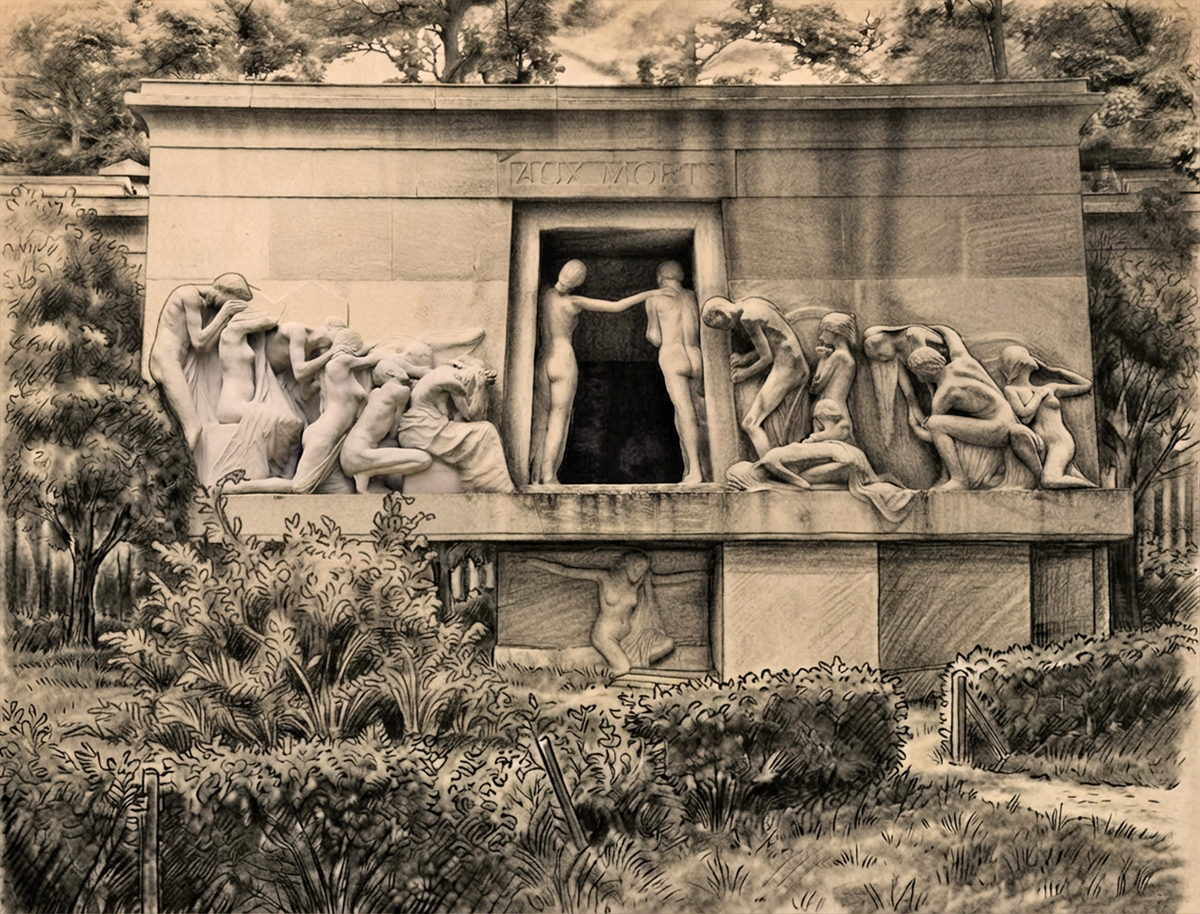
At the eastern end of Père-Lachaise, along the Avenue Circulaire that runs beside the boundary wall, some fifteen sculptures line up over a few hundred metres. None resembles the graves around them. Some are bronze, others volcanic stone, others black granite. Two giant clasped hands rise from a heap of rocks — the Ravensbrück memorial. A spectral figure emerges from a block of lava — the Auschwitz-Birkenau memorial. An upright bronze figure recalls the Vercors — the Buchenwald-Dora memorial. Each sculpture bears the name of a concentration or extermination camp: Mauthausen, Sachsenhausen, Dachau, Neuengamme, Natzweiler-Struthof, Flossenbürg, Bergen-Belsen. No body lies beneath these monuments. They are cenotaphs in the strictest sense: empty tombs raised for the dead who have no grave, in a cemetery built to hold bodies.
After 1945, the question arose: where to commemorate the deportees? There were no bodies to bury, no grave to locate, no remains to transfer. The dead of the camps had been burned, buried in mass graves or scattered as ashes. Survivors returning to France had nowhere to mourn. Père-Lachaise imposed itself for both a geographical and a symbolic reason. The cemetery already held the Communards' Wall, a memorial site for the victims of the 1871 Commune. The Avenue Circulaire, running along the eastern boundary wall, was already a space for political and social commemoration. The first associations of former deportees chose this same area to raise their monuments. The gesture was paradoxical: in a cemetery under such pressure that every square metre of plot was contested, monuments were installed for the absent. But it was precisely this absence that justified the place — the cemetery became a substitute for the grave the victims had never had.
No body lies beneath these monuments. They are cenotaphs — empty tombs — raised for hundreds of thousands of dead whose ashes were scattered in the ovens or in the soil of Poland, Germany and Austria.
The first monument was erected in 1946, a year after the Liberation. The others followed over seven decades, up to 2017. Each is the work of a different artist, funded by an association of former deportees or a memorial group. The Ravensbrück memorial, unveiled in 1951, is the work of the sculptor Edouard Morlaix: two giant clasped hands, disproportionately large, rising from a heap of stones — a tribute to the solidarity among the camp's women. The Auschwitz-Birkenau memorial, designed by Françoise Salmon, a former Resistance member and deportee, is a block of volcanic stone from which a spectral figure with an oversized head emerges. The Buchenwald-Dora memorial, a bronze by the sculptor Louis Bancel, a former Vercors fighter, was unveiled on 5 April 1964. Alongside these large monuments stand more modest steles: Nacht und Nebel, Convoy 73, the Jewish children murdered between 1942 and 1945. The whole is deliberately varied — each association wanted its own monument, its own form, its own grief.
The City of Paris and its website paris.fr describe this ensemble as “a unique syncretic memorial complex in France”. It is unique because it brings together, in a single space, the memory of the Commune, of anti-fascism, of the Resistance and of the Deportation. The continuity is both geographical — everything runs along the eastern boundary wall, between Division 76 and Division 97 — and chronological, from those shot in 1871 to the deportees of 1945. In 2018, the City added a memorial to the 94,415 Parisian dead and 8,000 missing of the Great War, mounted horizontally on the outer boundary wall along boulevard de Ménilmontant. Père-Lachaise had become the City of Paris's principal memorial site — a role neither Frochot nor Brongniart had foreseen when they laid out an English garden for the bourgeoisie's dead.
Every last Sunday of November, associations of former deportees and memorial groups lay wreaths at the foot of each monument. The processions follow the Avenue Circulaire, stop before each sculpture, lay a wreath of flowers and observe a minute of silence. The ritual has been the same for more than seventy years. Almost all the survivors are now gone — the last living deportees are over ninety-five — but children and grandchildren carry on the gesture. A visitor walking the Avenue Circulaire on an ordinary day passes these monuments with no guide, no explanatory panel, no context. Ravensbrück's hands, Auschwitz's figure, Buchenwald's bronze blend into the cemetery's funerary landscape. It is a memorial site that does not announce itself — and that may be what makes it so powerful: at Père-Lachaise, the dead of the camps lie among the other dead, with no hierarchy, no barrier, no distinction.
Which concentration camps are commemorated at Père-Lachaise?
Auschwitz-Birkenau, Buna-Monowitz, Buchenwald-Dora, Ravensbrück, Mauthausen, Sachsenhausen, Dachau, Neuengamme, Natzweiler-Struthof, Flossenbürg and Bergen-Belsen are commemorated by monuments along Père-Lachaise's Avenue Circulaire, alongside steles for the Nacht und Nebel prisoners and Convoy 73.
Where are the deportation memorials at Père-Lachaise?
The deportation memorials line the Avenue Circulaire, in the eastern part of Père-Lachaise, between Divisions 76 and 97. This stretch extends from the Communards' Wall and forms a commemorative ensemble unique in France, blending the memory of the Commune with that of the Deportation.
Is there a First World War memorial at Père-Lachaise?
Yes. On 11 November 2018, the City of Paris unveiled a memorial to the 94,415 Parisians killed and 8,000 reported missing in 1914-1918, set into the cemetery's outer boundary wall on Boulevard de Ménilmontant. The names are engraved on horizontal plaques.
Why are the deportation memorials at Père-Lachaise?
The victims of the Nazi camps have no grave: their bodies were burned or buried in mass pits. Père-Lachaise, already home to the Communards' Wall and anti-fascist monuments, became after 1945 the place where Paris commemorates its dead without a tomb.
 Heritage