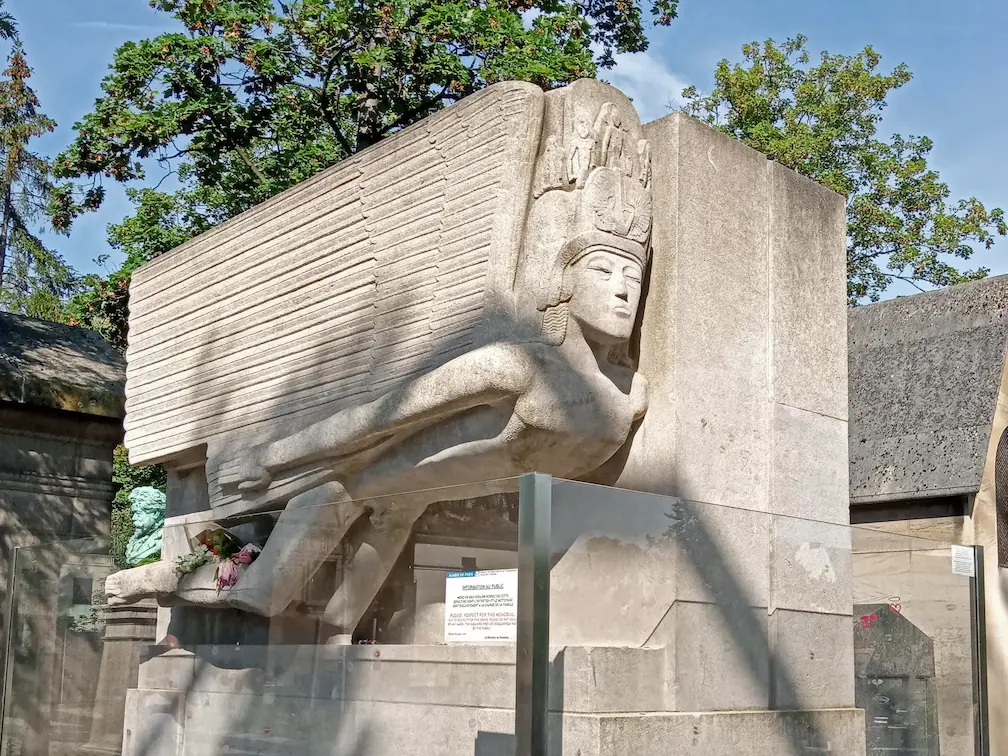

Oscar Wilde, the wittiest writer in London, was sentenced in 1895 to two years' hard labour for his affair with Lord Alfred Douglas. He died in 1900 in a Paris hotel, ruined, under the name Sebastian Melmoth. On his grave lies a winged sphinx of twenty tons, carved by Jacob Epstein — long covered in lipstick kisses, and behind glass since 2011.
The story
Married to Constance Lloyd in 1884 and father of two sons, Wilde met Lord Alfred Douglas in 1891. The affair was public; Douglas's father, the Marquess of Queensberry, made it impossible to sustain. In 1895 the English courts applied to him the gross indecency clause of the 1885 Act, which made sex between men a crime. The wittiest writer in London left for two years' hard labour in Reading Gaol.
Released in 1897, he crossed into France under the name Sebastian Melmoth — borrowed from Melmoth the Wanderer by his great-uncle Charles Maturin. He died of meningitis on 30 November 1900 in a hotel in the rue des Beaux-Arts, at forty-six, ruined. He was buried modestly at Bagneux.
It was Robert Ross, his first lover turned literary executor, who paid off the debts, secured the transfer of the body to Père-Lachaise in 1909 and commissioned the monument from the young sculptor Jacob Epstein. His own ashes were laid in the same tomb in 1950.
The sphinx reached the cemetery in 1912 and caused a scandal: judged indecent, it stayed under a tarpaulin, guarded by a gendarme, until August 1914, when the poet and occultist Aleister Crowley came and pulled the cover off himself. In 1961, unknown hands castrated the statue. The grave became, the Friends of the cemetery say, a meeting ground where the defenders of the homosexual cause crossed paths with their fiercest opponents.
From the 1990s on, the habit of kissing the stone took hold. Thousands of red kisses ate into the limestone, and the cleaning solvents finished the work. A glass panel now protects the monument: visitors leave their kisses on that instead, and the epitaphs cut around the base are legible again.
The grave
A great recumbent winged sphinx occupies the grave, carved from a single block of limestone by Jacob Epstein and commissioned by Robert Ross, the writer's first lover and literary executor. It reached the cemetery in 1912 and shocked by its nudity: it was left under a tarpaulin, guarded by a gendarme, until August 1914, when the poet and occultist Aleister Crowley came and pulled the cover off himself. Unknown hands emasculated it in 1961; the piece, they say at the cemetery, ended up as a paperweight in the administrative offices. The monument's surround bears several plaques quoting his work. After years of lipstick and of cleanings that were eating into the stone, the city council installed a glass screen in 2011 and had the monument restored.
On site, do not miss
Go up to the glass: recent kisses overlay older ones. Then walk round the monument — the epitaph plaques run the whole way around it, and from the front you see only one.
Visitors' questions
Why is Oscar Wilde's tomb behind glass?
Because visitors had taken to kissing the stone, leaving thousands of lipstick marks on it. The waxy residue and the repeated cleanings were eating into the limestone, so the city council installed a glass barrier in 2011.
Edmond AboutWhere is Oscar Wilde's grave?
In Division 89, in the upper, eastern part of the cemetery, about twenty minutes from the main entrance.
Marie d'AgoultWhat does the monument depict?
A winged sphinx lying down, carved from a single block of limestone by Jacob Epstein, which reached the cemetery in 1912. Its nudity caused a scandal: the monument stayed covered by a tarpaulin until August 1914, when the poet and occultist Aleister Crowley came and pulled the cover off himself. In 1961, unknown vandals emasculated it.
Alain (Émile Chartier)Why did Oscar Wilde die in Paris?
Released after two years of hard labour in England, Oscar Wilde had exiled himself to France under the name Sebastian Melmoth. He died penniless on 30 November 1900, in a hotel room on Rue des Beaux-Arts.
Miguel Ángel AsturiasAudio guide to Père Lachaise: the best unusual guided tour!
Discover the secrets of the most astonishing tombs
the audio guidefrom€6.99