In 1899, Hector Guimard designed the grave of a wine merchant, Ernest Caillat, in Division 2 of Père-Lachaise. It is the cemetery's only Art Nouveau grave by the architect behind the Paris métro entrances — and Guimard himself is not buried there.
Turning right past the main entrance of Père-Lachaise, on boulevard de Ménilmontant, one comes within a few steps on a shape unlike anything around it. Where the neighbouring graves line up neoclassical columns and granite chapels, a stone sculpture of plant-like curves unfolds like a living organism. Not a right angle, not a classical moulding, not a cross. The stone ripples, twists and wraps the space like a leaf folding shut. The signature is carved into the material: Hector Guimard. The man who designed the entrances to the Paris Métro, the balconies of the Castel Béranger and the Humbert de Romans concert hall also designed a grave. Just one, at Père-Lachaise. It dates from 1899 — the same year as the first Métro entrances.
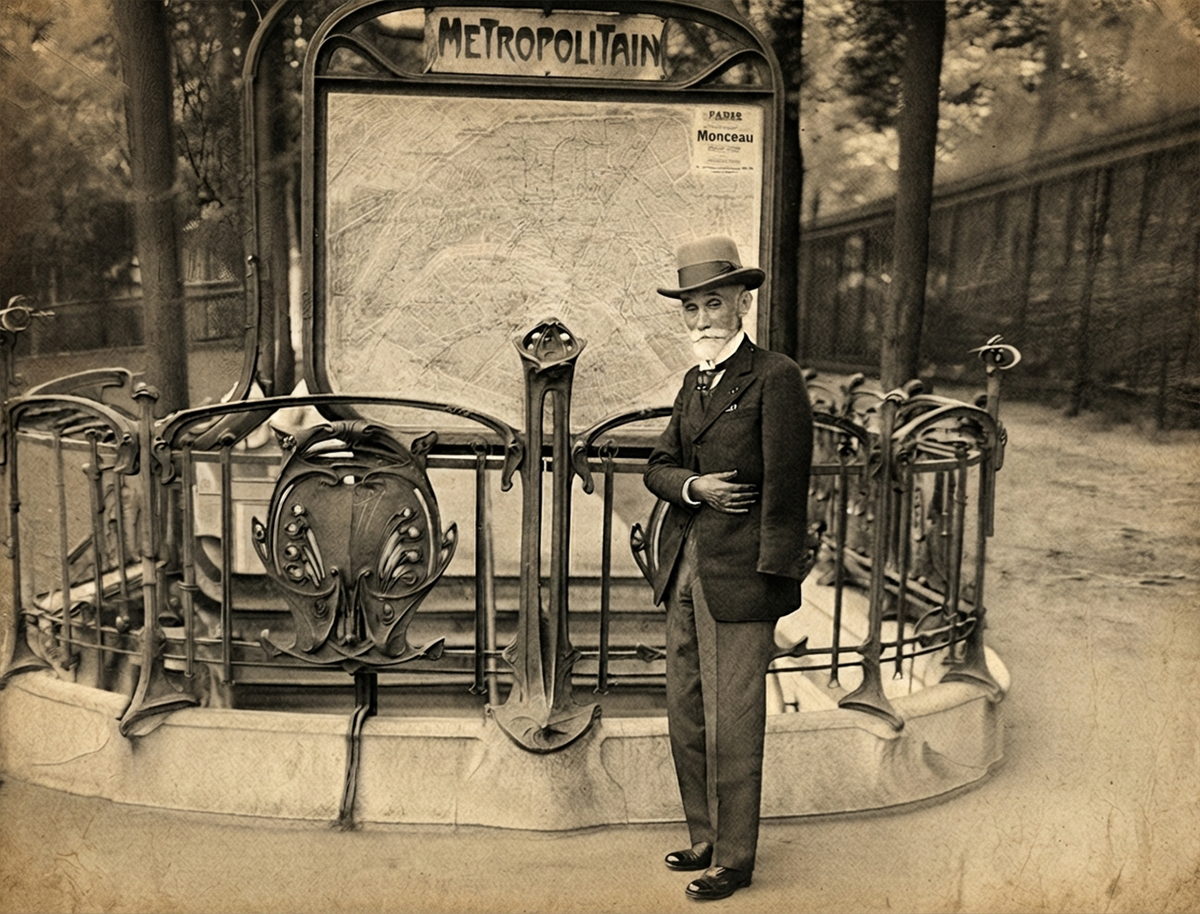
Hector Guimard was born in Lyon on 10 March 1867, the son of a gymnastics teacher. He moved to Paris as a teenager, studied at the École des Arts Décoratifs and then the Beaux-Arts, and completed his first building at 24. The Castel Béranger, on rue La Fontaine in the 16th arrondissement, finished in 1898, made him the leading figure of Art Nouveau in France. In 1900, the Métropolitain company commissioned him to design the entrances for its first line. Within months, the Guimard entrances became a symbol of Paris — cast-iron frames in plant shapes, stem-like lamp posts, orange glass panels reading “Métropolitain”. In all, Guimard designed 141 entrances, some 50 buildings, and furniture, door handles, vases and wallpaper. Everything followed the same principle: organic form, drawn from nature, was meant to replace the classical repertoire.
The Caillat grave, in Division 2, is the only tomb Guimard designed at Père-Lachaise. Ernest Caillat, a Parisian wine merchant, died in 1899. His family commissioned Guimard for a funerary monument in the style the architect applied to everything he touched: the stone is carved in continuous curves, with no break, no edge, no angle. The grave is an organic block whose every surface seems to have grown rather than been cut. The letters of the name are worked into the relief — not engraved on the stone but emerging from it. The effect is striking: amid the neoclassical steles and neo-Gothic chapels of Division 2, the Caillat grave looks like an object fallen from another century. It is one of fourteen funerary works known to be by Guimard, scattered across the cemeteries of Paris, Versailles, Vanves and the provinces — the only one at Père-Lachaise.
Guimard designed a hundred and forty-one métro entrances, some fifty buildings, furniture, door handles, vases — and a single grave at Père-Lachaise. It is still there. The architect himself died in exile.
Art Nouveau left only faint traces in Parisian cemeteries. The movement, which revolutionised domestic architecture and street furniture between 1895 and 1910, barely touched funerary art. Families commissioning graves at the turn of the century remained attached to the neoclassical vocabulary — columns, veiled urns, draped mourners — that had dominated for a century. The Caillat grave is an exception. Guimard transposed onto it exactly the same forms as in his buildings and Métro stations: asymmetrical curves drawn from plants, ornament built into the structure rather than applied to it, and a total absence of reference to antiquity. But the exception had no successors. Art Nouveau died out in Paris around 1910, supplanted by Art Deco, and Père-Lachaise returned to its broken columns and granite chapels.
Guimard died on 20 May 1942 in New York, where he had gone into exile in 1938 with his wife Adeline Oppenheim, who was Jewish, to escape the anti-Jewish laws. The architect who gave Paris its most recognisable image — the Métro entrances the whole world associates with the capital — has no grave in Paris. The Caillat grave, in Division 2, is the only trace of Guimard at Père-Lachaise. It still stands, a few steps from the main entrance, in reasonably good condition. Passers-by walk past without noticing it — or pause for a moment, intrigued by its unusual forms, before moving on towards the famous graves. It is one of Père-Lachaise's ironies: the most celebrated architect in Paris signed a work here, and no one looks for it.
Is there a grave by Hector Guimard at Père-Lachaise?
No, Guimard himself is not buried at Père-Lachaise. But the architect did design the Ernest Caillat grave, in Division 2, dated 1899 — the cemetery's only Art Nouveau tomb bearing his signature. Guimard died in exile in New York in 1942.
Where can you see Art Nouveau work at Père-Lachaise?
The Ernest Caillat grave, in Division 2 near the main entrance, is the only Art Nouveau tomb designed by Hector Guimard at Père-Lachaise. Its plant-like curves and absence of right angles stand out against the neoclassical steles and neo-Gothic chapels nearby.
Who is buried in the Guimard grave at Père-Lachaise?
The Division 2 grave designed by Hector Guimard holds Ernest Caillat, a Parisian wine merchant who died in 1899. The Caillat family commissioned this Art Nouveau tomb, Guimard's only funerary work at Père-Lachaise.
Guimard went into exile in New York in 1938 with his wife Adeline Oppenheim, who was Jewish, to escape Vichy's racial laws. The architect behind the entrances to the Paris Métro died in exile on 20 May 1942, never returning to France.
 Heritage