In 1837, the chemist Jean-Nicolas Gannal patented an arterial-injection embalming process that revolutionised the preservation of bodies. More than two thousand five hundred people were embalmed by his workshop over twenty years — many of whom rest at Père-Lachaise.
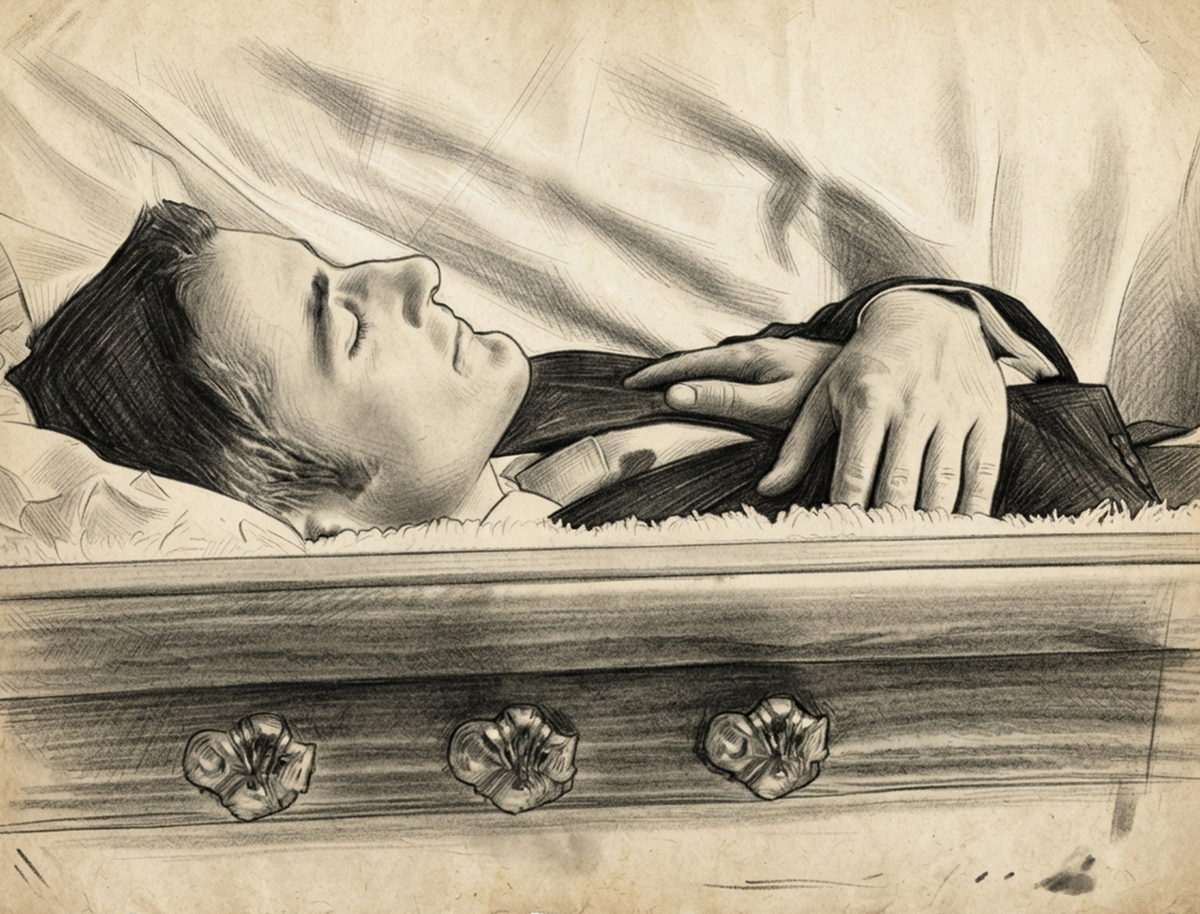
In the nineteenth century, the bourgeois families who had funerary chapels built at Père-Lachaise faced a problem that today's granite slabs no longer pose: the body. Before burial, the deceased had to be watched over for several days, laid out in a drawing room, visited by relatives, sometimes photographed. But a body decomposes. In summer, decay set in within hours. Perfume, sheets and flowers masked nothing. For the dead to remain presentable, an embalmer was needed — and in the Paris of the 1840s, the embalmer was Jean-Nicolas Gannal. A former military pharmacist and former assistant to Gay-Lussac at the École Polytechnique turned industrial chemist, he had devised a method of preserving bodies so effective that it would be copied around the world for a century.
Gannal was born in Sarrelouis on 27 July 1791. He served in Napoleon's armies from 1808 to 1812, was captured by the Russians, escaped, and was recaptured seven times in eighteen months. After the fall of the Empire, he joined the chemistry laboratory at the École Polytechnique, where he worked under Gay-Lussac and Thénard. He then moved into the chemical industry: refining borax, making glue and gelatine, producing white lead. In 1835, he discovered the effectiveness of aluminium salts for preserving anatomical specimens. Two years later, on 11 August 1837, he took out a patent for a method of embalming by arterial injection. The method was simple and required no mutilation: Gannal cut into the carotid artery, inserted a cannula and injected four to five litres of a solution of distilled water and aluminium sulphate. The body became rigid, incorruptible, presentable. The change was total: embalming, until then reserved for kings and saints, was now within reach of any family that could afford it.
Success was immediate. Within twenty years, the Gannal workshop embalmed more than 2,500 people — notables, members of the bourgeoisie, artists, soldiers. The patent was licensed across France, then in Nice, London, Saint Petersburg, New Orleans, Constantinople, Havana and Mauritius. In 1838, Gannal published his *History of Embalming and of the Preparation of Anatomical Specimens*, translated into English as early as 1840. The book crossed the Atlantic: Dr Thomas Holmes of New York adapted Gannal's method and used it during the American Civil War on Union soldiers whose families wanted their remains brought home — the founding act of modern embalming in the United States. But Gannal's success ran into opposition from the medical profession. In 1845, the Academy of Medicine held a contest between embalmers: Gannal was disqualified when it emerged that his formula contained arsenic, a toxic substance that would be banned from embalming by decree in 1846.
Gannal would cut the carotid artery, insert a cannula and inject four to five litres of a solution of distilled water, aluminium sulphate and arsenic. The body became imputrescible. The family could keep vigil over it for as long as they wished.
The disqualification did not end the business. Gannal reformulated his method without arsenic, and his son and then his grandson carried on the trade into the early twentieth century. The records of the Gannal firm show that the method was used to embalm the bodies of the singer Hortense Schneider, the poet Anna de Noailles, President Paul Doumer, assassinated in 1932, and Marshal Joffre, who died in 1931. Gannal himself died on 13 January 1852 in Paris, at 6 rue de Seine, and lies in the Montparnasse cemetery — not at Père-Lachaise. But hundreds of bodies embalmed by his workshop or by his successors lie in the chapels and vaults of Père-Lachaise. When a visitor passes a locked chapel in the older divisions, all that is visible is the stone. Below, in a vault no one will ever open again, a body prepared by the Gannal method may have been waiting for a century and a half.
Embalming by arterial injection, invented by Gannal in 1837, became modern thanatopraxy. The technique has evolved — the chemical formulas have changed, formaldehyde replaced aluminium salts, and other solutions have since replaced formaldehyde in turn — but the principle stays the same: inject a preserving fluid into the arterial network to slow decomposition. In France, thanatopraxy was not regulated until 1998. At Père-Lachaise, where the first burials date from 1804, bodies were embalmed long before the word “thanatopraxy” existed. Beneath its steles and inside its chapels, the cemetery thus preserves not only the memory of the dead but sometimes the dead themselves — kept by a method Gannal devised in a chemistry laboratory almost two centuries ago.
Jean-Nicolas Gannal (1791-1852), a chemist and former military pharmacist, patented an arterial-injection embalming process in 1837 that transformed the preservation of bodies. The technique spread across Europe and to the United States, where it was used during the Civil War.
How were the dead embalmed in nineteenth-century Paris?
The Gannal process, patented in 1837, involved cutting the carotid artery and injecting 4 to 5 litres of a solution of distilled water and aluminium sulphate. The body became resistant to decay, letting families keep vigil over the deceased for several days before the funeral.
Some were, yes. In the nineteenth century, bourgeois families had their dead embalmed by the Gannal firm or its rivals before burial. Hundreds of embalmed bodies rest in the vaults and chapels of Père-Lachaise.
Thanatopraxy is the modern technique for preserving bodies by injecting a preservative fluid into the arterial network. The principle was invented by the chemist Jean-Nicolas Gannal in 1837. In France, thanatopraxy was not regulated until 1998.
 Society