Over two centuries, Père-Lachaise has passed through every funerary style: neoclassical steles of the Empire, neo-Gothic chapels of the July Monarchy, Second Empire eclecticism, Art Nouveau, reinforced-concrete modernism — right up to today's polished granite slabs.
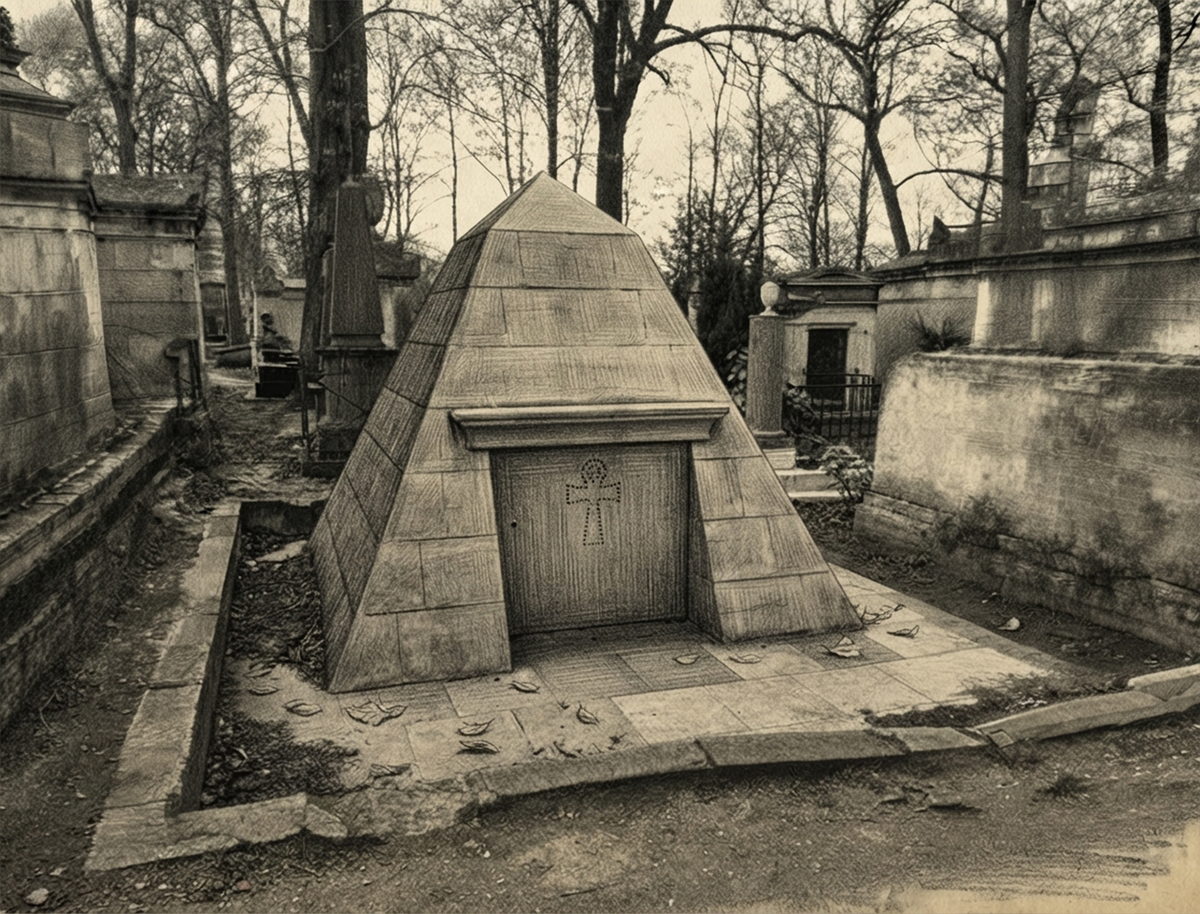
Entering by the main gate of Père-Lachaise, one first walks among neoclassical steles — fluted columns, sarcophagi set on antique-style plinths, veiled urns, triangular pediments. Everything is Greek or Roman. Then, climbing towards Divisions 10 to 15, the forms change: chapels appear, their façades bristling with pointed arches, pinnacles, gargoyles, rose windows — neo-Gothic has taken over the cemetery. Further still, towards Divisions 50 and 60, eclecticism runs riot: a Romanesque chapel stands beside an Egyptian temple, an obelisk faces a pagoda, a Renaissance mausoleum sits next to a Moorish stele. And in the most recent divisions, 85 to 97, it is polished granite, flat slabs, porcelain photo medallions. Crossing Père-Lachaise from west to east means crossing two centuries of funerary architecture — and two centuries of taste, belief and attitudes to death.
The earliest graves at Père-Lachaise, in Divisions 10 to 39 laid out by Brongniart, follow the neoclassical repertoire. The Revolution had broken with the Church: burials no longer took place in parish cemeteries but in an English-style garden, and the forms chosen for the monuments were those of pagan antiquity. Pedimented steles, Doric columns, cippi, sarcophagi, funerary urns, obelisks — the vocabulary is that of republican Rome and classical Greece. Wealthy families commissioned monuments in dressed stone or white marble, carved by specialist craftsmen. The Delille monument, in Division 11, a listed historic monument, is a perfect example of this early period: an antique sarcophagus topped with a bust, restrained, elegant, spare. The cenotaph of Héloïse and Abelard, reassembled in 1817 by Alexandre Lenoir using authentic medieval elements, stands as a Gothic exception in a landscape dominated by straight lines and pediments.
From the July Monarchy onward, fashion changed. Romanticism rehabilitated the Middle Ages, and neo-Gothic funerary chapels spread across Père-Lachaise. Bourgeois families built small stone structures with pointed arches, stained glass, pinnacles and gargoyles — miniature cathedrals set on two square metres of plot. The cemetery's first funerary chapel, that of the Comte de Greffülhe in Division 43, dates from 1810, but the neo-Gothic wave broke chiefly between 1840 and 1870. Under the Second Empire, eclecticism took over: everything was mixed together. Leading architects designed graves at Père-Lachaise. Visconti conceived the monument to Marshal Gouvion-Saint-Cyr. Victor Baltard, the architect of the Halles de Paris, designed Ingres's grave. Viollet-le-Duc, the restorer of Notre-Dame, built the chapel of the Duc de Morny. In 1905, the architect Raoul Brandon published his Nouveaux modèles de Tombeaux, eighty plates of funerary designs awarded prizes at the Expositions Universelles of 1889 and 1900 — evidence of a funerary art at the height of its craft.
Père-Lachaise is a conservatory of funerary architecture, where every division is a museum room and every path an exhibition corridor. Crossing one path takes you from neoclassical to neo-Gothic; turning one corner, from Second Empire to Art Deco.
Art Nouveau barely touched the cemetery. The Caillat grave, designed by Hector Guimard in 1899 in Division 2, is the only Art Nouveau grave at Père-Lachaise by a renowned architect — and it had no successors. The grave of the architect Georges Guët, in Division 19, listed as a historic monument in 1995, is one of the rare funerary monuments in reinforced concrete, built between 1905 and 1907 with a flamed sandstone bas-relief by Gentil and Bourdet. After the First World War, funerary art grew simpler. Art Deco produced a handful of monuments with clean geometric lines, but the movement was short-lived. The interwar years also saw the appearance of bronze busts signed by Pierre Vaudrey, whose workshop stood near the cemetery. After 1945, the trend turned to restraint: horizontal granite slabs, unadorned engraved lettering, porcelain photographs. Families ordering a grave in the 1950s or 1960s no longer wanted chapels, columns or sculpture. The cemetery's face was changing.
The result today is an architectural layering with no equivalent in France. Père-Lachaise is the only place where, within a single space of forty-four hectares, one can observe the full range of French funerary styles since the First Empire: the neoclassicism of Divisions 10 to 25, the neo-Gothic of Divisions 30 to 50, Second Empire eclecticism, the exceptional Art Nouveau of Division 2, the isolated modernism of Division 19, and the contemporary granite slabs of the eastern extensions. Each division is a geological layer of taste. The oldest divisions, their antique-style steles overgrown with ivy and their columns broken, resemble Roman ruins. The intermediate divisions, their neo-Gothic chapels crowded against one another, resemble medieval lanes. And the recent divisions, with their rows of slabs and standardised photographs, resemble what the cemetery has become: a functional place, where death is more an administrative fact than an architectural one.
What architectural styles can be found at Père-Lachaise?
Père-Lachaise displays every funerary style since 1804: neoclassical steles from the Empire, neo-Gothic chapels from the July Monarchy, Second Empire eclecticism, Art Nouveau (the Caillat grave by Guimard, 1899), reinforced-concrete modernism (the Guët grave, 1905) and contemporary granite slabs.
Are there graves designed by major architects at Père-Lachaise?
Yes. Visconti (the Gouvion-Saint-Cyr monument), Victor Baltard (Ingres's grave), Viollet-le-Duc (the Duc de Morny's chapel) and Hector Guimard (the Caillat grave, 1899) all designed graves at Père-Lachaise. The cemetery is a living record of French funerary architecture.
When did funerary chapels first appear at Père-Lachaise?
Père-Lachaise's first funerary chapel is that of the Comte de Greffülhe, in Division 43, built in 1810. The vogue for neo-Gothic chapels swept through mainly between 1840 and 1870, under the July Monarchy and the Second Empire, as bourgeois families took up the style.
After 1945, families stopped commissioning chapels, columns or sculptures. The trend turned to simplicity: horizontal granite slabs, plain engraved lettering, porcelain photographs. Funerary art now reflects a relationship with death that has become more functional than architectural.
 Heritage