In the nineteenth century, mourning families wore bracelets, rings and brooches plaited from the deceased's hair. Hair, being imputrescible, became a physical link between the living and the dead — a fragment of the body turned into a keepsake.
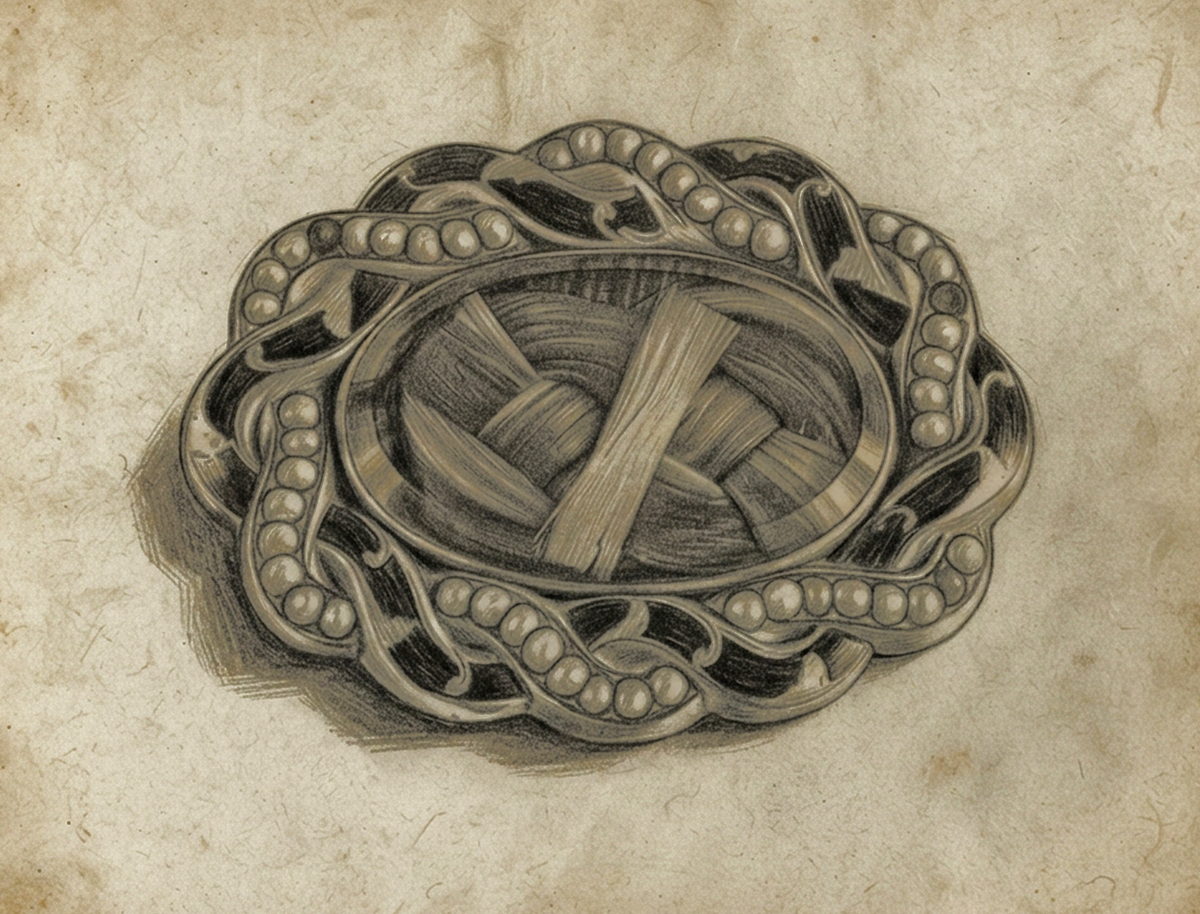
Among the objects that nineteenth-century families either buried with their dead or, conversely, kept on themselves afterwards, one has been entirely forgotten by the twenty-first century: hair jewellery. A bracelet plaited from the hair of a mother who died in childbirth. A ring holding a lock from a child who died at three. An oval locket, in gold or silver, opening onto a composition of hair — a weeping willow made from twisted brown strands against an ivory ground, a miniature cypress, a mourning wreath — signed on the back by the craftsman who made it. These pieces were worn every day, sometimes for decades. Families who had chapels built at Père-Lachaise, who commissioned bronze busts and stained-glass windows, also carried on their bodies a piece of their dead — the one piece that time does not destroy: hair.
Hair jewellery was not a macabre curiosity: it was a codified craft, practised by specialist artisans, with its own techniques, tools and conventions. The hair of the deceased was washed, sorted by length and colour, then worked using techniques borrowed from braid-making and lace-making. It was plaited on a bobbin, over a lace pillow — the same pillow used by lacemakers — or on a special loom. It was moulded around iron rods to form hollow tubes, which were then assembled into bracelets or watch chains. It was glued onto plates of glass or ivory to compose miniature pictures — trees, flowers, monuments, mourning scenes. The whole was protected by a domed glass, set in a case of gold or gilt metal. Hair jewellers worked in workshops where temperature and humidity were controlled so that the hair would not break.
The dead person's hair was washed, sorted by length and colour, and plaited on a lacemaker's bobbin cushion. The bracelet or ring that resulted was not an ornament: it was the deceased themselves, worn on the wrist or finger.
The golden age of hair jewellery ran from the early nineteenth century to the turn of the twentieth. The practice existed from the seventeenth century — hair relics of saints are the direct ancestors of the mourning jewel — but it was between 1820 and 1900 that hair jewellery became widespread and codified. Two developments drove this. The first was the rise of bourgeois mourning under the Restoration and the July Monarchy: well-off families adopted strict dress codes after a death — full black, veils, gloves, jet jewellery — and hair jewellery took its place within this apparatus of mourning. The second was the example of Queen Victoria. After the death of Prince Albert in 1861, Victoria wore, for forty years, lockets and brooches containing her husband's hair. Victorian fashion spread across Europe: hair jewellery became a mark of respectability and conjugal devotion, taken up by the industrial bourgeoisie.
The practice died out in the early twentieth century, a victim of several changes at once. The First World War upended funerary rituals: the dead were too numerous, too far away, too disfigured for a lock of hair to be taken. Codified mourning — a year in black clothing, jet jewellery, black-bordered visiting cards — faded gradually after 1918. Photography, and then cinema, offered other means of remembering the dead: people kept a portrait rather than a lock of hair. Hair jewellery, which depended on a physical, bodily bond with the matter of the dead, no longer fitted the sensibility of the twentieth century, which held death at a distance. The last hair jewellers closed their workshops between the wars. The pieces survive in drawers, jewellery boxes, antique-dealers' cabinets — and in a few decorative-arts museums.
At Père-Lachaise, no hair jewellery is on display. It never belonged in the cemetery: it belonged on the living, worn on the wrist, the neck, the finger, put away in a box once mourning ended, sometimes passed down to the next generation, sold or thrown out once no one knew any longer whose hair it held. Yet hair jewellery is as much part of Père-Lachaise's ecosystem as its bronze busts, stained glass and earthenware wreaths. The same families who had a neo-Gothic chapel built in Division 30, who commissioned a bronze bust from Dalou, who had a Collinet window installed — those same families wore a hair bracelet on their wrist as they left the cemetery. Hair jewellery is the hidden face of nineteenth-century mourning: the object taken home when the body was left behind at Père-Lachaise.
A mourning hair jewel is a bracelet, ring, brooch or locket made from the hair of the deceased. Common in the nineteenth century, hair jewellery was worn by grieving families as a physical link to the dead — hair being a material that does not decay.
The deceased's hair was washed, sorted by length and colour, then plaited on a bobbin-lace pillow or moulded over iron formers. Craftsmen assembled bracelets, chains and miniature scenes protected under domed glass, set in gold or gilded metal.
The First World War, photography and changing sensibilities ended the practice. Codified mourning — black clothing, jet jewellery, hair jewellery — faded away after 1918. The last hair jewellers closed between the two world wars.
Yes. After Prince Albert's death in 1861, Queen Victoria wore lockets and brooches containing her late husband's hair for forty years. The Victorian fashion for mourning jewellery spread through the European bourgeoisie in the nineteenth century.
 Society