Yvan Salmon, known as Victor Noir, a twenty-two-year-old anti-Bonapartist journalist, was shot dead on 10 January 1870 by Prince Pierre-Napoléon Bonaparte. Jules Dalou's bronze recumbent figure, placed in Division 92 of Père-Lachaise in 1891, has become the object of a fertility ritual.
The most-touched grave at Père-Lachaise is not that of a king, a poet or a musician: it is that of a twenty-two-year-old journalist whose real name almost no one knows. Yvan Salmon, known as Victor Noir, a writer for the republican newspaper *La Marseillaise*, was shot dead on 10 January 1870 by Prince Pierre-Napoléon Bonaparte, a cousin of Emperor Napoleon III, in a press quarrel. The killing set off a political crisis: a hundred thousand people followed the funeral procession to Neuilly. The man himself has been forgotten, but the bronze recumbent effigy commissioned by his family from the sculptor Jules Dalou, placed in Division 92 of Père-Lachaise in 1891, has become one of the cemetery's most visited and most photographed monuments — not for what it commemorates, but for what visitors do to it.
Victor Noir was born in Tours on 27 July 1848 as Yvan Salmon. In 1870, at twenty-two, he was working for *La Marseillaise*, the newspaper of Henri Rochefort, a fierce opponent of the Second Empire. On 10 January 1870, Victor Noir and a fellow journalist went to see Prince Pierre-Napoléon Bonaparte at Auteuil, to deliver a challenge to a duel on behalf of another journalist. The meeting turned violent. The prince fired. Victor Noir collapsed in the hallway, shot through the chest. The young journalist's death inflamed the republican press. Rochefort published an incendiary appeal: “I was foolish enough to believe that a Bonaparte could be something other than a murderer.” The funeral, on 12 January 1870, drew about a hundred thousand people to Neuilly — an immense procession that republicans tried, in vain, to divert towards Paris to spark an uprising.
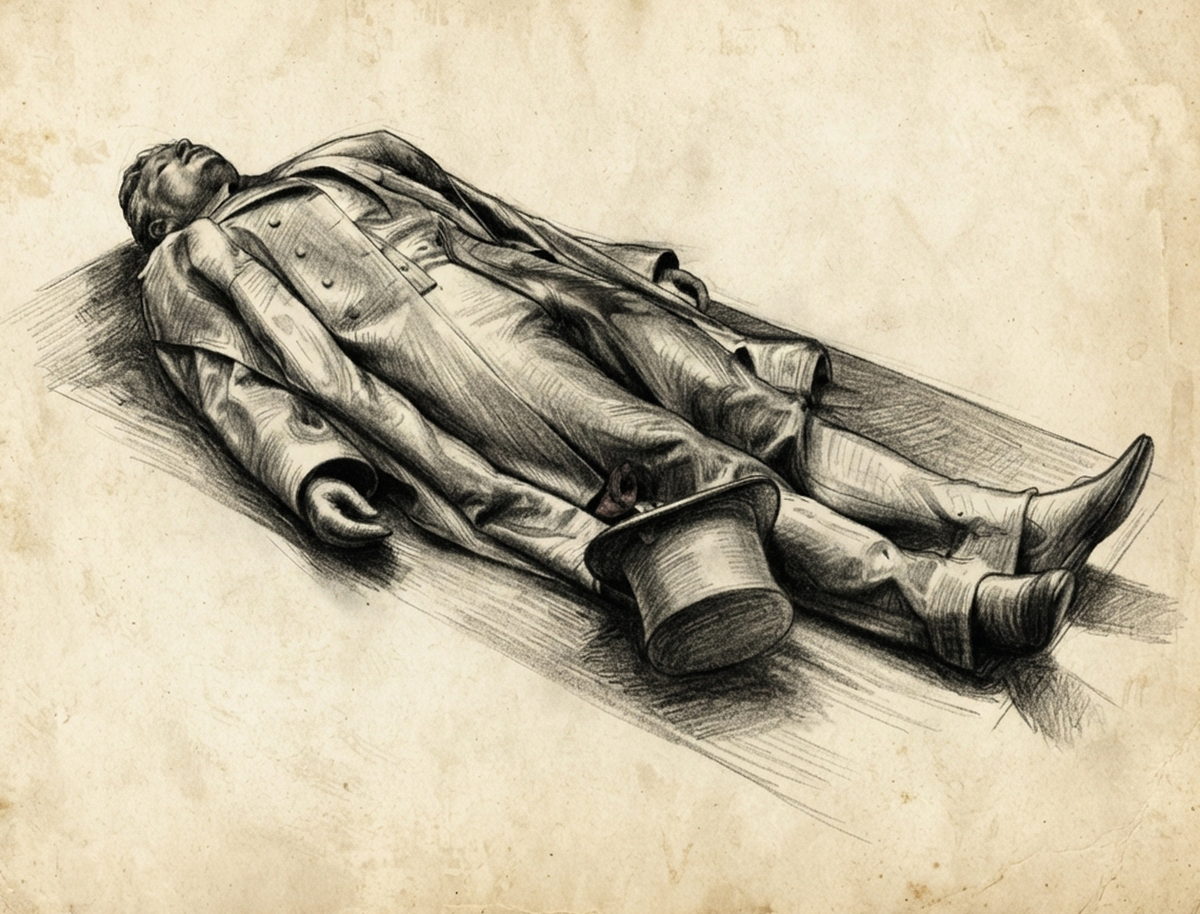
Victor Noir was first buried at the Neuilly cemetery. In 1891, after the fall of the Second Empire and the amnesty granted to the Communards, his remains were transferred to Père-Lachaise, in Division 92. His family commissioned a recumbent effigy from the sculptor Jules Dalou, a committed republican and former Communard, and the creator of the *Triumph of the Republic* on Place de la Nation. Dalou depicted Victor Noir just as he fell: lying on his back, his hat rolled beside his head, his coat open, his shirt unbuttoned, his boots still on. The realism is striking: the body seems frozen at the instant of the fall. The bronze was cast by Thiébaut and set on a granite base. The inscription gives only the name, the dates and the circumstances: “Victim of Prince Pierre-Napoléon Bonaparte.”
Dalou's bronze is polished bright in three places: the lips, the left boot and the groin. Visitors who touch the figure believe — no one knows since when — that the gesture brings luck in love or aids fertility.
No one knows exactly when Victor Noir's effigy became an object of superstition. Tradition holds that touching the bronze brings luck in love or aids fertility. The ritual targets three spots — the lips, the left boot and the crotch — worn shiny by millions of hands against the verdigris of the rest of the statue. The practice is attested at least since the 1960s, but its origin remains obscure. Nothing historically links Victor Noir to fertility: it was probably the anatomical realism of Dalou's effigy — the reclining body, the open coat, the bulge of the trousers — that set off the superstition. The ritual has grown with mass tourism, and Victor Noir's effigy appears in every Père-Lachaise guide as a required stop.
Victor Noir's effigy, in Division 92, is one of the most photographed monuments at Père-Lachaise. The bronze is worn shiny at the three points of contact, gleaming gold against the verdigris body. Flowers are often left on the base. Visitors who touch the statue follow a ritual whose meaning they do not know and whose origin no one can trace — a superstitious gesture performed on the grave of a twenty-two-year-old atheist republican killed by a Bonapartist prince. Of the man, only the effigy remains. Of the murder, only the inscription on the base remains. Of the hundred-thousand-strong procession at Neuilly, nothing remains. What remains is Dalou's bronze — and the hands that touch it.
Yvan Salmon, known as Victor Noir, was a 22-year-old republican journalist on the staff of the newspaper La Marseillaise. On 10 January 1870, he was shot dead by Prince Pierre-Napoléon Bonaparte at Auteuil. His funeral at Neuilly drew around 100,000 people.
Why do visitors touch Victor Noir's statue at Père-Lachaise?
Tradition holds that touching Victor Noir's bronze recumbent effigy, in Division 92, brings luck in love or aids fertility. The ritual targets the statue's lips, left boot and groin. The practice has been recorded since the 1960s, with no known origin.
Victor Noir's recumbent effigy was sculpted by Jules Dalou, a committed republican and former Communard, also the creator of the Triumph of the Republic on Place de la Nation. Dalou depicted the journalist as he fell, with striking realism.
Victor Noir's grave lies in Division 92 at Père-Lachaise. His remains were transferred from the Neuilly cemetery to Père-Lachaise in 1891, after the fall of the Second Empire. Jules Dalou's bronze recumbent effigy is one of the cemetery's most visited monuments.
 Figures