Inverted torches, winged hourglasses, broken columns, ouroboroi, stone butterflies: the graves of Père-Lachaise carry a vocabulary of symbols almost no one reads any more. Every motif carved in stone once held a precise meaning — and most visitors walk past without knowing it.
On the pilasters of the main gate of Père-Lachaise, designed by Étienne-Hippolyte Godde and unveiled in 1825, two inverted torches frame the entrance. Visitors pass between them without seeing them. Above the torches, a winged hourglass. Further on, on the steles and chapels of the older divisions, broken columns, laurel wreaths, anchors, snakes biting their own tails, butterflies resting on skulls, hands pointing skyward, pansies carved in marble. These are not ornaments: they are a language. A codified vocabulary, learned in stonemasons' workshops, passed down through catalogues of funerary designs, understood by nineteenth-century families as naturally as one reads a shop sign. Over two centuries, the code has been lost. The symbols are still there, by the thousand, carved into the stone of seventy thousand graves — but no one deciphers them anymore.
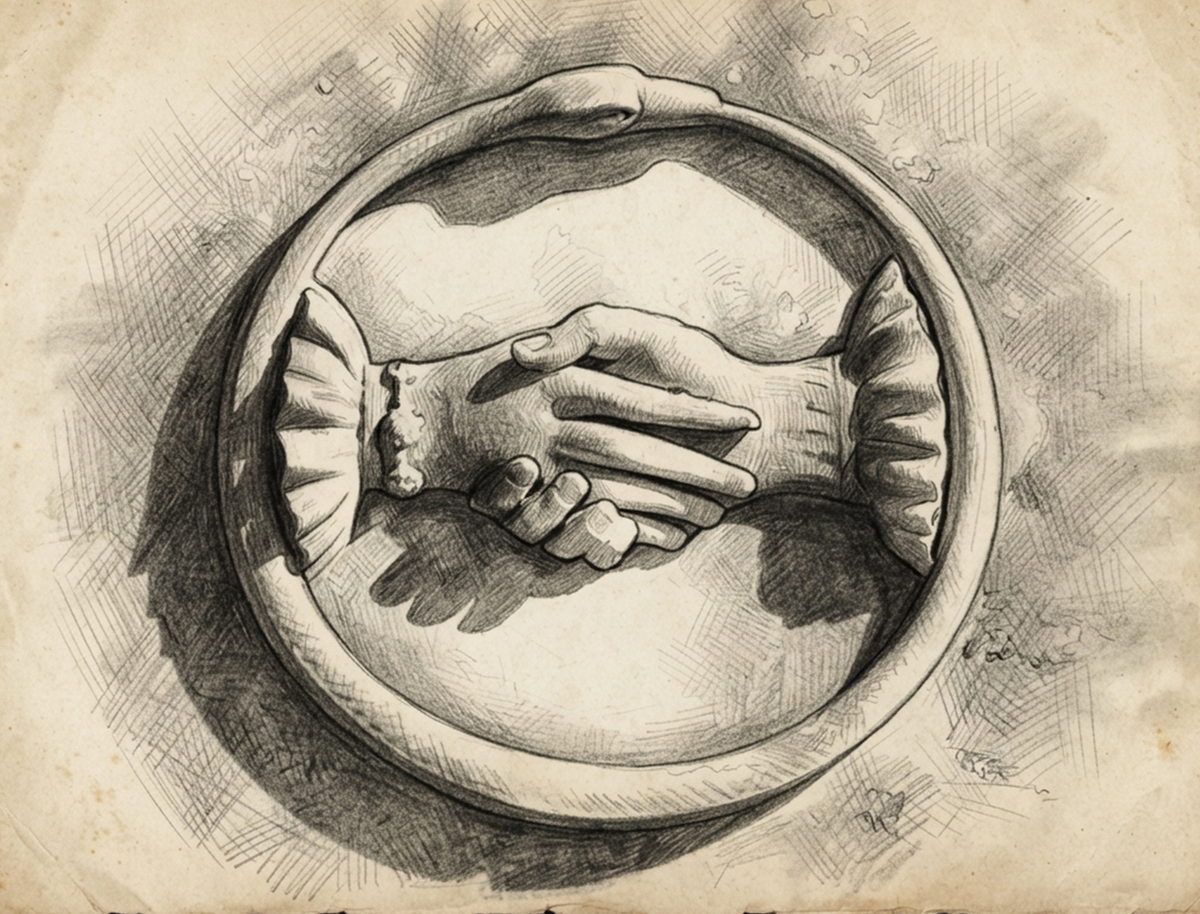
The most common symbols at Père-Lachaise speak of death and of time. The inverted torch — its flame pointing down towards the ground — is the most widespread: found on the main gate, on Bartholomé's Monument to the Dead, on hundreds of steles. The torch is a metaphor for the body, the flame for the soul: when the torch is turned over, the soul escapes the body. It is not a symbol of extinction, but of passage. The winged hourglass, another omnipresent motif, recalls the flight of time — tempus fugit, the memento mori of baroque vanitas translated into stone. The broken column signals a life cut short before its time: it appears mainly on the graves of young people, mothers who died in childbirth, children. The ouroboros — the snake biting its own tail, forming an endless circle — embodies the eternal cycle of death and rebirth. It is found on the cemetery's oldest graves, in Divisions 10 to 15, where the neoclassical vocabulary is at its densest.
Other symbols speak not of death but of what survives it. The laurel wreath, inherited from antiquity, signifies glory and immortality: it is carved on the graves of soldiers, scholars, artists. The palm signifies martyrdom or victory — victory over death, victory over sin. The anchor, a Christian symbol of hope, appears on sailors' graves but also on those of ordinary Catholic bourgeois. The butterfly, in funerary iconography, represents the soul: the caterpillar is the earthly body, the chrysalis the tomb, and the butterfly that emerges from it the soul taking flight to heaven. It is found carved in relief on steles at Père-Lachaise, sometimes resting on a skull — vanity and resurrection in a single motif. The pansy, a flower carved on dozens of graves, is a play on words: in French, pensée means both the flower and remembrance. Having a pansy carved on a grave is a way of asking the passer-by: think of me.
An inverted torch does not signify the end: it signifies life changing form. The flame goes out in the body but keeps burning elsewhere. That was exactly what the families who had it carved on their graves believed.
Père-Lachaise also carries symbols of trade and faith. The lyre marks a musician — found on Frédéric Chopin's grave, in Division 11, and on those of dozens of composers and performers. The compass and set square, crossed or not, mark membership of Freemasonry. The acacia, a tree that never sheds its leaves, symbolises the immortality of the soul in Masonic tradition. The Star of David identifies Jewish graves — concentrated in Divisions 7, 44, 86 and 96, but also present elsewhere in the cemetery. The chrism — the interlaced Greek letters Chi and Rho, a monogram of Christ — adorns the graves of the most devout Catholics. The caduceus identifies doctors. The scales, lawyers and magistrates. The eternal flame, on twentieth-century commemorative monuments, is a secular symbol of remembrance, detached from any faith. On the most recent graves, the symbolic vocabulary has almost entirely disappeared: a photograph of the deceased, a first name, two dates.
Visitors who learn to read this vocabulary no longer see the same cemetery. Every path becomes a text, every grave a sentence. An inverted torch beside an anchor says: he is dead, but we hope to find him again. A broken column beside a wreath of roses says: she died young, and she was loved. A butterfly resting on a skull says: death is only a transformation. Nineteenth-century stonemasons composed these sentences for families who understood them without any explanatory note. Today the code is lost, and the symbols have become mere ornaments — shapes people find beautiful without knowing what they say. Père-Lachaise is a book of seventy thousand pages whose alphabet has been forgotten.
What does the inverted torch on Père-Lachaise graves mean?
The inverted torch symbolises the passage from life to death. The torch stands for the body, the flame for the soul: turning the torch over lets the soul escape. The motif appears on Père-Lachaise's main gate (1825) and on hundreds of steles across the cemetery.
A broken column marks a life cut short. At Père-Lachaise, this symbol appears on the graves of the young dead — children, mothers who died in childbirth, soldiers. The motif is common in the cemetery's older Divisions, where neoclassical imagery dominates.
How can you recognise Masonic symbols at Père-Lachaise?
The most visible Masonic symbols at Père-Lachaise are the interlaced compass and square, the acacia (a symbol of immortality) and the blazing star. They are found carved into steles across several Divisions of the cemetery, often quite discreetly.
Are there Jewish symbols on graves at Père-Lachaise?
Yes. The Star of David, the menorah and the hands of the priestly blessing mark Jewish graves at Père-Lachaise. Jewish graves are concentrated in Divisions 7, 44, 86 and 96, though they can also be found in other parts of the cemetery.
 Symbols