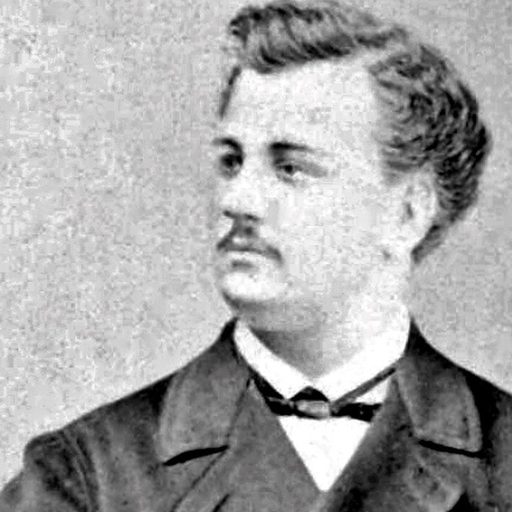
Victor Noir, a reporter of twenty-one, came to arrange a duel at Prince Pierre Bonaparte's house on 10 January 1870: the prince slapped him with his left hand and shot him dead with his right. The murderer's acquittal raised an outcry that counts among the ferments of the fall of the Empire. On his grave, visitors' hands have polished the bronze of Jules Dalou's effigy to gold.
The story
On the morning of 10 January 1870 the reporter Yvan Salmon, who signed himself Victor Noir, called with Ulric de Fonvielle at the house of Prince Pierre Bonaparte, cousin of Napoleon III: Paschal Grousset had sent them as his seconds to arrange a duel. The prince slapped him with his left hand, drew a revolver with his right and fired point-blank. Noir staggered out, collapsed in the street and died at the chemist's shop next door. He was twenty-one.
The next day Henri Rochefort, the pamphleteer who ran La Marseillaise, published his headline: “Murder committed by Prince Pierre Napoléon Bonaparte upon the citizen Victor Noir.” The paper was seized, but a hundred and forty-five thousand copies had already sold. The emperor had his cousin arrested that same evening.
The funeral, on 12 January, took place in abominable weather before a crowd put at more than a hundred thousand. There was argument about carrying the coffin into Paris, at the risk of a riot; caution won, and the burial took place at Neuilly. Louise Michel was there, and Rochefort had to call for calm.
On 27 March 1870 the High Court of Justice, sitting at Tours to keep the case away from Paris, acquitted the prince on grounds of self-defence. The anger that verdict raised counts among the ferments of the fall of the Empire, five months later.
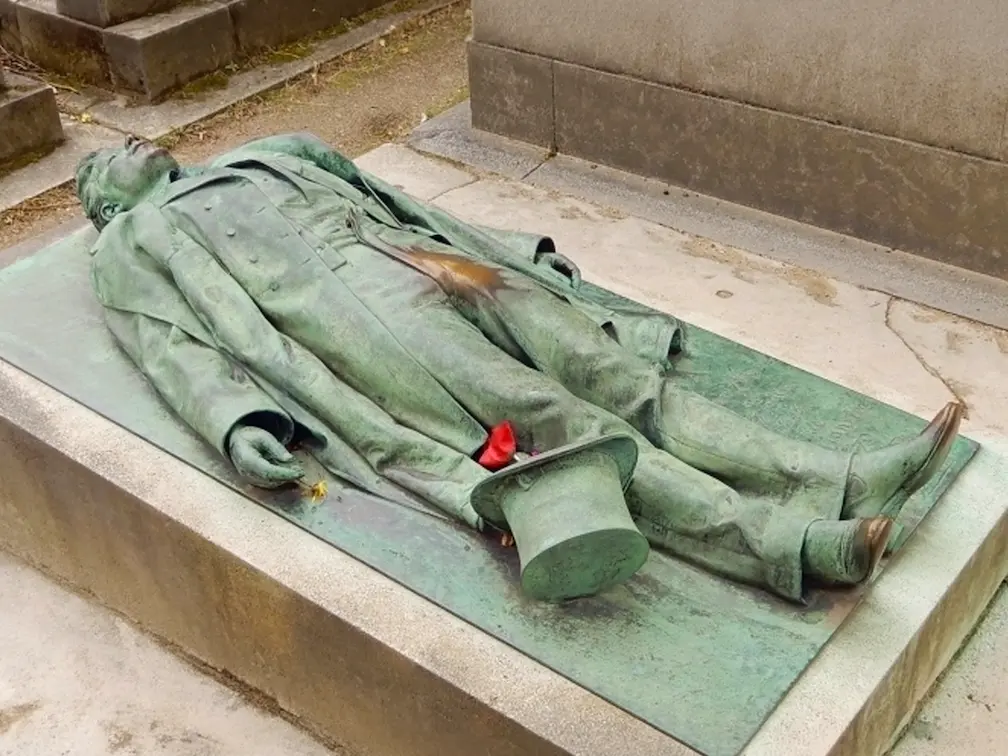
In May 1891 the Republic had his remains moved to Père-Lachaise, to Division 92, and Jules Dalou's recumbent bronze raised there by national subscription. A pronounced swelling in the bronze trousers did the rest: women visitors read it as a promise of fertility, and their hands have rubbed the metal to gold, like the lips and like the hat where visitors leave flowers. In 2004 a railing put up around the statue caused such protest that it was taken down.
The grave
A bronze recumbent effigy by Jules Dalou occupies the grave, in Division 92, Avenue Transversale no. 2: it shows Victor Noir in the second after the murder — on the ground, his waistcoat open to let him breathe, the bullet hole visible, his top hat overturned beside his head. Dalou, a former pupil of Carpeaux, was by then the sculptor of the Republic. The plaster was shown at the Salon of 1890, the bronze unveiled in the cemetery on 15 July 1891. A national subscription paid for the tomb — the inscription says so — and the plot was granted free of charge by prefectoral decree.
On site, do not miss
Look at the metal, not the figure: the areas polished to gold say exactly where hands have rested for a century. The rest of the bronze has stayed dark.
Visitors' questions
Why do people touch the statue of Victor Noir?
A superstition that arose in the twentieth century credits the statue with powers of fertility. Visitors' hands have polished the bronze, above all at the trousers, the lips and the hat.
François Astier de la VigerieWhere is Victor Noir's grave?
In Division 92, Avenue Transversale no. 2, first row, in the upper, eastern part of the cemetery — the division next to Oscar Wilde's. Look for a bronze figure lying flat on the slab.
Pierre AugereauWho was Victor Noir?
A republican journalist of twenty-one, shot dead in January 1870 by Prince Pierre Bonaparte, a cousin of Napoleon III. His funeral drew more than a hundred thousand people and turned into a political demonstration.
Paul BarrasWhat can be seen on Victor Noir's grave?
A bronze recumbent effigy by Jules Dalou, unveiled in 1891, showing the journalist just as he fell: on the ground, his waistcoat open, the bullet hole visible, his top hat overturned beside his head. Visitors leave flowers inside the hat.
Félix de BeaujourAudio guide to Père Lachaise: the best unusual guided tour!
Discover the secrets of the most astonishing tombs
the audio guidefrom€6.99