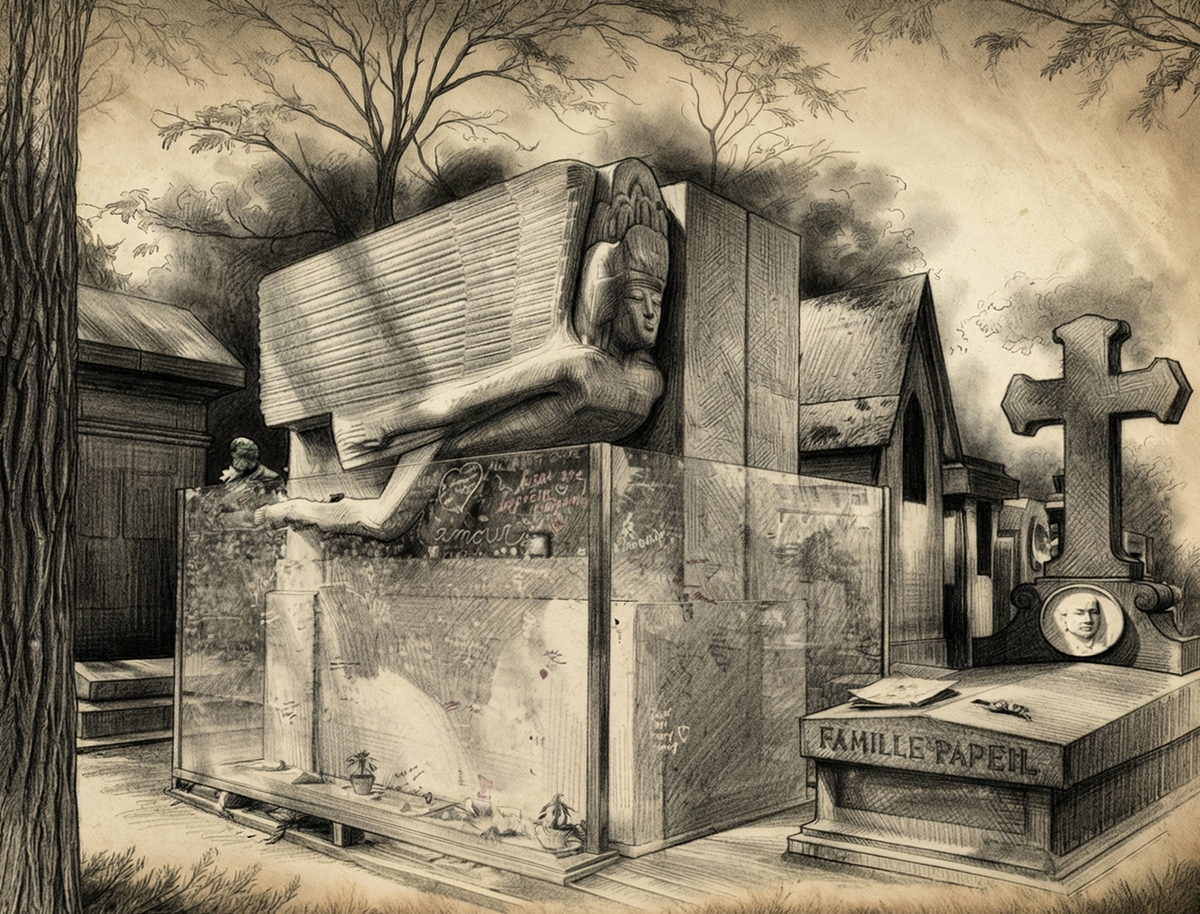
Oscar Wilde's tomb in Division 89 of Père-Lachaise, a winged sphinx carved by Jacob Epstein in 1912, was covered in lipstick marks for decades. In 2011, a protective glass screen put an end to the ritual of kissing it — and changed how visitors related to the monument.
Oscar Wilde died in Paris on 30 November 1900, in a room at the Hôtel d'Alsace, rue des Beaux-Arts, at forty-six. Ruined, exiled, and broken by two years of hard labour in English prisons for “gross indecency”, the Irish writer had found refuge in Paris after his release in 1897. His body was first buried at the Bagneux cemetery, in the southern suburbs. In 1909, a friend of Wilde's, Robert Ross, funded the transfer of the remains to Père-Lachaise, in Division 89, and commissioned a monument from the American sculptor Jacob Epstein. The monument, installed in 1912, is a winged sphinx in limestone, massive and angular, drawn both from the winged Assyrian bulls at the British Museum and from Wilde's poem *The Sphinx*. The sphinx stares straight ahead, wings spread, its face expressionless. It resembles nothing else at Père-Lachaise.
Jacob Epstein was twenty-nine when he received the commission from Robert Ross. The sculptor, born in New York to Polish Jewish parents and settled in London, was already a controversial figure for his expressionist sculpture. The sphinx he carved from a block of Hopton Wood stone — a very fine English limestone — is a hybrid figure: the body of a bull, angel's wings, an androgynous face, a pharaonic headdress. The monument weighs several tonnes and needed a reinforced base. As soon as it was installed in 1912, the sculpture caused a scandal: legend has it that a Père-Lachaise guard covered the sphinx's genitals with a tarpaulin, judging them too explicit. The controversy died down, but the monument remains apart from the rest of the cemetery's landscape — a modernist sculpture amid neo-Gothic chapels and steles in the antique style. Oscar Wilde's grave was listed as a historic monument in 1995.
The tradition of leaving lipstick kisses on Oscar Wilde's grave probably dates from the 1990s. Visitors — mostly women — press a lipstick kiss onto the limestone, sometimes with a message added in felt-tip pen or pencil. Within a few years, the sphinx was covered in thousands of red, pink and purple marks. The gesture was photographed, posted on social media, and repeated by millions of tourists. But the grease in the lipstick soaked into the porous stone and damaged it. Repeated cleanings made the erosion worse: each scrub stripped away a layer of limestone. In 2011, the Père-Lachaise authorities and the Irish consulate had a glass screen installed around the monument, funded to the tune of several tens of thousands of euros. Visitors can no longer touch the stone. Kisses now land on the glass — wiped off every week by the cemetery's staff.
The lipstick kisses are not an old tradition: the practice probably dates from the 1990s. Within a few years, the grease in the lipstick had attacked the limestone to the point of threatening the monument's structural integrity.
Oscar Wilde lived in Paris for only three years. Arriving in 1897 under the pseudonym Sebastian Melmoth, ill and drinking heavily, he drifted between the Hôtel de Nice and the Hôtel d'Alsace, wrote little, and lived on the generosity of friends and admirers. *The Ballad of Reading Gaol*, published in 1898, was his last major work. Wilde probably died of meningitis following chronic inflammation of the ear, worsened by alcohol and syphilis — the exact diagnosis remains disputed. His apocryphal last words — “This wallpaper is dreadful. One of us will have to go.” — sum up the dark humour that never left him. Paris did not save Wilde, but Paris took him in when London had cast him out. Père-Lachaise is the final stop of an exile that lasted three years.
Epstein's sphinx, in Division 89, is today one of the three most visited monuments at Père-Lachaise, along with Jim Morrison's grave and Victor Noir's recumbent effigy. The glass screen, installed in 2011, is constantly marked with fresh kisses and messages. Flowers, letters and paperbacks are left at the foot of the monument. The sphinx still stares straight ahead, indifferent to tributes and selfies. Oscar Wilde, who wrote that life imitates art far more than art imitates life, would no doubt have appreciated the irony: the most-kissed monument in Paris is a statue no one can touch any more.
Oscar Wilde's grave lies in Division 89 at Père-Lachaise. The monument, a winged sphinx in limestone carved by Jacob Epstein in 1912, has been protected by a glass screen since 2011. The grave was listed as a historic monument in 1995.
The tradition of lipstick kisses on Oscar Wilde's grave dates from the 1990s. The gesture, repeated by millions of tourists, damaged the limestone of Epstein's sphinx, leading to the installation of a protective glass screen in 2011.
Jacob Epstein, an American sculptor based in London, carved the winged sphinx of Oscar Wilde's tomb in 1912. Inspired by Assyrian winged bulls and Wilde's poem The Sphinx, the Hopton Wood stone monument is a hybrid modernist figure unique at Père-Lachaise.
Oscar Wilde died on 30 November 1900 in a room at the Hôtel d'Alsace, Rue des Beaux-Arts in Paris, aged 46. Ruined and exiled after two years of hard labour in England, Wilde had been living in Paris since 1897 under the pseudonym Sebastian Melmoth.
 Figures