Frédéric Chopin has been buried in Division 11 of Père-Lachaise since 1849. But the composer's heart is not in the grave: preserved in cognac by his sister Ludwika, it has rested since 1879 inside a pillar of Holy Cross Church in Warsaw.
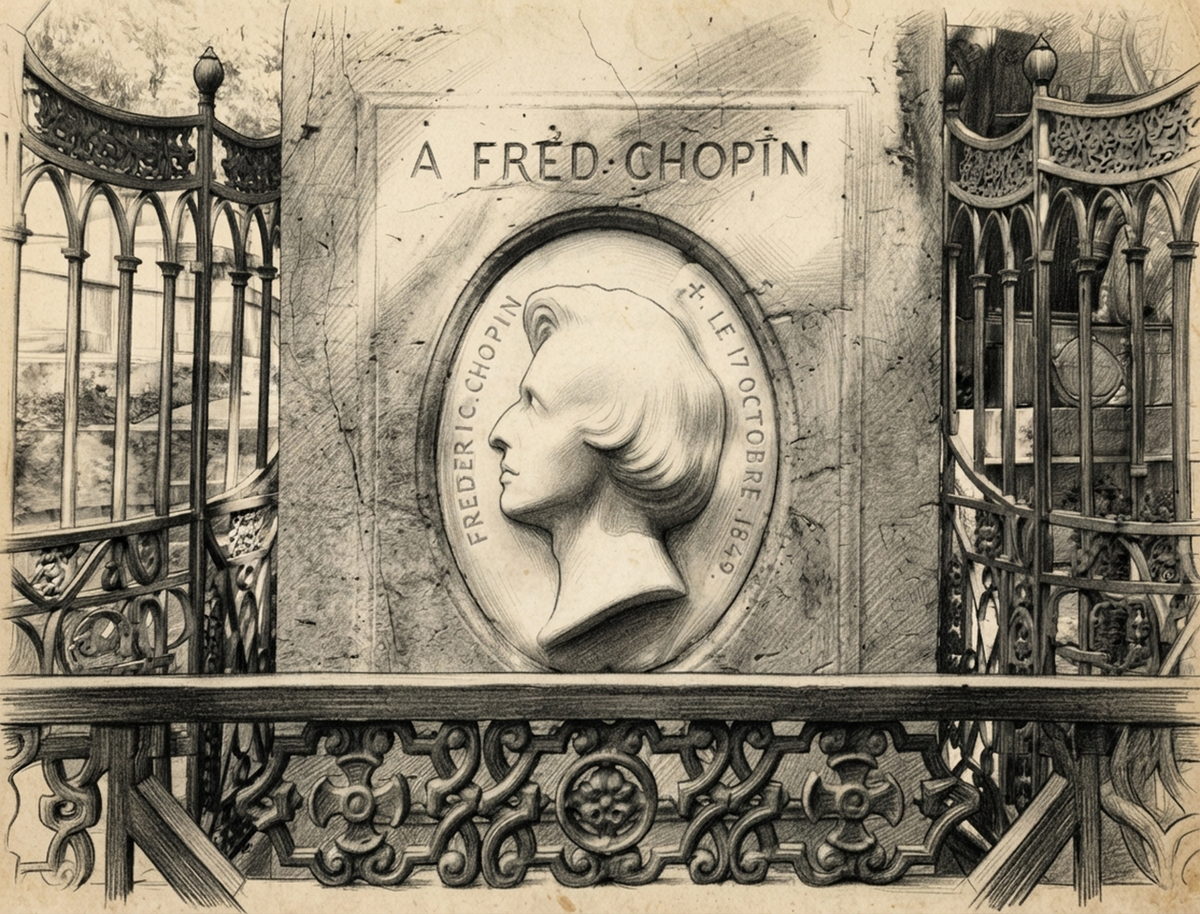
A visitor who stops in front of Frédéric Chopin's grave, in Division 11 of Père-Lachaise, sees an elegant monument topped by a weeping muse carved by Auguste Clésinger, George Sand's son-in-law. Fresh flowers are laid there every week. But the monument is incomplete: it is missing the heart. Chopin died on 17 October 1849, in Paris, at 12 place Vendôme, at the age of thirty-nine. The day after his death, in keeping with a wish he had long expressed, Dr Jean Cruveilhier performed the autopsy and removed the composer's heart. The heart was placed in a crystal jar filled with cognac, sealed, and entrusted to Chopin's elder sister, Ludwika Jędrzejewicz. The body, without the heart, was buried at Père-Lachaise on 30 October 1849. The heart, meanwhile, set off for Poland.
Ludwika Jędrzejewicz left Paris in November 1849 with the jar hidden beneath her clothes. The act was nothing eccentric for the time: the practice of separating the heart — “devotional cardiectomy” — was an old tradition, inherited from medieval royalty, by which the heart of the dead was to rest in their native soil even when the body was buried elsewhere. Chopin, who had lived in exile in France since 1831, had never stopped thinking of himself as Polish. The heart reached Warsaw and was at first kept in Ludwika's flat. In 1879, thirty years after the composer's death, the jar was sealed into a pillar of the Holy Cross Church in Warsaw — the baroque church in the city centre where the Chopin family had worshipped. A marble plaque marks the spot, but the jar itself is invisible, sealed inside the stone.
Chopin's heart was removed from his chest hours after his death, sealed in a jar of cognac, smuggled across Europe by his sister, then walled into a church pillar — where it remains to this day.
Chopin's heart did not rest in peace inside its pillar. In September 1944, during the Warsaw Uprising, the German army systematically burned and destroyed the buildings of the city centre. Before the Holy Cross Church was destroyed, a German officer — the fact is documented — had the jar removed from the pillar and handed it over to the Polish church authorities. The heart was carried out of Warsaw, kept safe through the war's final months, and returned to the rebuilt church after 1945. The jar found its way back into its pillar. The episode reveals the status of Chopin's heart in the Polish national consciousness: a national relic, treated with the same care as a state treasure.
In 2014, in the greatest secrecy, the Polish authorities carried out a scientific inspection of the jar. The heart was examined visually — but not opened — by a team of doctors and pathologists. Their findings, published in the *American Journal of Medicine* in 2017, confirmed that the heart shows signs of fibrinous pericarditis, consistent with the tuberculosis that killed Chopin. The amber liquid the heart has rested in for 165 years is still cognac. The jar was resealed, photographed for the first time, and returned to its pillar in the Holy Cross Church. Chopin's heart is the only organ of a nineteenth-century composer ever to undergo a modern medical examination.
At Père-Lachaise, Chopin's grave in Division 11 bears no mention of the missing heart. Clésinger's weeping muse, a medallion in profile, flowers — nothing indicates that the monument marks a burial without a heart. A visitor who lays a rose on Chopin's grave pays tribute to a body missing its most symbolic organ. The heart is in Warsaw, inside a church pillar, in a jar of cognac sealed since 1849 — 1,500 kilometres from Division 11, on the other side of Europe, in the country Chopin had left at twenty-one and to which he never returned alive.
Frédéric Chopin's body has rested in Division 11 at Père-Lachaise since 30 October 1849. But the composer's heart was removed after death and taken to Poland. Since 1879 the heart has been sealed inside a pillar of Holy Cross Church in Warsaw.
Chopin had wished for his heart to rest in his native land. “Devotional cardiectomy”, a tradition inherited from medieval royalty, allowed a dead person's heart to rest apart from the body. Chopin's sister carried the jar to Warsaw in 1849.
Has Chopin's heart ever been examined by scientists?
Yes. In 2014, Polish doctors visually inspected Chopin's heart, kept since 1849 in a jar of cognac. The examination revealed signs of fibrinous pericarditis consistent with tuberculosis. The findings were published in 2017.
The weeping muse atop Chopin's grave in Division 11 at Père-Lachaise was sculpted by Auguste Clésinger, George Sand's son-in-law. The monument was funded by public subscription after the composer's death on 17 October 1849.
 Figures