Père-Lachaise holds a hundred and sixty-eight bronze busts, a hundred and twenty of them dating from 1850 to 1918. Painters, musicians, doctors, members of parliament, mayors: the bourgeoisie of the Third Republic had themselves portrayed on their graves by the leading sculptors of the day.
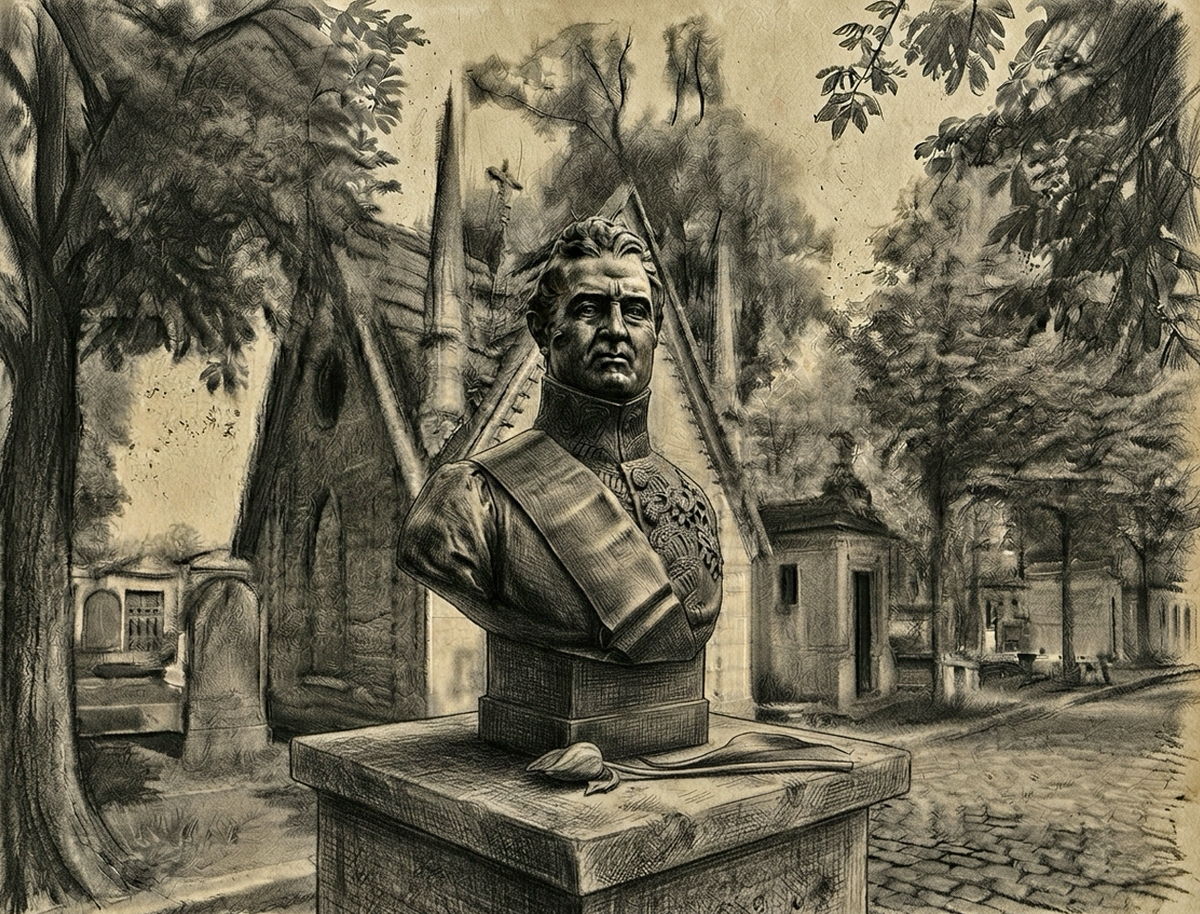
Walking the paths of Père-Lachaise, one meets faces. Not painted or photographed faces — faces of bronze, set on stone plinths, staring straight ahead for a century or more. Thick moustaches, trimmed beards, high collars, knotted ties, stern or dreamy gazes: one hundred and sixty-eight bronze busts stand in the cemetery, catalogued by the Association des Amis et Passionnés du Père-Lachaise. Most date from a precise golden age: between 1850 and 1918, one hundred and twenty busts — seventy-one per cent of the total — were placed on Père-Lachaise graves. This was the time of the Third Republic, when the Parisian bourgeoisie had its features cast in metal just as it had had them painted on canvas a century before. The bronze bust is a portrait for eternity.
The first bronze bust at Père-Lachaise is that of Abraham Louis Breguet, the Swiss watchmaker, sculpted by Mathieu Kessels and dated 1818 — possibly 1815. The bust was placed on the monument in 1823. An earlier bust may have existed and disappeared, but no document confirms it. At the other end of the timeline, the most recent bust is that of François Magnien, a figure about whom nothing is known, signed by Georges Oudot and installed in 2024. Between these two dates, two centuries of portrait sculpture run through the cemetery. But the great majority cluster in the period 1850–1918, alongside the rise of funerary chapels among Catholic families and the spread of bronze portraiture among the rest of the well-off bourgeoisie. The funerary bust was no aristocratic luxury: it was a social marker, that of a class wanting to leave a visible trace of its faces after death.
Families commissioning a bust sometimes turned to leading sculptors. Jules Dalou, creator of the celebrated recumbent effigy of Victor Noir, signed four busts at Père-Lachaise: the chemist and deputy Boussingault, the President of the Chamber of Deputies Charles Floquet, the songwriter Jules Jouy and the journalist Albert Wolff. Pierre-Jean David d'Angers sculpted the busts of the astronomer François Arago in 1858 and of Honoré de Balzac in 1844. Auguste Clésinger, creator of the Chopin monument, made the bust of the academician Henry Houssaye. Henri Chapu, creator of the high relief in the Thiers chapel, signed the bust of the founder Ferdinand Barbedienne. Six women sculptors are also represented: Laure Coutan-Montorgueil, Giovanna Dubray, Herminie Hanin, Jeanne Hugues-Royannez, Jeanne Itasse and Marguerite Syamour. Among the one hundred and twenty busts from the period 1850–1918, only one depicts a woman: the actress Marguerite Lacressonnière, who died in 1859. The sculptor of that bust is unknown.
Of the hundred and twenty busts from 1850 to 1918, only one depicts a woman: the actress Marguerite Lacressonnière, who died aged thirty-seven in 1859. The sculptor is unknown.
Those honoured with a bust were first and foremost painters, musicians, sculptors, doctors, deputies, mayors and municipal councillors — public officials and the world of the fine arts. Then writers, founders, merchants, generals, entrepreneurs and industrialists. And finally rarer trades: a pastry chef, a cabinetmaker, an ornamental ironworker, an inventor, a photographer, a veterinarian, a costumier, a caricaturist, a school inspector. The bust was often paid for by public subscription: money was collected from colleagues, friends, family, and sometimes newspapers were enlisted to reach a wider public. The bust of Louis Lucipia, mayor of the nineteenth arrondissement, was funded this way in 1907. That of General Émile Eudes, a Commune commander, in 1888.
Comparing the busts reveals an era: facial hair was in fashion — thick moustaches, neatly trimmed beards, imposing sideburns. The poses are frontal, the gazes direct, the collars high. Only four busts are attached to chapels — those of Louis Biétry on the façade, and of Noël Boulanger, Narcisse Clément Julien and Pierre Jules Ronnet inside. All the others stand in the open air, exposed to weather and theft. For bronze gets stolen: busts have vanished over the decades, melted down or sold on. Those that remain form a museum of nineteenth-century portrait sculpture, scattered across forty-four hectares, with no catalogue, no signage, no particular protection. Visitors making their way through Père-Lachaise meet these faces one by one, at random along the paths — a painter here, a general there, a pastry chef further on — without knowing that Dalou, David d'Angers or Clésinger worked the same bronze.
168. Père-Lachaise holds 168 bronze busts catalogued by the APPL. 120 of them (71%) date from 1850 to 1918, the heyday of the funerary bust under the Third Republic. The oldest, that of the clockmaker Breguet, was sculpted by Kessels in 1818.
Which famous sculptors made busts at Père-Lachaise?
Jules Dalou (Victor Noir's recumbent effigy), David d'Angers (the Balzac bust), Auguste Clésinger (the Chopin monument), Henri Chapu (the Thiers chapel) and Tony Noël all signed bronze busts at Père-Lachaise. Around forty lesser-known sculptors are also represented there.
Who is depicted in the bronze busts at Père-Lachaise?
The busts at Père-Lachaise mostly depict painters, musicians, doctors, deputies and mayors — the civic officials and art world of the Third Republic. Rarer trades appear too: a pastry chef, a photographer, a cabinetmaker, a veterinary surgeon.
The oldest bronze bust identified at Père-Lachaise is that of Abraham Louis Breguet, the Swiss clockmaker, sculpted by Mathieu Kessels and dated 1818. The bust was placed on the monument in 1823. The most recent, by Georges Oudot, dates from 2024.
 Heritage