Joseph Lesurques, guillotined on 30 October 1796 for the robbery of the Lyon mail coach, rests in Division 8 of Père-Lachaise. The epitaph carved on the grave says it all: “He was the victim of the most deplorable of human errors.” He was never exonerated.
In Division 8 of Père-Lachaise, a grave bears an inscription found on no other tomb in the cemetery: *Il fut victime de la plus déplorable des erreurs humaines* (“He was the victim of the most deplorable of human errors”). Not a title, not a profession, not a eulogy — a verdict. Joseph Lesurques, born in Douai on 1 April 1763, was guillotined in Paris on 30 October 1796 for the attack on, and murder of, the Lyon mail coach's guard. The case is one of the most notorious miscarriages of justice in French history. Lesurques was condemned in place of the real culprit — a man named Dubosc, who physically resembled him — on the strength of mistaken eyewitness testimony. For 230 years, the Lesurques family and his defenders have sought his rehabilitation. It has never been granted.
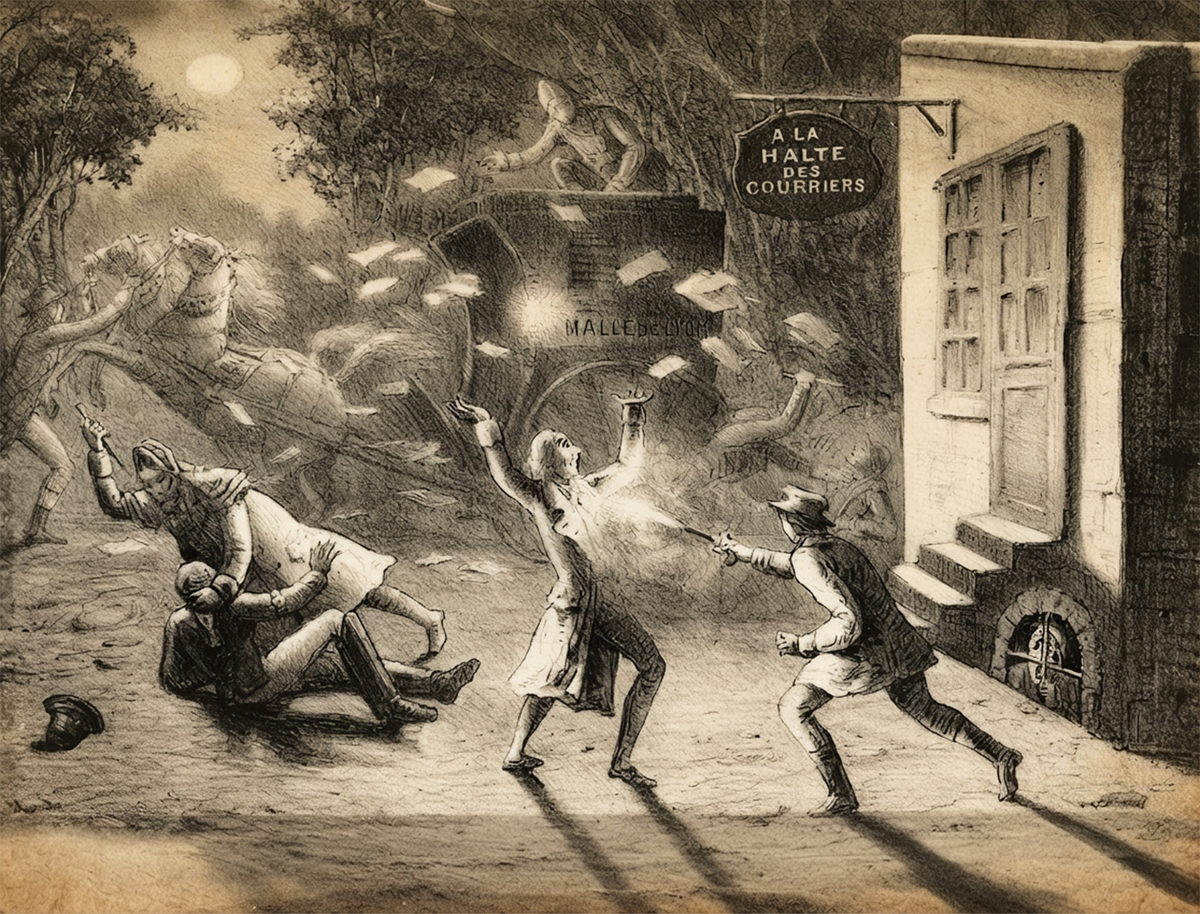
On 27 April 1796, the mail coach travelling from Paris to Lyon was attacked on the road near Melun, in the Sénart forest. The guard was killed, a postilion wounded, and the dispatches and funds stolen. The investigation quickly identified a gang of criminals. Joseph Lesurques, a well-off man of independent means and a family father, was arrested because several witnesses — innkeepers, postilions — identified him as one of the riders who had escorted the mail coach before the attack. The witnesses were adamant: they recognised the face, the build, the coat. Lesurques protested his innocence, produced alibis, and pointed out that he knew none of the accused. The Seine criminal court sentenced him to death on 12 August 1796. The real culprit, Joseph Dubosc, was a man who physically resembled Lesurques — same height, same build, same type of face. Dubosc himself would later be arrested, tried and guillotined in 1801 for the same crime.
Lesurques was guillotined on 30 October 1796, at the Place de Grève. Before he died, he is said to have declared: “I am innocent. My blood will fall on the heads of the jurors who condemned me.” His death destroyed his family. His wife lost her mind. His daughter took her own life. His son, who had joined Napoleon's army, died during the Russian campaign in 1812. Victor Hugo, in a celebrated letter, argued for the condemned man's rehabilitation. The novelist Émile Gaboriau drew on the case for his detective novels. The theatre took it up: the play *Le Courrier de Lyon* was performed hundreds of times in the nineteenth century. The Lesurques case became the byword for a miscarriage of justice — the textbook example cited before the Dreyfus affair.
Lesurques's epitaph is a standing indictment, carved into the stone of Père-Lachaise: “He was the victim of the most deplorable of human errors.” Two centuries on, the words are still legible — and the error still stands, officially.
Since the early nineteenth century, several requests for rehabilitation have been filed. None has succeeded. The legal obstacle is formidable: to clear Lesurques, one would have to prove the witnesses were mistaken — and the witnesses have been dead for two centuries. The French justice system has no procedure suited to so old a case. The Lesurques affair nonetheless helped shape criminal law: it is one of the arguments cited by nineteenth-century abolitionists to show that the death penalty is irreversible and that no human justice is infallible. The 1899 Constans law on the review of criminal trials was adopted partly under the influence of cases such as Lesurques's — even though the Dreyfus affair was its immediate trigger.
The grave of Joseph Lesurques, in Division 8 of Père-Lachaise, is one of the few in the cemetery to carry a message addressed not to the dead man but to the society of the living. The epitaph — *Il fut victime de la plus déplorable des erreurs humaines* — is not a tribute: it is an accusation. Two centuries later, the stone is still there, the inscription still legible, and the rehabilitation still absent. A visitor who stops in front of Lesurques's grave reads, in a single sentence, the sum of everything justice can do at its worst: convict an innocent man, execute him, and refuse to admit the error after his death. Père-Lachaise is a cemetery of famous dead. Lesurques is the only one whose fame rests on the fact that he should never have been there at all.
Joseph Lesurques (1763-1796) was a man of independent means from Douai, guillotined for the 1796 Lyon mail-coach robbery. Convicted in place of the real culprit, Joseph Dubosc, Lesurques became France's symbol of miscarried justice — well before the Dreyfus affair.
Joseph Lesurques's grave lies in Division 8 at Père-Lachaise. The epitaph carved on the stone reads, in French, “Il fut victime de la plus déplorable des erreurs humaines” (He was the victim of the most deplorable of human errors). It is one of the cemetery's few graves to address the living directly.
No. Despite several petitions for exoneration filed since the nineteenth century, none has succeeded. Proving the error of witnesses dead for two centuries remains a legal impossibility. The case nonetheless helped shape the evolution of French criminal law.
On 27 April 1796, the Paris-Lyon mail coach was attacked in the Forest of Sénart: the courier was killed and the funds stolen. Joseph Lesurques, mistaken for the real culprit Dubosc because of a physical resemblance, was sentenced to death and guillotined in October 1796.
 Figures