Between 1820 and 1900, the Parisian bourgeoisie built an unprecedented cult of the dead: perpetual plots, family chapels, Sunday visits, All Saints' wreaths. Père-Lachaise is the central monument of this secular religion of remembrance.
On 1 November, All Saints' Day, Père-Lachaise today receives between twenty and thirty thousand visitors. They come to lay flowers on graves, clean steles, and pause for a moment before the stone of a father, a mother, a grandparent. This yearly ritual seems as if it has always existed — but it has not. Before the nineteenth century, the dead were buried in mass graves at the foot of churches, bodies were stacked on top of one another, names faded within a few years, and no one “visited” a dead relative at the cemetery. It was between 1820 and 1900 that the French bourgeoisie invented what the historian Guillaume Cuchet calls “the cult of the dead”: a set of practices — the perpetual plot, the family chapel, the regular visit, the chrysanthemum wreath — that turned the cemetery into a place of memory, and the dead into someone one goes on visiting after death.
The first pillar of this cult was the plot. Before Père-Lachaise, Parisian cemeteries offered only mass graves: a body was buried for five years, then the bones were dug up and moved to an ossuary to free the space. The imperial decree of 1804 changed everything: it allowed individual and family plots — temporary, thirty-year, or perpetual. The perpetual plot was the decisive innovation: for the first time, a family could buy a piece of ground in perpetuity, build a monument on it, and be sure the grave would never be destroyed. The rise of perpetual plots at Père-Lachaise began around 1825 and took off between 1830 and 1860. The bourgeoisie of the July Monarchy bought plots the way it bought buildings: it was an investment in property, an act of ownership that wrote the family into eternity.
The modern cemetery is not a place of death: it is a place to visit. Nineteenth-century families came to Père-Lachaise the way one goes to a temple — regularly, ritually, with flowers and a codified form of reflection.
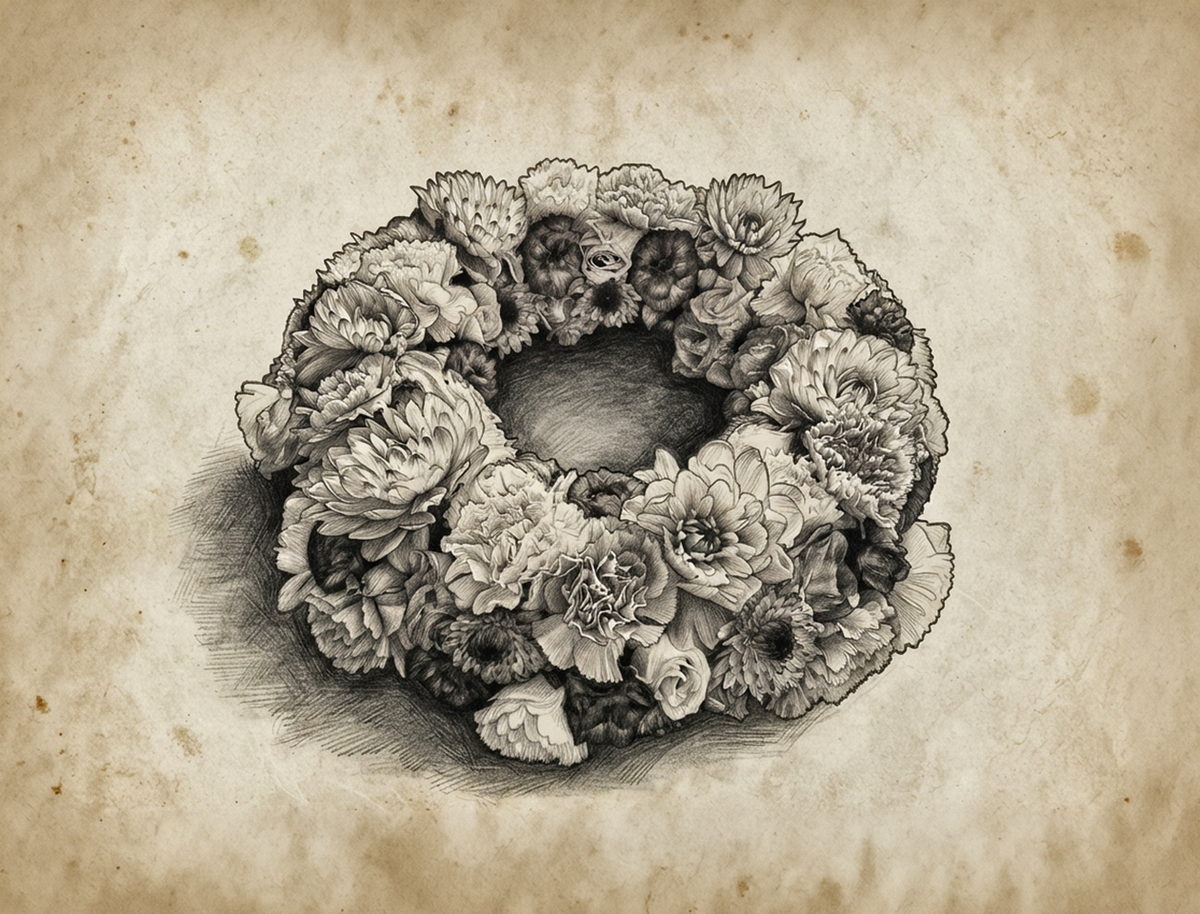
The second pillar was the visit. From the 1830s, Parisian families made a habit of going to the cemetery on Sundays, on All Saints' Day, on the anniversary of a death. The visit followed a ritual: clean the grave, change the flowers, check the state of the stone, pray or simply pause in remembrance. Funeral suppliers sold wreaths of beads, earthenware or everlasting flowers. Stonemasons offered engraved plaques — “To our beloved mother”, “Eternal remembrance”. All Saints' Day, a religious feast turned civil day of remembrance, concentrated the ritual into a single day. Suburban railways added extra carriages every 1 November to carry families out to the cemeteries. Newspapers ran reports on the crowds at Père-Lachaise — the same papers that, twenty years earlier, had published romantic serials about melancholy strolls through the cemetery's alleys.
The cult of the dead did not stay within the cemetery: it spread into domestic and public life. Grieving families wore black for a year — two years for a widow — along with jet jewellery and jewellery made from the dead person's hair. Visiting cards were bordered in black. Writing paper was framed with a black line. The mirrors in the house were veiled. The shutters were closed. The dead were present everywhere: in clothing, in objects, in social convention. Funeral suppliers, by now a thriving business, sold catalogues of funerary ornaments — wreaths, plaques, crosses, vases, railings, chains — that families ordered the way one orders furniture. Mourning was a market, and Père-Lachaise was its shop window.
This cult of the dead collapsed in the twentieth century. The First World War, with its millions of dead who had no individual grave, made the system of perpetual plots and first-class funeral processions seem absurd. Codified mourning — black clothing, jet jewellery, crepe veils — gradually disappeared between 1920 and 1960. Cremation, the scattering of ashes, and the dematerialisation of memory completed the change. But Père-Lachaise remains the monument to that vanished century. The family chapels, the bronze busts, the stained glass, the earthenware wreaths, the perpetual plots overrun with ivy — everything a visitor sees today is the product of a cult of the dead that lasted a century, between the Restoration and the Great War. Père-Lachaise is the cathedral of a religion that no longer exists.
When did All Saints' Day become a cemetery day of remembrance?
All Saints' Day became the secular day of remembrance for the dead from the 1830s, when the Parisian bourgeoisie took up the habit of visiting graves on 1 November. Suburban trains added special carriages to carry families to the Paris cemeteries.
A perpetual plot is a piece of cemetery ground bought in perpetuity to build a family grave. Created by the imperial decree of 1804, the perpetual plot at Père-Lachaise allowed bourgeois families to carve their name into stone for eternity.
How was mourning observed in nineteenth-century Paris?
Bourgeois mourning in the nineteenth century required black clothing for a year (two years for widows), jet or mourning-hair jewellery, black-bordered writing paper, veiled mirrors and shuttered windows in the house of the deceased.
Why did the cult of the dead disappear in the twentieth century?
The First World War, with millions of dead left without an individual grave, made codified mourning obsolete. The system of black clothing, jet jewellery and class-ranked funeral processions gradually disappeared between 1920 and 1960.
 Society