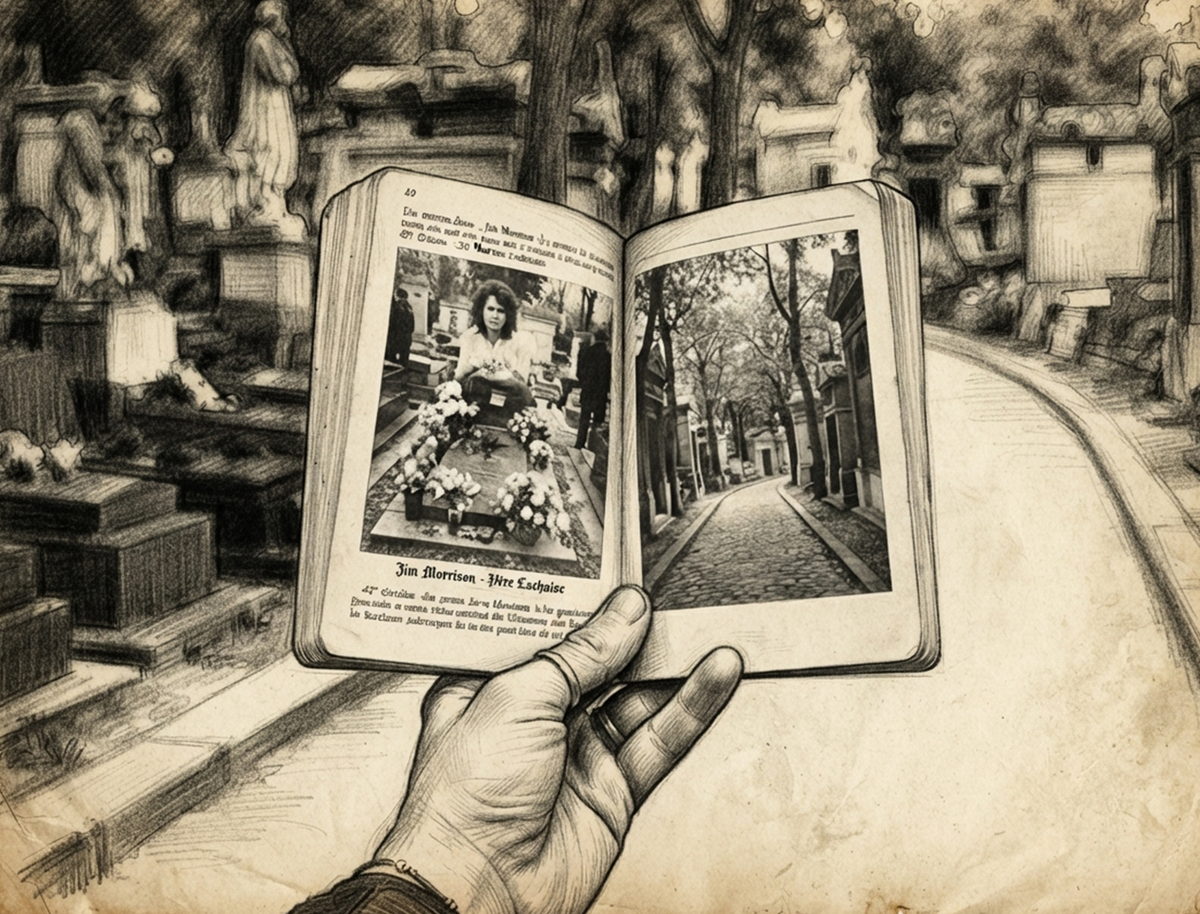
Between 1808 and 1830, at least nine guidebooks were devoted to Père-Lachaise: sentimental journeys, philosophical rambles, illustrated companions. It was this funerary literature, unmatched anywhere in the world, that turned a shunned garden into a prestige necropolis.
Père-Lachaise is the most written-about cemetery in the world. No necropolis has inspired as many guidebooks, engravings, lithographs and accounts as this hill in eastern Paris. Between 1808 and 1830, at least nine works were devoted to it — a new guide roughly every two years, for a place that counted only six hundred graves at the turn of the century. These publications were not administrative directories: they were “sentimental journeys,” “philosophical strolls,” illustrated “guides” with engravings and foldout plans. They blended biography, poetry, moral reflection and topographical description. The genre had no equivalent: no one wrote a sentimental guidebook for the Montmartre or Montparnasse cemeteries. Père-Lachaise was at once a place of memory and an editorial phenomenon.
The first guide appeared in 1808: Antoine Caillot's Voyage pittoresque et sentimental au champ de repos sous Montmartre et à la maison de campagne du Père-Lachaise à Montlouis, two hundred and twelve pages of funerary inscriptions accompanied by reflections on the dead. The cemetery was only four years old, with a few dozen plots, but it already had its book. In 1816, Roger father and son published Le Champ du repos, ou le Cimetière Mont-Louis, dit du Père de la Chaise — two volumes, eight hundred and thirty-eight pages in all, with plates and portraits. That same year, C. P. Arnaud brought out a Guide du voyageur sentimental, a more modest thirty-six pages with a plan. In 1817, the year Molière and La Fontaine were transferred, Arnaud published a Recueil de tombeaux des quatre cimetières de Paris. The market was under way: every publisher competed in thoroughness, plates and melancholy prose. The nineteenth-century bourgeois reader read Père-Lachaise the way one might read a novel: moved by the epitaphs, informed by the biographies, touched by the children's graves.
Nine guidebooks in twenty years, hundreds of engravings, thousands of pages: no cemetery in the world has spawned such a funerary library.
One man dominated this output: François-Marie Marchant de Beaumont. Between 1820 and 1828, he published at least four works devoted to Père-Lachaise. Le Conducteur au cimetière de l'Est (1820), four hundred and sixty-five pages with a plan and engravings, ran to three expanded editions in 1822, 1825 and 1828. Les Vues pittoresques, historiques et morales (1821), five hundred and twenty-six pages, accompanied the text with numerous engravings of monuments. L'Itinéraire du curieux (1828) offered two hundred and fifty-six illustrated pages. Marchant de Beaumont was no man of letters: he was a professional guide who sold death the way others sold travel. In 1822, the English lithographer Charles Hullmandel published an album of twenty-four views of the cemetery after drawings by John James Chalon — proof that the necropolis already drew interest abroad. In 1824, Guillaume Viennet brought out a Promenade philosophique in which he “judged” two hundred and eighty notable figures buried in the cemetery. In 1832, the Italian artist Ferdinando Quaglia engraved a Recueil de dessins des principaux monuments — the most precise lithographs of Père-Lachaise's graves ever produced.
These publications did not merely document the cemetery: they filled it. The mechanism was circular. The guides presented the graves as curiosities; readers came for a stroll; families noted the place was fashionable; they bought a plot; the next guide added new entries. Roger father and son published eight hundred and thirty-eight pages in 1816, when the cemetery counted only six hundred graves: more than a page per grave. The editorial glut preceded the funerary one. In 1835, Balzac closed Le Père Goriot with the scene that would become famous, in which Rastignac, standing atop Père-Lachaise, looks out over Paris and issues his challenge. By then the cemetery was so well known it served as the setting for the climax of the most widely read novel in the Comédie humaine. At that date, Père-Lachaise already held thirty-three thousand plots. The necropolis Parisians had refused in 1804 had become, thirty years on, a literary symbol of Paris.
Publishing on the subject continued throughout the nineteenth century. Benjamin Gastineau published a Paris historique devoted to the cemetery in 1854. Théophile Astrie brought out a Guide dans les cimetières de Paris in 1865 — two hundred and eighty-eight pages with plans of the three great cemeteries. In 1909, Jules Moiroux, the curator of Père-Lachaise, published his Guide illustré, enriched with photographs and engravings. The work, reprinted until 1922, was the last of the great nineteenth-century tradition of funerary guidebooks — and the most complete ever produced. Today, most of these old guides can be consulted online on Gallica, the digital library of the Bibliothèque nationale de France. Roger father and son, Marchant de Beaumont, Viennet, Astrie: their texts are still there, with their engravings, their plans, their slightly dated prose. The visitor who opens a phone before a grave at Père-Lachaise makes the same gesture as the stroller of 1820 opening Marchant de Beaumont's Conducteur: they are looking for a story behind the stone.
Antoine Caillot's Voyage pittoresque et sentimental, published in 1808, is the earliest guide devoted to Père-Lachaise. The cemetery was only four years old, with a few dozen plots. The 212-page book mixes funerary inscriptions, moral reflections and descriptions of the earliest monuments.
Was Père-Lachaise a tourist attraction in the nineteenth century?
Yes. From the 1820s, Père-Lachaise was a favoured walking destination for Parisians and foreign visitors alike. The English lithographer Hullmandel published an album of views of the cemetery in 1822. In 1835, Balzac chose Père-Lachaise as the setting for the final scene of Old Goriot.
How many guidebooks were written about Père-Lachaise in the nineteenth century?
At least fifteen books devoted to Père-Lachaise appeared between 1808 and 1909, not counting reprints. The most prolific authors were Marchant de Beaumont, with four works between 1820 and 1828, and Jules Moiroux, the cemetery's curator, who published his Guide illustré in 1909.
Where can the old maps and guides to Père-Lachaise be consulted?
Most of the early guides to Père-Lachaise have been digitised and can be consulted free of charge on Gallica, the BnF's digital library. Marchant de Beaumont's Conducteur (1820), Quaglia's engravings (1832) and Moiroux's guide (1909) are all available online.
 Society