 History
From Mont-Louis to Père-Lachaise
From a Jesuit property in 1626 to the largest cemetery in Paris: four centuries of transformation on the Charonne hill.
HistoryFrom a Jesuit property in 1626 to the largest cemetery in Paris: four centuries of transformation on the Charonne hill.
On 21 May 1804, thirteen graves occupied the seventeen hectares of the new Eastern Cemetery. Parisians shunned this hilly ground perched on the Charonne hill, too far from the centre, with no church or bell tower to consecrate the place. Two centuries later, forty-four hectares hold seventy thousand plots, three and a half million visitors walk its paths every year, and the official name has long since given way to that of a Jesuit who died in 1709: Père-Lachaise.
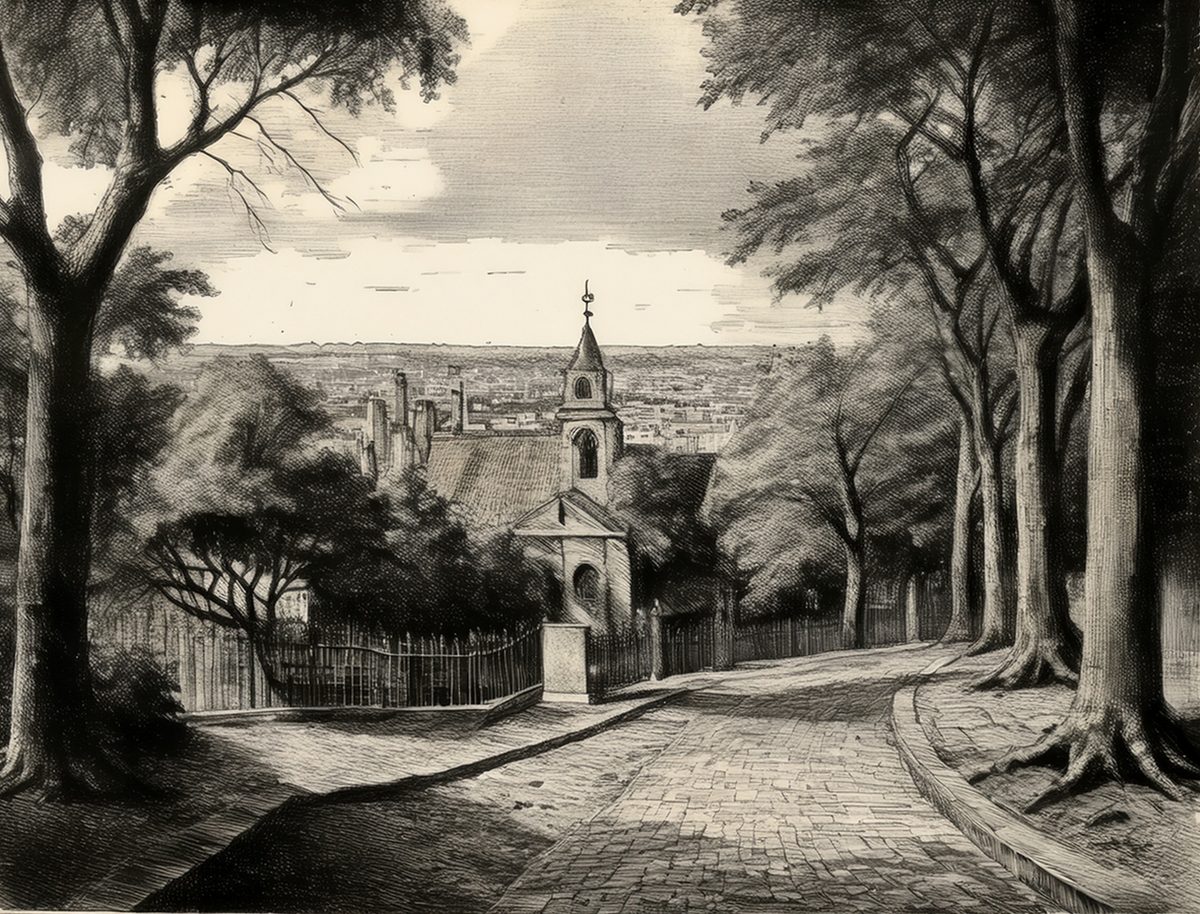
In the thirteenth century, the Archbishop of Paris owned a rural property on the Charonne hill, known as “champ l'évêque.” In 1626, the Jesuits of the Rue Saint-Antoine acquired it and named it “Mont-Louis” in honour of Louis XIII. It was there, in 1652, that the young Louis XIV watched the Battle of the Faubourg Saint-Antoine from the heights. From 1675, Father François d'Aix de La Chaise, confessor to the Sun King, spent his spiritual retreats there and had a château built for himself, complete with French-style gardens, funded by the sovereign. After the Jesuits' expulsion in 1762, the estate passed through several private hands. The château took on the popular name “Maison du Père La Chaise,” the gardens fell into neglect, and the hill awaited its fate.
On 10 January 1804, Nicolas Frochot, prefect of the Seine, bought Mont-Louis for a hundred and eighty thousand francs on behalf of the City of Paris. The architect Alexandre-Théodore Brongniart designed the site as an English-style funerary park — hilly, wooded, made for strolling — but Parisians refused to bury their dead there: no parish, no tradition, and a distance judged excessive. In 1817, Frochot pulled off a masterstroke: he had the supposed remains of Molière, La Fontaine, Héloïse and Abelard transferred to the cemetery in spectacular monuments. The move was an immediate success. By 1830, thirty-three thousand graves covered the slopes, and five successive extensions — in 1824, 1829, 1832, 1842 and 1850 — took the area from seventeen to forty-four hectares, spread across ninety-seven divisions.
In 1817, Frochot pulled off a masterstroke: he had the supposed remains of Molière, La Fontaine, Héloïse and Abelard transferred there. The cemetery became fashionable.
The nineteenth century inscribed France's political history into the cemetery's stone. In 1832, the cholera epidemic carried off the head of government Casimir Périer, whose monumental tomb faces that of General Foy, a rallying point for Bonapartists. In 1871, Père-Lachaise became the stage for the final fighting of the Paris Commune: on 28 May, a hundred and forty-seven Communards were shot against the boundary wall of Division 76, since known as the Communards' Wall. At the end of the century, the architect Jean Camille Formigé designed France's first crematorium, opened in 1889 in a neo-Byzantine style, while the columbarium was built in stages between 1896 and 1920. In 1899, Paul-Albert Bartholémé's Monument to the Dead, a monumental sculpture born of the artist's own grief, was listed as a historic monument as soon as it was unveiled.
Two world wars left their mark: bombing in the First World War damaged graves, and fifteen Deportation memorials were later erected along the Avenue Circulaire after 1945 — Auschwitz, Buchenwald, Ravensbrück, Mauthausen. In 1985, the City of Paris created, within the cemetery grounds, France's first Garden of Remembrance, intended for the scattering of ashes. Today, Père-Lachaise is at once a working cemetery — with close to ten thousand ceremonies a year — an open-air conservatory of sculpture with fourteen listed monuments, and the largest green space within central Paris, with more than four thousand trees and sixty-two recorded bird species. Three and a half million visitors cross paths there each year, making this former Jesuit estate the most visited necropolis in the world.
It takes its name from Father François d'Aix de La Chaise, confessor to Louis XIV, who had stayed on this estate as early as 1675. After the official opening of the “Cimetière de l'Est” in 1804, Parisians spontaneously renamed it after this popular Jesuit.
Read the article on Father La ChaiseOn 21 May 1804. Prefect Nicolas Frochot had bought the Mont-Louis estate on 10 January 1804 for 180,000 francs and entrusted its layout as an English-style park to the architect Alexandre-Théodore Brongniart.
Browse political figures at Père-LachaiseOn 28 May 1871, during the Bloody Week, 147 Communard fighters were shot against the boundary wall in Division 76. This wall, known as the Communards' Wall, became a site of memory and an annual political pilgrimage.
See the Communards' Wall pagePère-Lachaise holds around 70,000 plots across 44 hectares spread over 97 Divisions. A working cemetery with close to 10,000 ceremonies a year, it also receives 3.5 million visitors, making it the most visited necropolis in the world.
See practical information