 History
The First Burial
1804: the lilac child, Père-Lachaise's first breath.
History1804: the lilac child, Père-Lachaise's first breath.
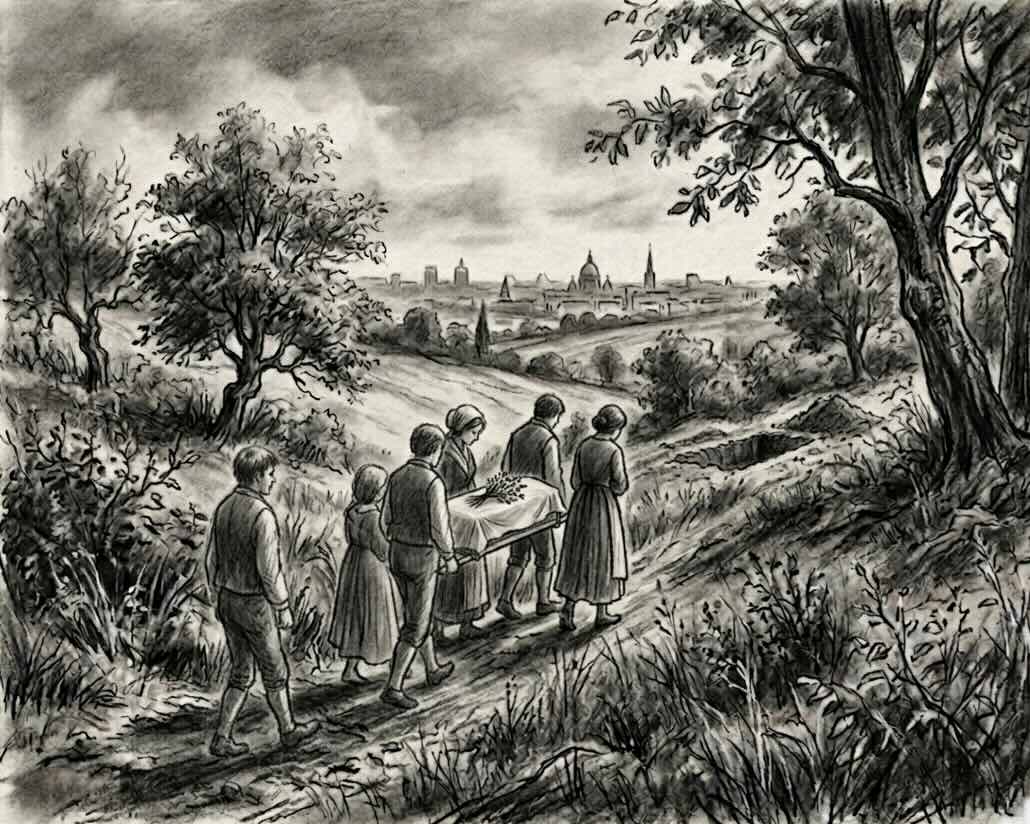
It is a tiny figure who, that morning, opens the march of history. It is 1 June 1804 — or the fifteenth of Prairial, Year XII, for those nostalgic for the revolutionary calendar — when a little girl named Adélaïde is laid in the ground on a hill east of Paris, a place whose name still means nothing to anyone. The cemetery of Père-Lachaise had opened its gates a few days earlier, on 21 May, but it was then no more than a ghost garden, with no paved paths, no monuments, no visitors. Nothing remained there but a former Jesuit park hastily converted into a necropolis, where lime and chestnut trees swayed their branches above ground still untouched by any grave.
And so Adélaïde Marie Antoinette Paillard de Villeneuve, cut down at the tender age when one has only just begun to make sense of the world's letters, became for ever the very first resident of this city of the dead. The daughter of a modest bell-ringer from the Faubourg Saint-Antoine, she did not belong to that lineage of men who buy themselves immortality in marble. She was granted, then, a temporary plot, right at the top of what would become Division 60, in the quiet shadow of the common graves. Much later, the curator Jules Moiroux would note, with sober melancholy: “The grave no longer exists.” The woman who inaugurated the world's most famous cemetery seems, it would appear, to have left no visible trace there.
Père-Lachaise's story begins with an erasure: that of a child whom two centuries of silence could not quite blot out.
And yet the family's fate offers a striking contrast. While the child's grave gradually faded beneath the wild grass, her younger brother went on to a brilliant career as a lawyer, defending figures as celebrated as Alphonse Karr and Victor Hugo. In an irony only time could arrange, he eventually acquired a perpetual chapel in Division 42 of the same cemetery, recently restored. So the Paillard de Villeneuve family returned to anchor themselves in stone, in the very place where their eldest had dissolved into oblivion.
The registers measure this coolness exactly. In 1804 the cemetery held only thirteen plots; forty-four the following year, forty-nine in 1806, sixty-two in 1807. Napoleon himself stepped in, ordering in 1806 the transfer of the remains of Louise de Lorraine, wife of Henri III, and of Admiral Bruix — the first illustrious guests of a hill that had asked for no such thing. The graft took hold slowly: eight hundred and thirty-three plots by 1812, then, after the great transfers of 1817, an avalanche — thirty-three thousand graves by 1830. The cemetery Paris had once shunned had become its most sought-after mirror.
It is hard to imagine that, in the spring of 1804, Père-Lachaise struggled to win Parisians over, who judged it too remote, too rural, and preferred the familiar squalor of the old parish graveyards. It would take spectacular schemes, and the transfer of the ashes of Molière, La Fontaine, and the eternal lovers Héloïse and Abelard, before the bourgeoisie finally agreed to buy their rest there. But before the poets and the lovers, the ground first welcomed the daughter of a bell-ringer. Père-Lachaise begins its story with an erasure: that of a child whom two centuries of silence could not entirely wipe away, since her name remains, unchanged and intact, on the very first entry register of the necropolis.
Adélaïde Marie Antoinette Paillard de Villeneuve, a five-year-old girl, daughter of a bell-ringer from the Faubourg Saint-Antoine. She was buried on 1 June 1804, eleven days after the cemetery opened.
See all the gravesNo, it is gone. Her family had taken only a temporary plot, in Division 60: the grave was reclaimed long ago, and nothing today marks the site of Père-Lachaise's first grave.
Plan your visitBecause it was seen as too far from the centre and too rural: Parisians were wary of this hillside planted at the edge of the city. The cemetery held only 13 plots by the end of 1804.
Who was Father La Chaise?Through a stroke of marketing genius: in 1817, the authorities transferred the remains of Molière and La Fontaine there with great ceremony, then those of Héloïse and Abelard. The effect was immediate — from 833 plots in 1812 to 33,000 in 1830.
The tomb of Héloïse and Abelard