 Curiosities
The Forgotten Mosque
Mainland France's first mosque, at the heart of the necropolis.
CuriositiesMainland France's first mosque, at the heart of the necropolis.
If there is one place where the souls of Paris whisper secrets that time seems to have crossed out, it is surely along the paths of Père-Lachaise. Visitors often go looking for the trace of a poet or an idol, but who would suspect that on this consecrated ground, long before the minarets of the fifth arrondissement rose towards the sky, a sanctuary to Islam already stood?
It all began with a diplomatic incident amid the gilt of the Second Empire, when a member of the Ottoman embassy died on Parisian soil. The Sublime Porte then demanded, with the solemnity due to its rank, a burial ground observing Muslim rites. Napoleon III, moved by genuine gratitude towards this decisive ally of the Crimean War, granted the request: by a decree of 1856, the Muslim enclosure was thus officially established at the heart of Division 85.
Seventy years before the Grand Mosque of Paris, a breath of the East already dwelt in this garden of stone.
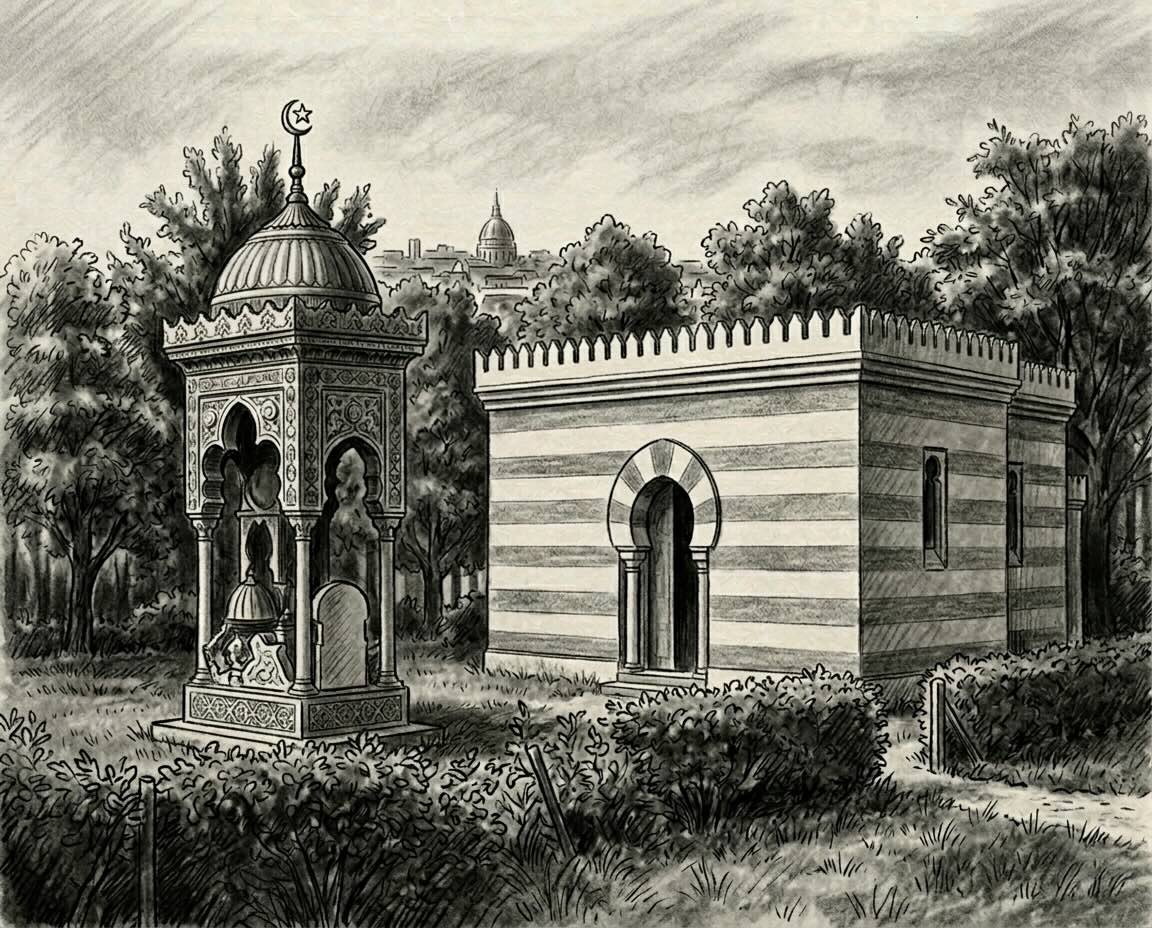
Opened in the early days of 1857, this mosque was more than a mere Orientalist folly; it was a genuine place of worship, housing beneath its modest roof a prayer room and a lavatorium for ritual ablutions. Though contemporary records describe a plain, almost fragile building, it nonetheless marked a major historical milestone, standing as mainland France's very first mosque since the Saracens withdrew, back in the distant tenth century.
Yet the building's fate proved as fleeting as a season of mist. Neglected by a Turkey that failed to maintain it, it slowly sank into disrepair, while political history sealed its fate. The 1881 law tore down the walls separating faiths, and the first stirrings of the Great War, straining diplomatic ties, finally reduced to dust what was already little more than a ruin.
But if the walls have collapsed, the ground has kept the memory of uncommon lives. One can still sense the presence of Malka Khachwar, Queen of Oudh, who came from the far reaches of India to plead her imperial cause before being struck down, dying only three days after reaching Paris. Further on, silence surrounds Sadegh Hedayat, the ill-fated writer whose Iranian pen broke in exile, and the Berber singer Idir, whose voice still carries beyond the cypresses.
Today, only a small, unassuming hedge still traces the outline of this forgotten space, where the absence of any commemorative plaque leaves a strange sense of oblivion hanging over it. And yet, seventy years before the Grand Mosque of Paris came into being, a breath of the East already dwelt in this garden of stone, reminding wandering visitors that the capital's history is also written in the silences of its cemeteries.
Yes. Opened in 1857 in the Muslim enclosure of Division 85, it was the first mosque in mainland France since the 10th century. It held a prayer room and a lavatorium for ablutions.
The history of Père-LachaiseNothing visible. The law of 1881, which banned denominational enclosures in cemeteries, followed by the First World War, sealed its disappearance. Division 85 retains no trace of the building.
Plan your visitA decree of 1856 created it at the request of the Ottoman embassy, to provide a fitting burial place for dignitaries of the Empire who died in Paris. The French capital was then home to many foreign delegations staying for long periods.
The twilight of the Queen of OudhDivision 85 holds Marcel Proust's black marble slab, where readers leave madeleines, and the grave of the Queen of Oudh, the cemetery's first Indian grave. It lies in the eastern part of Père-Lachaise.
Marcel Proust's grave