 Mysteries
The Dark Legends
Nocturnal rituals and occult folklore: two centuries of tales that haunt the paths.
MysteriesNocturnal rituals and occult folklore: two centuries of tales that haunt the paths.
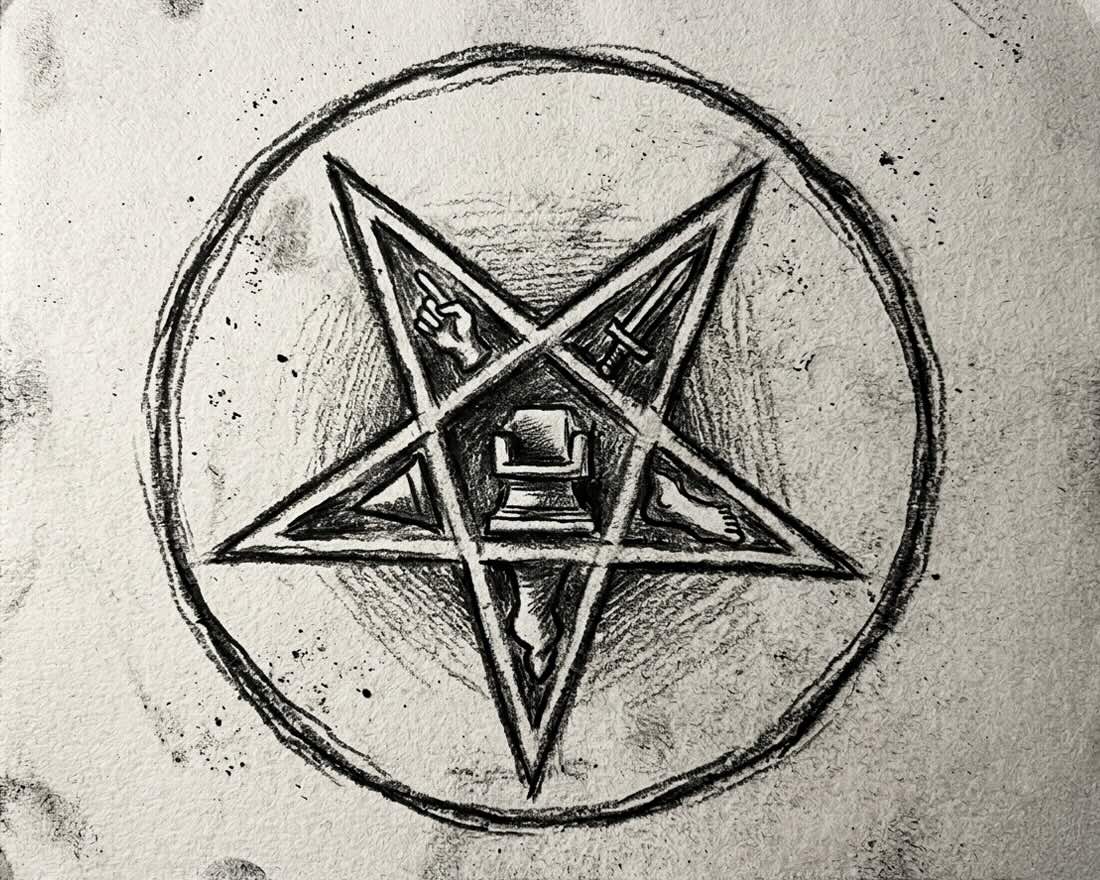
On a winter night in 1992, as the moon slipped behind a veil of cloud, the guardians of Père-Lachaise had their round interrupted by a sight that still haunts their memories today. Rounding a corner in Division 15, they came upon a circle of black candles tracing a short-lived pentagram, while chalk inscriptions invoked names decency forbids repeating. In the freezing air hung a smell of incense mixed with the metallic scent of animal blood, freezing the witnesses in stone-still shock. Far from an isolated act, this incident was merely the latest tremor of an occult folklore that, for over a century, has dug its stubborn roots into the soil of the world's most famous necropolis.
The historian Stéphanie Sauget, tracing the genealogy of these beliefs with great care, reminds us that they take root in the cemetery's very infancy. As early as the 1820s, the Paris press, hungry for mystery, was echoing tales of nocturnal apparitions gliding between the yews, reporting pale shapes and muffled groans rising from the vaults. These stories, serialised in widely read feuilletons, eventually planted in the popular imagination the unsettling idea that, once the gates close, Père-Lachaise no longer quite belongs to the realm of the living.
Once the gates close, Père-Lachaise no longer quite belongs to the realm of the living.
The phenomenon saw a dramatic resurgence at the dawn of the twenty-first century, driven by the rise of Goth culture. Defying the boundary walls, small groups seeking a thrill occupied the grounds to hold rituals somewhere between teenage rebellion and esoteric delirium. While Allan Kardec's grave, the father of Spiritism, became the stage for improvised séances, Oscar Wilde's was credited with unsuspected aphrodisiac powers. Stranger still, the slab of the mysterious “Crookes,” whose identity remains a puzzle, became the focus of a spontaneous cult mixing feverish prayers and cabalistic graffiti.
None of these beliefs, however, matches the longevity of the one surrounding Victor Noir's recumbent figure, in Division 92. This journalist, shot dead in 1870 by a cousin of Napoleon III, lies beneath a bronze of unsettling realism by the sculptor Jules Dalou — and rumour, said to have started as a student prank, holds that touching the statue brings luck in love to men and fertility to women. A century of devoted hands has polished its lips and the tips of its boots, which gleam golden amid the verdigris bronze. In 2004, Paris City Hall saw fit to fence off the grave against this “superstitious vandalism”; the outcry — including a self-styled “Liberation Front for the Recumbent Figure” — was such that the fence was removed a few months later. Legend had won out over the municipal order.
Yet this air of mystery was also carefully cultivated by those who held the keys. The curator Vincent de Langlade, through night tours in which he doled out a theatrical brand of dread, did much to thicken this mythological fog. In truth, every legend seems to mirror the anxieties of its age: whether it is the nineteenth-century dread of premature burial or the cut-price Satanism of the 1990s, the cemetery never manufactures its own ghosts. It is the living, tirelessly, who come to project their own, seeking in the silence of the dead some answer to their own turmoil.
No sighting has ever been documented, but the folklore is old: as early as the 1820s, the Paris press was reporting nighttime presences among the yew trees. Two centuries of stories have made the cemetery the most legend-laden place in Paris.
The history of Père-LachaiseThree, mainly: Allan Kardec's dolmen in Division 44, where visitors place a hand and make a wish; Victor Noir's recumbent effigy in Division 92, touched for fertility; and Oscar Wilde's sphinx in Division 89, long covered in kisses.
Allan Kardec's gravePut up in 2004 to protect the recumbent effigy from “superstitious vandalism,” it was taken down a few months later under public pressure. Visitors were determined to keep touching the bronze, polished in places to a gold shine.
Victor Noir's graveNo, the cemetery closes at nightfall and no night visits are allowed. Rituals occasionally discovered early in the morning — such as the chalk pentagram found in Division 15 in 1992 — are the result of trespassing.
Opening hours and access