Gérard Encausse, known as Papus, a doctor and occultist born in A Coruña in 1865, founder of the Martinist Order in 1891 and adviser to Tsar Nicholas II, rests in Division 93 of Père-Lachaise. He died on 25 October 1916 of tuberculosis contracted at the front, leaving a hundred and sixty published works.
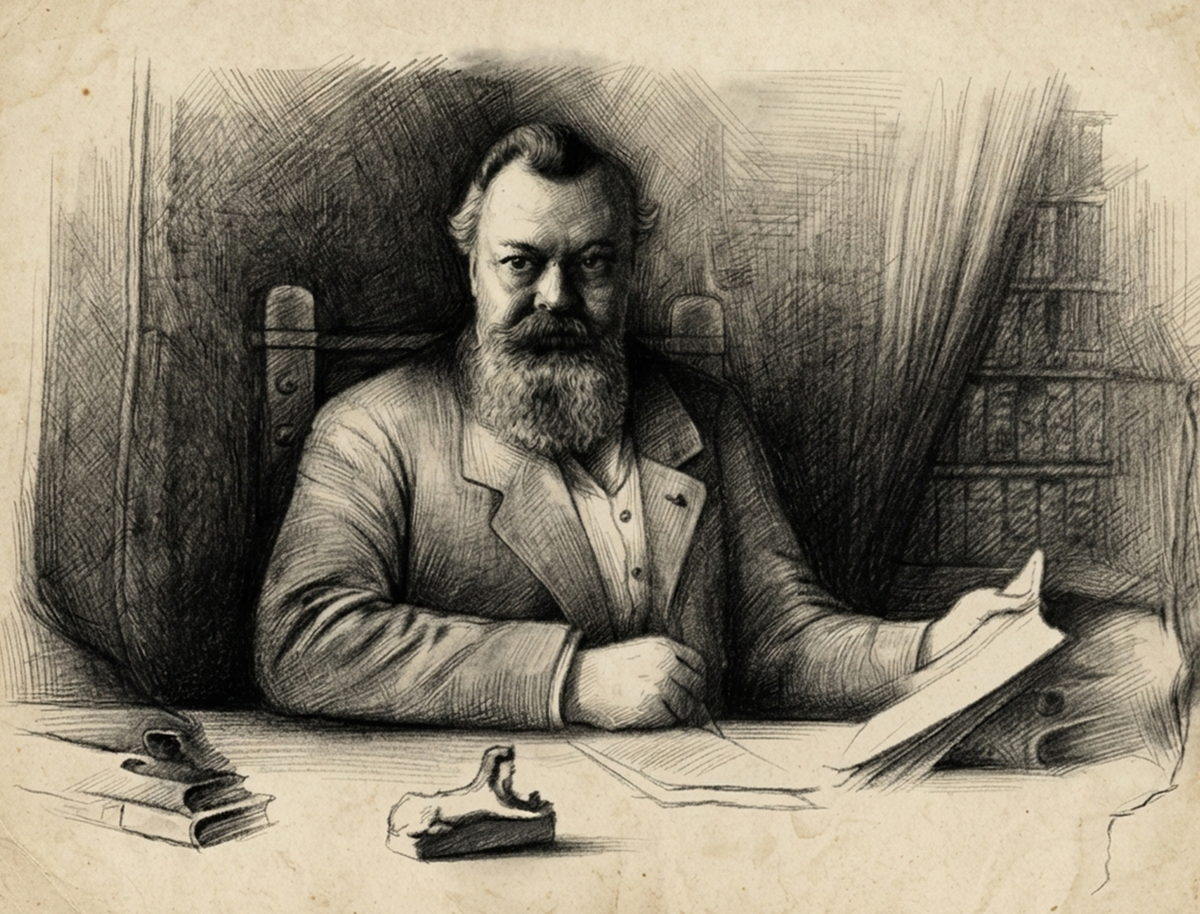
In Division 93 of Père-Lachaise, a grave bears the name of the Encausse family. A plaque reads: “Ici repose le corps de Gérard d'Encausse, Papus, médecin philosophe écrivain, grand maître de l'Ordre martiniste, désincarné le 25 octobre 1916 à l'âge de 51 ans” (“Here lies the body of Gérard d'Encausse, Papus, physician, philosopher, writer, grand master of the Martinist Order, disincarnated on 25 October 1916 at the age of 51”). The word “disincarnated” is no accident: for Martinists, death is a separation of soul from body, not an end. The man buried there is Gérard Anaclet Vincent Encausse, born on 13 July 1865 in A Coruña, Galicia, to a French chemist father and a Spanish mother. Having arrived in Paris at the age of four, young Gérard would go on to become one of the most influential figures in European occultism during the Belle Époque — a trained physician, a leading figure of Western esotericism, and the founder of an initiatory order still active today.
Papus — a pen name borrowed from the Nuctemeron of Apollonius of Tyana, a treatise on the spirits of the hours — earned his medical doctorate in Paris. But even before finishing his studies, Encausse had set himself the task of fighting the scientism of the age by spreading a doctrine drawn from the sources of Western esotericism. In 1888, Papus founded the journal L'Initiation. In 1889, he joined the Kabbalistic Order of the Rose-Croix, founded by Stanislas de Guaita and Joséphin Péladan. In 1891, Papus founded the Martinist Order with Augustin Chaboseau, in homage to Louis-Claude de Saint-Martin, the eighteenth-century “unknown philosopher”. The hermetic movement that formed around Papus drew in the brightest names of literary symbolism: Paul Adam, Maurice Barrès, Stanislas de Guaita, Victor-Émile Michelet. Papus published one hundred and sixty books, including the Traité élémentaire d'occultisme (“Elementary Treatise on Occultism”) in 1898.
In 1905, Nicholas II summoned Papus to Saint Petersburg. The occultist conjured the spirit of Tsar Alexander III, who foretold a terrible revolution. Before long, the arrival of Rasputin at court would displace the French doctor.
In the autumn of 1905, Tsar Nicholas II summoned Papus to Saint Petersburg. Russia was in the grip of revolutionary unrest. Nicholas II wanted advice — not from his ministers, but from a French occultist. During a séance, Papus is said to have summoned the spirit of Tsar Alexander III, Nicholas II's father, who had died in 1894. The dead tsar's spirit, Martinist tradition reports, urged repression and foretold a terrible revolution — one that “could only be averted for as long as Papus was alive”. The story, impossible to verify, is emblematic of the man: poised between medicine and spiritism, between science and mystification. But Rasputin's arrival at the Russian court pushed Papus out. The French physician returned to Paris. War broke out in 1914. Papus, chief physician of a front-line ambulance unit, devoted himself to his wounded.
Papus died on 25 October 1916 of pulmonary tuberculosis contracted in a front-line ambulance. Martinist tradition holds that as his coffin left the church of Notre-Dame-de-Lorette, a piece of the sculpted hand of an angel broke off the façade and landed at the centre of a wreath laid on the bier. Chance, or a sign — Papus, it is said, would not have drawn the distinction. The Encausse family grave in Division 93 of Père-Lachaise bears a plaque that reads: “Le véritable ésotérisme est la science des adaptations cardiaques” (“True esotericism is the science of the heart's adaptations”). The Martinist Order, founded in 1891, still exists. Papus's grave is one of the stops on Père-Lachaise's esoteric trail, alongside that of Allan Kardec, the founder of spiritism, and the graves adorned with Masonic symbols.
Papus is the pseudonym of Gérard Encausse (1865-1916), a physician and occultist born in A Coruña. Founder of the Martinist Order in 1891 and author of 160 esoteric works, Papus lies in Division 93 of Père-Lachaise under the Encausse family name.
Papus's grave (Gérard Encausse) lies in Division 93 of Père-Lachaise, under the Encausse family name. A plaque bears the inscription “grand master of the Martinist Order, discarnated 25 October 1916.”
Which esoteric graves can be visited at Père-Lachaise?
The esoteric trail at Père-Lachaise takes in the grave of Papus (Division 93), founder of the Martinist Order, that of Allan Kardec (Division 44), founder of Spiritism, and numerous graves adorned with Masonic symbols scattered across the cemetery.
The Martinist Order is an initiatory society founded in 1891 by Papus (Gérard Encausse) and Augustin Chaboseau, in homage to Louis-Claude de Saint-Martin, an 18th-century philosopher. The Martinist Order still exists today, and Papus lies in Division 93 of Père-Lachaise.
 Mysteries