In 1809, the mother of Antoine de Guillaume-Lagrange, a non-commissioned officer of the 16th Dragoons killed in Poland on 4 February 1807, had Père-Lachaise's first sculpture erected in Division 29. The cenotaph, the work of Godde and listed as a historic monument in 1983, gave its name to the Chemin du Dragon.
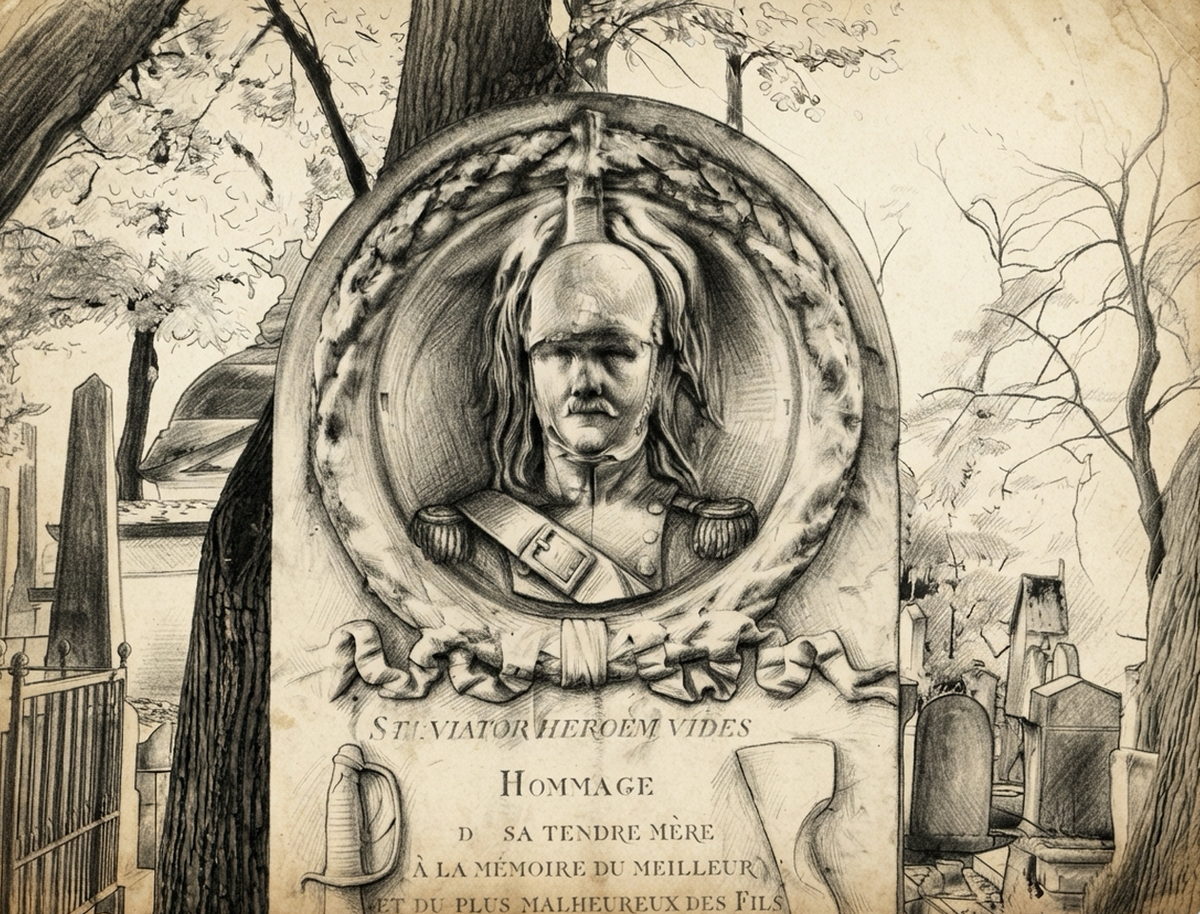
In Division 29 of Père-Lachaise, in a grove the cemetery's plans call the “Dragon Grove”, a stone stele bears a Latin inscription: “Sta viator, heroem vides” (“Stop, traveller, you see a hero”). The monument is a cenotaph: the hero's body is not there. Antoine de Guillaume-Lagrange, born in Orléans in 1782, a non-commissioned officer in the 16th Dragoon Regiment, died on 4 February 1807 on the plains of Poland, during the Prussian campaign. The monument, erected in 1809 by his mother, is the first sculpture at Père-Lachaise — the first tribute in stone in a cemetery that still had nothing but mass graves and modest tombs. The architect was Étienne-Hippolyte Godde, the very man who would go on to build the cemetery's main gate and chapel.
Guillaume-Lagrange belonged to an old noble family from the Limousin. Having joined the cavalry, the young non-commissioned officer fought in the campaigns of Napoleon's Empire: Austerlitz in 1805, Jena and Erfurt in 1806, Spandau. In February 1807, the 16th Dragoon Regiment was operating in Poland, amid the cold and mud of the eastern plains. On 4 February, at the entrance to a village, the way ahead was dangerous. A volunteer was called for. Guillaume-Lagrange stepped forward: “It is I.” He charged. A bullet pierced his heart. The non-commissioned officer was twenty-five years old. His last words, the epitaph carved on the back of the cenotaph reports, were: “Ma mère ! Ma pauvre mère !” (“Mother! My poor mother!”). The inscription, written by his mother herself, is one of the most heart-rending texts in all of Père-Lachaise — a dialogue between an inconsolable mother and a son who died on the “affreux déserts de Pologne” (“dreadful wastes of Poland”).
“Who wants to go first? — I do!” He rushed forward. A bullet pierced his heart. His last words were: “My mother! My poor mother!” Guillaume-Lagrange was twenty-five.
On 16 December 1808, Guillaume-Lagrange's mother obtained permission to build a cenotaph on a perpetual plot. The monument was erected in 1809. One face of the stele is adorned with a medallion showing the young dragoon's face in dress uniform, framed by a carved sabre and carbine. At the base stands a classical allegory of grief: a veiled woman kneeling beside a funerary urn, a bare child at her side. Under the Restoration — the monarchy restored after Napoleon's fall — the cenotaph became a gathering place for Bonapartists, who were no longer allowed to celebrate the Empire in public. The Dragon monument drew Napoleon's faithful like a magnet, to the point that the royal authorities altered the cemetery's paths and built around it to disperse the crowds. But the Empire's marshals, by choosing to be buried nearby, would go on to form the “Marshals' Square” around the Dragon.
The Dragon grave was listed as a historic monument by decree of 14 November 1983. The monument gave its name to the Dragon Grove and the Chemin du Dragon — the path along which also stands the grave of Hahnemann, the founder of homeopathy. Restored a few years ago, the stele has once again fallen into disrepair: the stone is crumbling, the medallion is fading, and the mother's inscription is becoming hard to read. The monument is maintained by the City of Paris. The visitor who stops in front of the Dragon grave finds the very first sculpted monument at Père-Lachaise, raised by a mother for a twenty-five-year-old son killed in Napoleon's cavalry — one that became, without ever meaning to, the rallying point for all those who refused to forget the Empire.
The Dragon's Tomb is the cenotaph of Antoine de Guillaume-Lagrange (1782-1807), a non-commissioned officer in the 16th Dragoon Regiment killed in Poland. Erected in 1809 in Division 29, the monument is the first sculpture at Père-Lachaise and has been a listed historic monument since 1983.
What is the oldest sculpted monument at Père-Lachaise?
The Dragon cenotaph, erected in 1809 in Division 29, is the first sculpture at Père-Lachaise. The monument, the work of architect Godde, was commissioned by the mother of the dragoon Guillaume-Lagrange, killed in Poland on 4 February 1807 at the age of 25.
Why is it called the Dragon path at Père-Lachaise?
The Dragon path takes its name from the cenotaph of the dragoon Guillaume-Lagrange, erected in 1809 in Division 29. The Dragon grove, recorded as early as 1836 in guides to the cemetery, is the first site of military remembrance at Père-Lachaise.
Père-Lachaise has 14 listed monuments and around 30,000 graves recorded on the historic monuments register. The Dragon's Tomb (1809), listed in 1983, is among the oldest. The cemetery is considered the largest open-air sculpture museum in France.
 Heritage