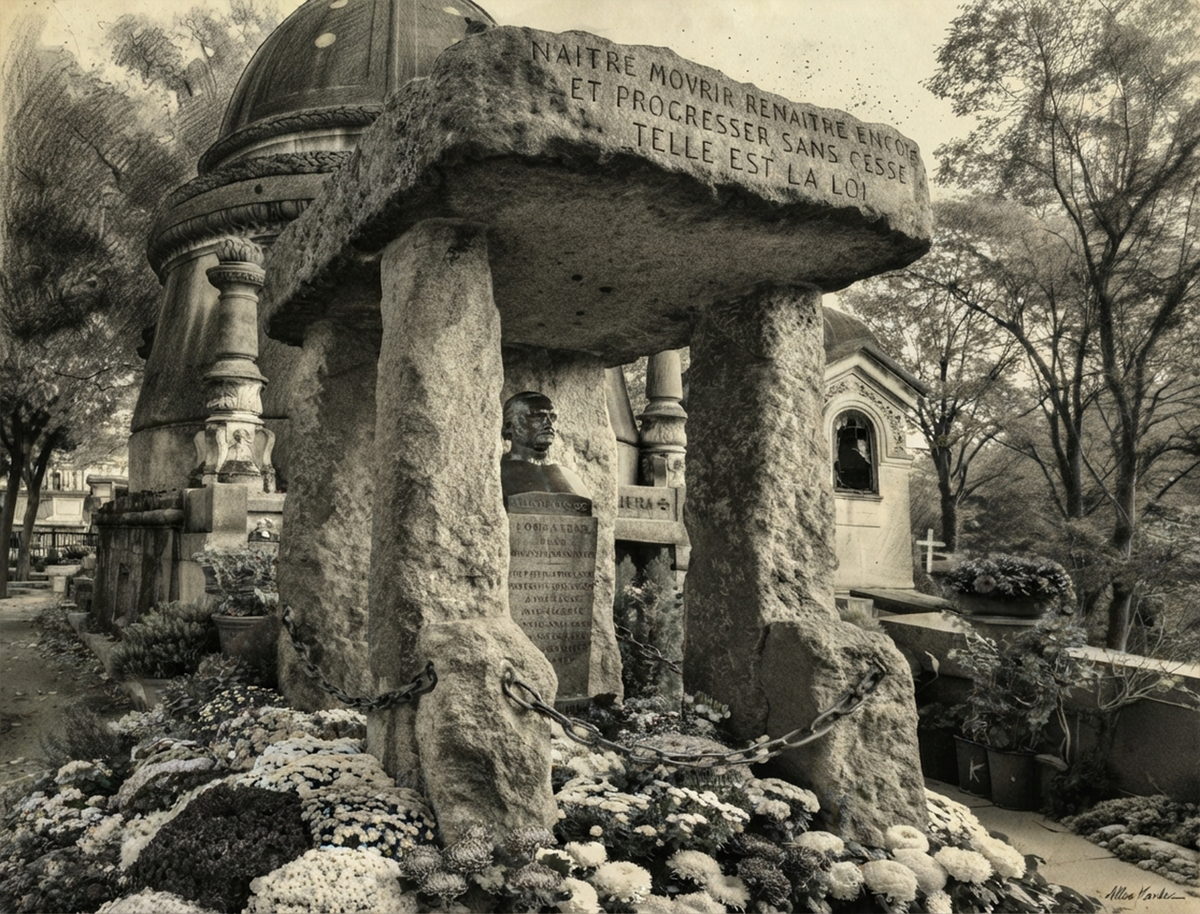
Allan Kardec, a teacher from Lyon who became the codifier of Spiritism in 1857, rests in Division 44 of Père-Lachaise beneath a granite dolmen covered in flowers. Twenty million Brazilians follow the Spiritist doctrine — Kardec's grave is the most flower-covered in the cemetery.
In Division 44 of Père-Lachaise, a grey granite dolmen rises above the ordinary chapels and headstones. The monument is covered in fresh flowers — every day of the year. A bronze bust, the work of Paul-Gabriel Capellaro, depicts a man with a broad forehead and a solemn gaze. The inscription on the dolmen's capstone sums up an entire doctrine: “Naître, mourir, renaître encore et progresser sans cesse, telle est la Loi” (“To be born, to die, to be reborn again, and to progress without ceasing — such is the Law”). The man is Hippolyte Léon Denizard Rivail, born on 3 October 1804 in Lyon, a teacher, textbook author and translator — and, at the age of fifty-one, under the pen name Allan Kardec, the founder of the spiritist doctrine. The dolmen was chosen in reference to a past life Kardec claimed to have lived as a Gaulish druid.
Rivail was first and foremost a teacher. Trained in Switzerland under Johann Heinrich Pestalozzi, the great educational reformer, the young man from Lyon moved to Paris in 1820 and opened a private school at 35 Rue de Sèvres. Rivail taught physics, chemistry and astronomy, published textbooks, and devised a method of mental arithmetic. In 1832, Rivail married Amélie Boudet, a schoolteacher and collaborator. His teaching career lasted thirty-five years. In 1855, at the age of fifty-one, the teacher was invited to observe séances of table-turning — a fashion that had come from the United States. Rivail brought to these phenomena the rigour of a man of science. On 18 April 1857, Rivail published Le Livre des Esprits (“The Spirits' Book”) under the pen name Allan Kardec. The book set out the spiritist doctrine: the soul survives the body, spirits communicate with the living through mediums, and reincarnation is a law of progress.
“To be born, to die, to be reborn again and to progress ceaselessly — such is the Law.” The inscription carved on Kardec's dolmen in Division 44 sums up Spiritist doctrine in a single sentence — and explains why the grave is never short of flowers.
Success was immediate. In 1858, Kardec founded the Revue Spirite and the Parisian Society for Spiritist Studies. Le Livre des Médiums (“The Mediums' Book”) appeared in 1861, and L'Évangile selon le spiritisme (“The Gospel According to Spiritism”) in 1864. Five books, published over seven years, made up the “spiritist codification”. Victor Hugo, Théophile Gautier and Arthur Conan Doyle all took an interest in the movement. Kardec died suddenly on 31 March 1869, at the age of sixty-four, of a ruptured aneurysm, leaving unfinished manuscripts that were published after his death. Spiritism reached Brazil at the end of the nineteenth century, where the doctrine took on a religious dimension absent from Kardec's original formulation. Today, more than twenty million Brazilians identify as Kardecist spiritists. Brazilian delegations visit the Division 44 grave throughout the year.
Allan Kardec's grave in Division 44 of Père-Lachaise is the most flower-covered in the cemetery — a title long held by the grave of Frédéric Chopin. Visitors come from Brazil, Portugal and Latin America. Some place a hand on the bronze bust and make a wish — a practice Kardec never taught, but one that popular tradition has established. The granite dolmen, the most archaic form of funerary monument, is also one of the most photographed graves at Père-Lachaise. The Revue Spirite, founded by Kardec in 1858, is still published today. The teacher from Lyon who once taught chemistry and astronomy at 35 Rue de Sèvres founded, at the age of fifty-one, a doctrine that now counts millions of followers across three continents — one whose centre of gravity is no longer Paris, but São Paulo.
Allan Kardec's grave stands in Division 44 of Père-Lachaise, beneath a grey granite dolmen topped with a bronze bust by sculptor Paul-Gabriel Capellaro. The grave is the most flower-covered in the cemetery and draws visitors from around the world, notably from Brazil.
Allan Kardec (1804-1869), born Hippolyte Rivail in Lyon, was a teacher who became the founder of Spiritism. Kardec published The Spirits' Book in 1857 and codified Spiritist doctrine across 5 works. More than 20 million Brazilians identify as Kardecist Spiritists.
Allan Kardec's grave in Division 44 is the most flower-covered at Père-Lachaise thanks to the millions of Spiritists worldwide, notably in Brazil. Popular tradition holds that the dolmen grants the wishes of those who touch the bronze bust.
The granite dolmen of Allan Kardec in Division 44 refers to a past life Kardec claimed to have lived as a Gaulish druid. The pseudonym “Allan Kardec” is said to be the name of that druid from an earlier incarnation.
 Mysteries