 Symbols
The Freemasons' Whisper
Squares, compasses and acacias: the secret alphabet carved in stone.
SymbolsSquares, compasses and acacias: the secret alphabet carved in stone.
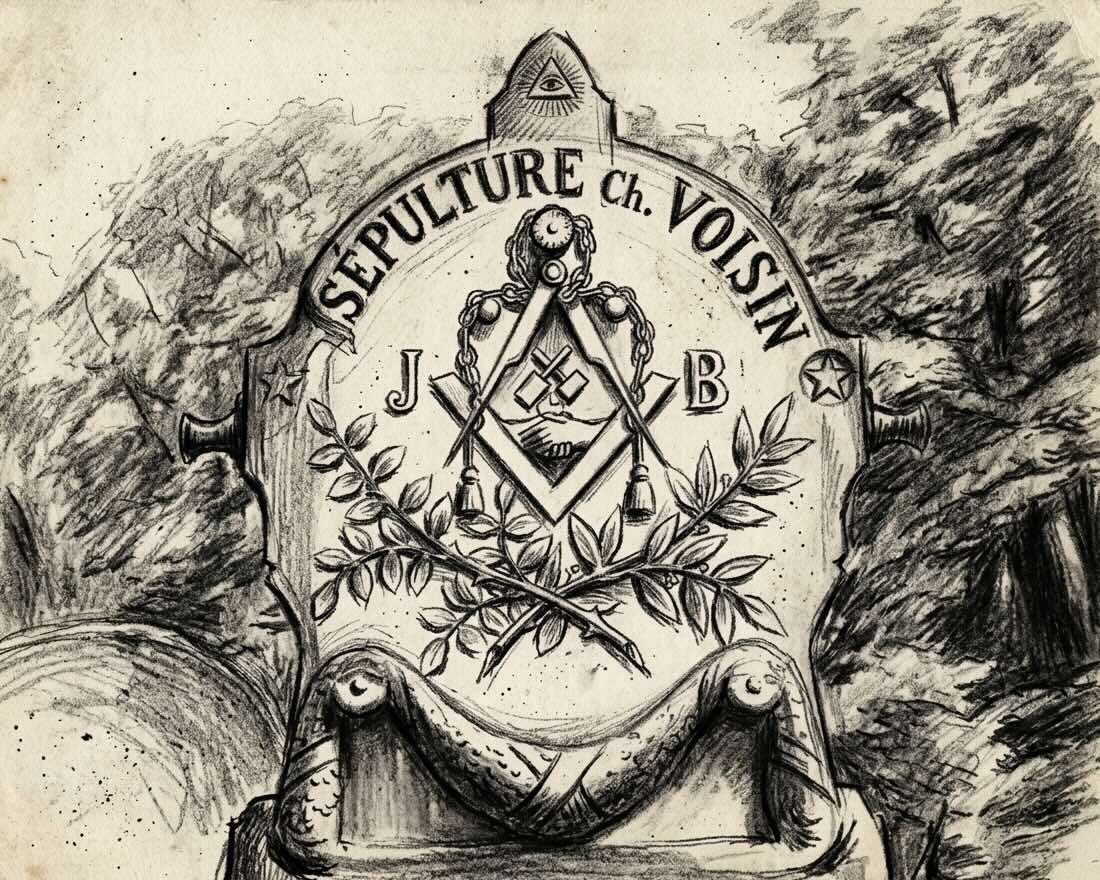
Whether they were influential ministers, marshals of the Empire, visionary scholars, ill-fated poets or humble craftsmen, they shared in life a bond that death did not sever; and yet, within the necropolis, they reveal themselves to the passer-by only through a silent language the uninitiated cannot read. At Père-Lachaise, hundreds of graves bear, carved with calculated discretion, the age-old symbols of Freemasonry. Here, a half-open compass seems to measure eternity; there, a set square recalls the rectitude of the just, while elsewhere two hands clasp at a precise angle, or a sprig of acacia, a sign of immortality, slips between the lines of an epitaph. So many clues that, for the initiated, turn a simple stroll into a coded reading of French history.
This invisible presence takes root at the very origins of the cemetery, for when the prefect Frochot opened the hill in 1804, French Freemasonry was living through its golden age. While Voltaire — whose grand initiation into the Lodge of the Nine Sisters once caused a great stir — now rests beneath the vaults of the Panthéon, his brothers of the Order populate the shaded paths of eastern Paris by the dozen. Marshal Masséna, a worshipful master of his lodge, watches over Division 28, while the composer Méhul, whose eternal resting place proudly bears the tools of the builder, lies a few steps from Cherubini. The same holds for Doctor Guillotin, initiated in 1765 into La Parfaite Union in Angoulême, whose gravestone seems to have faded with time, as though to draw one final veil over the secret of his membership.
For the initiated, a simple stroll becomes a coded reading of French history.
It must be said that the place itself is the work of an initiate: Alexandre-Théodore Brongniart, the architect to whom the prefect Frochot entrusted the cemetery's design in 1804, belonged to Freemasonry. The attentive walker will notice an Avenue des Acacias crossing the heights — the very tree that, in Masonic tradition, marks the grave of Hiram and promises immortality. A caution is needed, though, for the amateur decoder: the obelisks and pyramids bristling across the divisions are not signs of membership, but simply the century's taste for Egyptian style. As connoisseurs point out, there is no such thing as a Masonic symbol in itself — only a Masonic reading of symbols.
What is most fascinating in this hidden geography is the counter-history the stone quietly traces. While official guides classify residents by fame or fortune, Martine Bayard's research reveals an underground network of brotherhoods running unbroken through the centuries. Whole lodges seem to have arranged to meet beyond the veil: revolutionaries of 1789 lie alongside insurgents of the Commune, and fervent abolitionists rest beside builders of empire, all bound by the invisible thread of the apron and the strength of the oath.
What strikes the mind is the persistence of this sacred gesture across the ages. Even at the dawn of the third millennium, families still have the set square and compass carved into the granite walls of the columbarium, carrying a ritual born three centuries earlier into the stark modernity of the crematorium. Père-Lachaise, which many think they know through its famous poets and rock stars, thus conceals within the very grain of its limestone a parallel alphabet, an eternal murmur between initiates that only a practised eye can still make out.
By four recurring symbols: the interlocking square and compass, the acacia branch, and two clasped hands. Hundreds of graves in the cemetery bear them, discreetly carved on the monument's pediment or base.
Spirituality & mysteriesMarshal Masséna, in Division 28, the composer Étienne-Nicolas Méhul, and Doctor Joseph-Ignace Guillotin, initiated in 1765. The cemetery has one of the highest concentrations of Masonic graves in France.
See all the gravesImmortality and rebirth, in Masonic tradition. The motif is so tied to the place that an Avenue des Acacias runs through the high ground of Père-Lachaise, in the eastern part of the cemetery.
The funerary art of Père-LachaiseYes. Alexandre-Théodore Brongniart, who designed the cemetery in 1804, belonged to Freemasonry. He also designed the Greffulhe chapel, in Division 43, the only one he completed before his death in 1813.
The first chapel