Gioacchino Rossini died at Passy on 13 November 1868. A funeral procession crossed the whole of Paris to Père-Lachaise, Division 4. Nineteen years later, on 1 May 1887, his remains were exhumed and repatriated to Florence, to the Basilica of Santa Croce. The chapel at Père-Lachaise is a cenotaph.
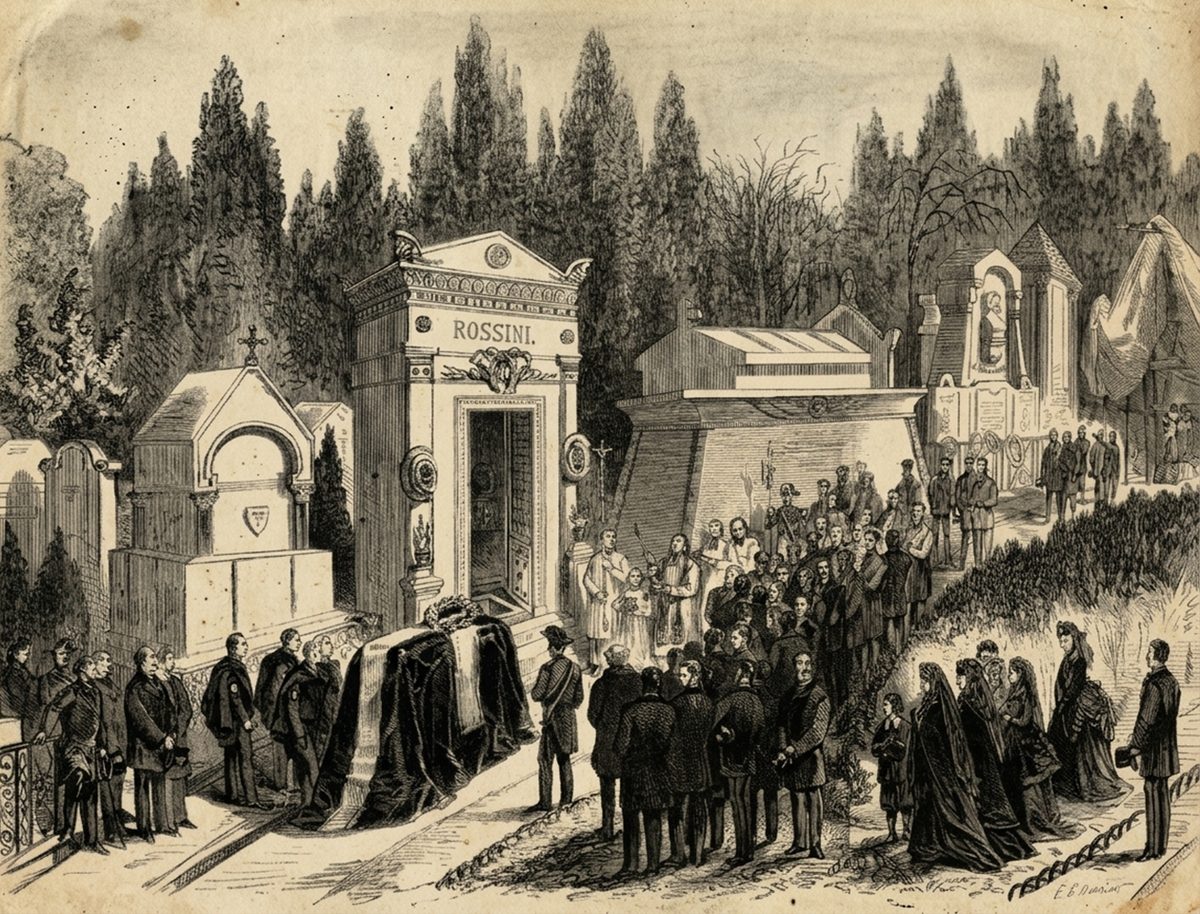
On Friday 13 November 1868, shortly before midnight, Gioacchino Rossini died at his house in Passy, carried off by a chronic bronchial catarrh that had plagued him for years. The composer was seventy-six. Since the Revolution of 1830 and the loss of Charles X's patronage, Rossini had lived in a long, semi-retirement — productive but discreet, marked by the Stabat Mater in 1841 and the Petite Messe solennelle in 1864. On 21 November, a grand funeral ceremony was held at the Church of the Trinité. A procession then crossed the whole of Paris to reach Père-Lachaise. Engravings of the day show a dense crowd packed along the boulevards. At the cemetery, after a final speech, Rossini was laid in temporary vault number four in Division 4, while a funerary chapel was completed.
The chapel was built on a plot acquired by Marietta Alboni-Zieger, the celebrated Italian contralto who had settled in Paris and was a friend of the composer. Rossini's body was solemnly moved there within the cemetery. But a reunified Italy demanded the return of its national hero. Rossini had left Italy for France in 1848 and had never gone back. Diplomatic negotiations succeeded: on 1 May 1887, the remains were exhumed at Père-Lachaise in the presence of official witnesses. Photographs published in Le Monde Illustré show that some of those present were troubled by the smell. The coffin was taken to the crypt of the Madeleine, where it awaited its final journey to Florence.
The funeral procession set out from the Church of the Trinité, went down the grands boulevards and crossed the whole of Paris to Père-Lachaise. Engravings from the period show a considerable crowd massed along the route.
Rossini's repatriation was both a diplomatic and a cultural event. The body left Paris and crossed Europe to reach Florence, where a fresh ceremony was held. Rossini was reinterred in the basilica of Santa Croce, alongside Michelangelo, Galileo and Machiavelli — Italy's pantheon of great men. The Florentine monument, a neoclassical marble cenotaph by Giuseppe Cassioli, was unveiled in 1900. Italy had at last recovered the man Verdi called “the glory and pride of the homeland”. Rossini thus joined Dante, whose body had been the object of a similar dispute between Ravenna and Florence — for a nineteenth-century nation, a great man's remains were worth a treaty.
At Père-Lachaise, Rossini's funerary chapel still stands in Division 4, on Chemin Molière. The monument is intact: a plain chapel with a classical pediment, bearing the composer's name. But the chapel is empty — a cenotaph since 1887. A visitor who stops before Rossini's tomb at Père-Lachaise is standing before a monument that held the composer's body for nineteen years before it was returned to Italy. The contralto Marietta Alboni, who had funded the chapel, also rests at Père-Lachaise, in Division 67. Rossini's journey through Père-Lachaise sums up a phenomenon typical of the nineteenth century: the cemetery as a temporary stop in the posthumous geography of great men, where the adopted nation and the homeland fought over the privilege of hosting illustrious remains.
Rossini's funerary chapel lies in Division 4 at Père-Lachaise, on Chemin Molière. The monument has been a cenotaph since 1887: the composer's remains were repatriated to Florence, to the Basilica of Santa Croce, at the request of a reunified Italy.
A reunified Italy demanded the composer's return, regarding him as a national hero. Rossini's remains were exhumed from Père-Lachaise on 1 May 1887 and transferred to Florence, to the Basilica of Santa Croce, the pantheon of great Italians.
Which celebrities rest in Division 4 at Père-Lachaise?
Division 4 at Père-Lachaise holds Rossini's cenotaph, built in 1868 and empty since 1887, President Félix Faure, who died in 1899, and Sergeant Hoff, a hero of 1870. The Division is among the oldest and most visited in the cemetery.
Which famous composers are buried at Père-Lachaise?
Père-Lachaise holds the graves of Frédéric Chopin (Division 11), Georges Bizet (Division 68) and Luigi Cherubini (Division 11), and Rossini's cenotaph, empty since 1887, in Division 4. The columbarium keeps the ashes of Maria Callas.
 History