Père-Lachaise is the largest green space within central Paris: forty-four hectares, four thousand one hundred and thirty-four trees of eighty species, two hundred and twenty wild plant species and a hundred and forty animal species.
The largest green space within Paris proper is not a park. It is a cemetery. Père-Lachaise covers forty-four hectares in the twentieth arrondissement — more than the Parc des Buttes-Chaumont, more than the Parc Montsouris, more than the Luxembourg Gardens. The grounds are planted with four thousand, one hundred and thirty-four trees belonging to eighty different species: plane trees, maples, limes, chestnuts, cedars of Lebanon, ginkgos, yews, cypresses. More than two hundred and twenty wild plant species grow between the graves. One hundred and forty animal species live on the site. Père-Lachaise is a living paradox: a place dedicated to the dead that has become, without meaning to, one of the richest reservoirs of biodiversity in the capital.
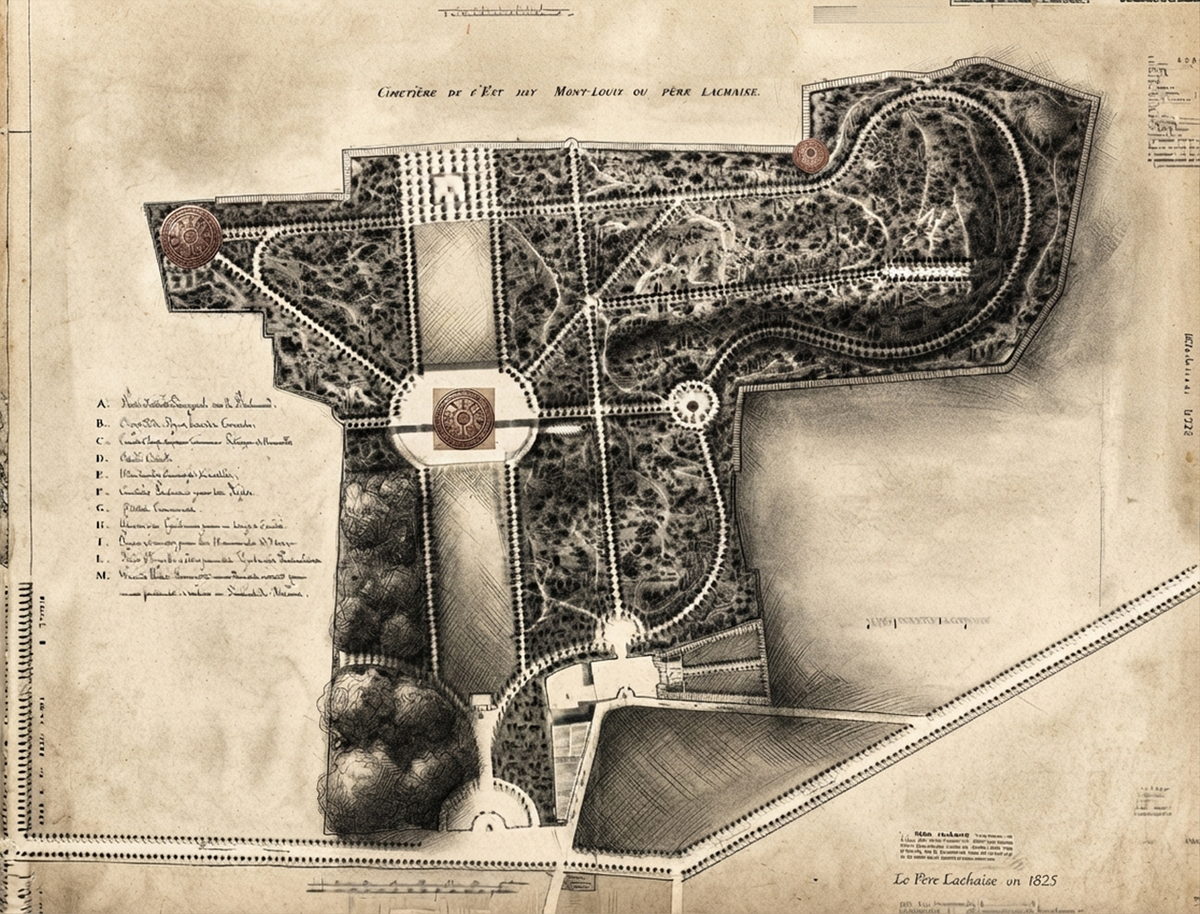
Père-Lachaise was designed as a garden. In 1803, the architect Alexandre-Théodore Brongniart laid out an English-style garden cemetery — winding paths, lawns, clumps of trees, vistas — at a time when Paris had almost no public gardens at all. When the cemetery opened on 1 June 1804, Parisians went there as much to stroll as to mourn. Père-Lachaise was the forerunner of Parisian parks: it would take until the Second Empire for Napoleon III to create the Buttes-Chaumont and Montsouris. But the cemetery's success turned the garden into a saturated necropolis: ninety-six thousand, six hundred plots, seventy thousand graves, whole divisions covered in stone and granite. The greenery retreated for a century and a half.
Père-Lachaise is larger than the Parc des Buttes-Chaumont, the Parc Montsouris and the Jardin du Luxembourg combined. The difference is that ninety-six thousand six hundred plots cover the ground.
The return of plant life to Père-Lachaise dates from 2015, when the cemetery stopped all chemical treatment. In ten years, the transformation has been dramatic. The avenues have been grassed over. The paths between the graves have been turfed. Wild plants — violets, stonecrop, ivy-leaved toadflax, wall lettuce — have colonised the slabs, the joints, the wrought-iron railings. Wild orchids have appeared in summer. The return of plants brought the return of insects, then of birds — sixty-two species — then of birds of prey — the tawny owl, the Eurasian sparrowhawk — then of mammals — foxes, stone martens, hedgehogs, seven species of bat. The Petite Ceinture, the disused railway line running alongside the cemetery's eastern edge, forms an ecological corridor linking Père-Lachaise to the rest of Paris's green network.
A visitor entering through the main gate of Père-Lachaise, Godde's hemicycle built in 1822, walks up an avenue lined with century-old plane trees. To left and right, graves vanish beneath the foliage. In summer, the canopy grows so dense that no sunlight gets through. The noise of traffic on Boulevard de Ménilmontant fades away within twenty metres. Birds sing. A Eurasian jay calls from the branches. Père-Lachaise is open every day and admission is free. The cemetery welcomes three and a half million visitors a year — grieving families, tourists, taphophiles, photographers, Sunday-morning joggers. Nine of the cemetery's trees are listed as remarkable by the City of Paris. The oldest, a Montpellier maple in Division 77, was planted in 1833. Père-Lachaise is a cemetery, an open-air sculpture museum, a zoological park and an arboretum — all of these at once, across forty-four hectares, in the heart of Paris.
Is Père-Lachaise the largest green space in Paris?
Yes. Père-Lachaise is the largest green space within inner Paris, at 44 hectares — more than the Buttes-Chaumont (25 ha), Montsouris (15 ha) or the Luxembourg Gardens (23 ha). The cemetery has 4,134 trees and 220 wild plant species.
Père-Lachaise has 4,134 trees of 80 different species across 44 hectares. 9 trees are listed as remarkable by the City of Paris. The oldest is a Montpellier maple planted in 1833 in Division 77. The tallest stands 26 metres in Division 45.
Both. Père-Lachaise was designed in 1803 as a garden cemetery by Brongniart, a forerunner of Parisian parks. The cemetery is also the largest green space within inner Paris and a haven for biodiversity, with 140 animal species.
Yes. Père-Lachaise is open every day and admission is free. The cemetery welcomes 3.5 million visitors a year. Opening hours vary by season. The cemetery closes at 6pm and has no night-time lighting.
 Society