Félix Faure, seventh president of the Third Republic, died at the Élysée Palace on 16 February 1899 in circumstances that became famous. The state funeral, on 23 February, was marked by Paul Déroulède's attempted coup. The president rests in Division 4 of Père-Lachaise.
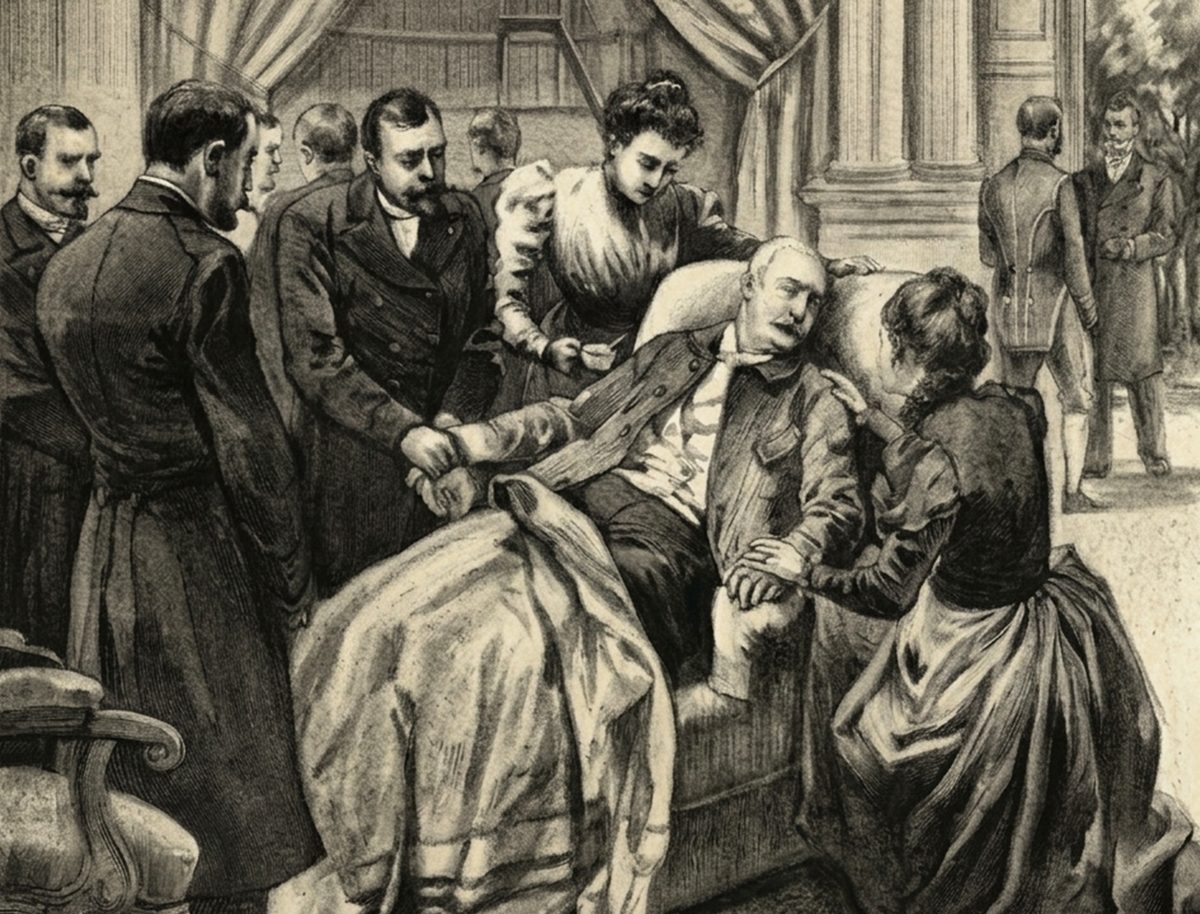
On 16 February 1899, at around six in the evening, President Félix Faure suffered a stroke in his office at the Élysée. He died a few hours later, at fifty-eight. What sealed the event's place in history was the presence, at the moment of his collapse, of Marguerite Steinheil — “Meg” — wife of the painter Adolphe Steinheil, whom the president had been receiving regularly since 1897. The press of the day, muzzled by the law but inventive with euphemism, spread the line attributed to Clemenceau: Il se croyait César, il ne fut que Pompée (“He believed himself Caesar; he turned out to be only Pompey”). Félix Faure remains the only president of the French Republic to have died at the Élysée while in office. The context was explosive: the Dreyfus Affair was dividing the country, the army, the press and Parliament.
The state funeral took place on 23 February 1899. The religious ceremony was held at Notre-Dame. The procession crossed Paris under military escort: cadets from Polytechnique and Saint-Cyr marched at the head, the state bodies following. The crowd was immense. But the day turned on the way back from the cemetery. Paul Déroulède, a nationalist deputy and president of the Ligue des Patriotes, tried to lead General Roget and his troops towards the Élysée to overthrow the Republic. The attempted coup collapsed miserably: Roget refused to follow, and Déroulède was arrested. The episode, known as the “23 February coup attempt”, turned a presidential funeral into a political crisis. Déroulède would be sentenced to ten years' banishment by the Senate's High Court.
“He thought himself Caesar; he was only Pompey.” Clemenceau's quip, playing on the double meaning of “Pompée” — pomp and Pompey — is the only thing posterity has kept from seven years of presidency.
Marguerite Steinheil did not vanish from history with Félix Faure's death. In 1908, the painter's wife was accused of murdering her husband Adolphe Steinheil and her own mother, both found strangled in their house on Impasse Ronsin. The Steinheil trial, in 1909, was one of the most famous of the Belle Époque. Meg was acquitted, left France and rebuilt her life in England under an assumed name. Félix Faure's death, meanwhile, fed a stubborn legend: that of a president who died in épectase — a medical term for death during intercourse that twentieth-century chroniclers preferred to cruder words. Clemenceau's quip, the Steinheil scandal and the circumstances of his death eclipsed everything else — seven years as president, during which Faure had received Tsar Nicholas II in Paris and cemented the Franco-Russian alliance.
Félix Faure's grave lies in Division 4 of Père-Lachaise, not far from Rossini's cenotaph. The funerary monument is a bronze recumbent effigy showing the president draped in the tricolour, laid out on a ceremonial bier — one of the few presidential effigies of this kind in a Parisian cemetery. The grave is plain and seldom visited. When Père-Lachaise's tourist guides mention Félix Faure at all, it is for Clemenceau's quip and the circumstances of his death — never for the coup attempt that took place on the very day of his funeral. Yet a visitor who stops before the bronze effigy in Division 4 is standing before the summary of a day when the Republic very nearly toppled over a coffin.
Félix Faure's grave lies in Division 4 at Père-Lachaise. The monument is a bronze recumbent effigy showing the president draped in the tricolour, laid out in state. The grave is rarely visited despite the notoriety of the president's death.
Félix Faure died on 16 February 1899 at the Élysée Palace of a cerebral haemorrhage, in the presence of Marguerite Steinheil. Clemenceau is said to have remarked: “He wanted to be Caesar, but he was only Pompey.” Faure is the only president to have died in office at the Élysée.
Who attempted a coup during Félix Faure's funeral?
On 23 February 1899, the deputy Paul Déroulède, president of the Ligue des Patriotes, a nationalist veterans' league, tried to lead General Roget towards the Élysée during Félix Faure's funeral. The attempted coup failed, and the Senate sentenced Déroulède to banishment.
Which presidents of the Republic rest at Père-Lachaise?
Félix Faure (1841-1899) is the only French president of the Republic buried at Père-Lachaise, in Division 4. Adolphe Thiers, head of the executive from 1871 to 1873, also rests at Père-Lachaise, in Division 55.
 History