Between 1824 and 1850, five successive extensions took Père-Lachaise from seventeen to forty-four hectares. The last, on the Charonne plateau, turned the romantic garden into a grid-planned city of the dead, with paved streets, pavements and fountains.
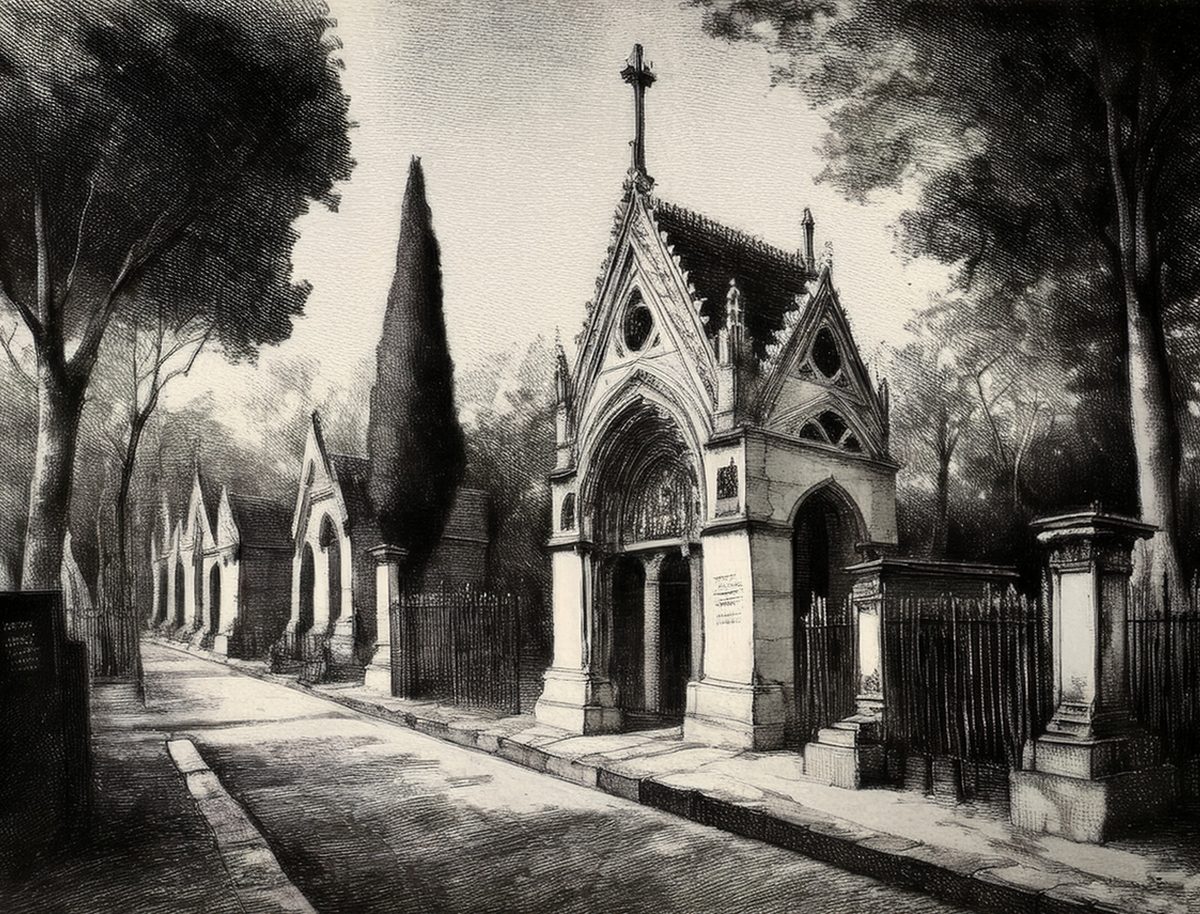
Anyone who walks the Chemin Denon today, in Division 48, suddenly steps into another world. Behind them, the curving paths of the old cemetery follow the slope of the hill, graves nestle among the trees, and light filters through the canopy. Ahead, the Charonne plateau opens out like a chessboard: straight avenues, stone pavements, rows of chapels lined up like Haussmann-era apartment blocks. This contrast between the romantic garden on the hillside and the rational grid of the plateau is no accident. It is the result of five successive extensions, spread between 1824 and 1850, which took Père-Lachaise from seventeen hectares and fifty-eight ares to forty-three hectares and ninety-three ares — more than double its original size. The hill was swallowed by the city of the dead.
The first extension took place in 1824, under the Restoration. The success of perpetual plots, up from forty-nine in 1806 to thirty-three thousand by 1830, made it necessary to push the cemetery's boundaries north and east, onto land at Ménilmontant. That same year, the architect Étienne-Hippolyte Godde completed the semicircular entrance gate — two neoclassical pylons framing a monumental grille, decorated with winged hourglasses and inverted torches. A year earlier, in 1823, Godde had finished the chapel replacing Brongniart's never-built pyramid at the top of the hill. Under Charles X, a second extension followed in 1829. New divisions were laid out to the south-east, along the Rue des Partants, a former path that had separated Mont-Louis from the village of Ménilmontant. The cemetery absorbed the orchards and vineyards bordering it. But demand for plots still outstripped supply: the Parisian bourgeoisie wanted its own chapel at Père-Lachaise, alongside the Empire's generals and the first literary celebrities.
By 1830, there were thirty-three thousand graves. The cemetery was running out of space: it had to expand or close.
The third extension came in 1832, against the backdrop of a public-health disaster. On 26 March, the first case of cholera was reported in Paris. Within six months, the epidemic killed eighteen thousand Parisians. Père-Lachaise's common graves overflowed. The head of government Casimir Périer, who had visited the sick at the Hôtel-Dieu, died on 16 May; his monument, topped with a statue by Jean-Pierre Cortot, would be erected in 1837 on the cemetery's central roundabout. That same year saw the deaths of the Egyptologist Jean-François Champollion, the palaeontologist Georges Cuvier, and the economist Jean-Baptiste Say. The influx of dead demanded an urgent extension. The cemetery gained new ground to the east, but densification had already begun: Brongniart's winding paths were now lined with tight rows of tombs and chapels. The original garden model, with its common graves and scattered burials, was gradually giving way to that of a “city of the dead.”
The fourth extension, in 1842, extended the cemetery southward. The fifth and last, in 1850, was by far the largest: seventeen hectares in a single block, on the Charonne plateau. This extension permanently changed the character of Père-Lachaise. The hillside kept its winding paths, its groves and its picturesque atmosphere — the spirit of the garden cemetery Brongniart had intended. The plateau, by contrast, took on an urban grid: parallel avenues, right-angled junctions, cobblestones, pavements, benches and fountains. Its divisions were numbered continuously, up to the ninety-seventh. In 1856, a Muslim enclosure was created in Division 85, at the request of the Ottoman Empire. An even more ambitious scheme was considered at the time of the 1850 extension: to exploit the underground gypsum quarries stretching beneath the plateau as far as the Thiers fortifications, and turn them into catacombs. The 1859 annexation, which brought the communes of Belleville and Ménilmontant into Paris and banned the opening of quarries within the capital, put an end to the plan.
By 1850, Père-Lachaise had doubled its original size and held seventy-five thousand three hundred and ninety-three graves. The 1859 annexation brought the cemetery within the city — though it had been founded outside its walls. Before the great parks of the Second Empire were created — the Bois de Boulogne, the Bois de Vincennes, the Parc des Buttes-Chaumont — Père-Lachaise was the capital's largest green space. There would be no further extension after 1850: from then on, the cemetery kept receiving its dead through the reclaiming of abandoned plots, the densification of existing divisions, and the building of the columbarium in 1896. The duality born of the five extensions remains Père-Lachaise's most visible feature: on one side, the romantic garden where time stands still; on the other, the funerary city of ranked chapels — two visions of death, two eras, two landscapes separated by a single path and half a century.
Père-Lachaise grew through five extensions between 1824 and 1850, from 17.58 to 43.93 hectares. The last, in 1850, added 17 hectares on the Charonne plateau, laying out the urban grid still visible today.
Why does Père-Lachaise have two distinct atmospheres?
The hillside, laid out by Brongniart in 1803, forms an English-style garden with winding paths. The Charonne plateau, acquired in 1850, follows a gridded urban plan with paved streets, pavements and fountains. The contrast comes from fifty years of successive extensions.
What role did the 1832 cholera epidemic play at Père-Lachaise?
Cholera killed 18,000 Parisians in six months in 1832, among them Prime Minister Casimir Périer. The surge of deaths forced a third extension of Père-Lachaise and hastened the crowding of its graves.
No, the fifth extension in 1850 was the last. Since then, the cemetery has managed overcrowding by reclaiming abandoned plots, packing existing Divisions more tightly, and building the columbarium in 1896 to hold cinerary urns.
 History