Signed at Saint-Cloud on 12 June 1804 by Napoleon Bonaparte, the imperial decree on burials banned interment within towns and founded modern French funeral law. Its two co-signatories — Chaptal and Maret — rest at Père-Lachaise.
On 12 June 1804 — 23 Prairial, Year XII, in the Republican calendar — Napoleon Bonaparte signed at the Palace of Saint-Cloud a decree of twenty-seven articles arranged in five titles. The text has neither the grandeur of the Civil Code nor the solemnity of the coronation soon to come, but it changed for ever the French relationship with death. Two names appear at the foot of the document: Hugues Bernard Maret, secretary of state and future Duke of Bassano, now buried in Division 31 of Père-Lachaise; and Jean-Antoine Chaptal, minister of the interior and renowned chemist, who rests in Division 89. The two co-signatories of the decree that founded the great Parisian cemeteries both ended up buried in one of them.
The decree answered both a public-health emergency and a centuries-old scandal. Until 1780, Parisians were buried in parish cemeteries in the heart of the city, among the living. The oldest, the Cimetière des Innocents, beside Les Halles, had been receiving bodies since the Middle Ages. Its common graves were so full that the ground had risen several metres above street level. In 1780, the wall of a neighbouring building gave way under the pressure of decomposing corpses: the Conseil d'État ordered the cemetery closed. The bones of two million dead were moved to the old quarries beneath the Montagne Sainte-Geneviève — the future catacombs. The Revolution sped things up: a law of 1791 required cemeteries to be moved beyond the city walls. But the Convention, caught up in wars and constitutions, lacked the means to enforce it. By 1804, Paris had more than five hundred and fifty thousand inhabitants and still had no cemetery worthy of the name.
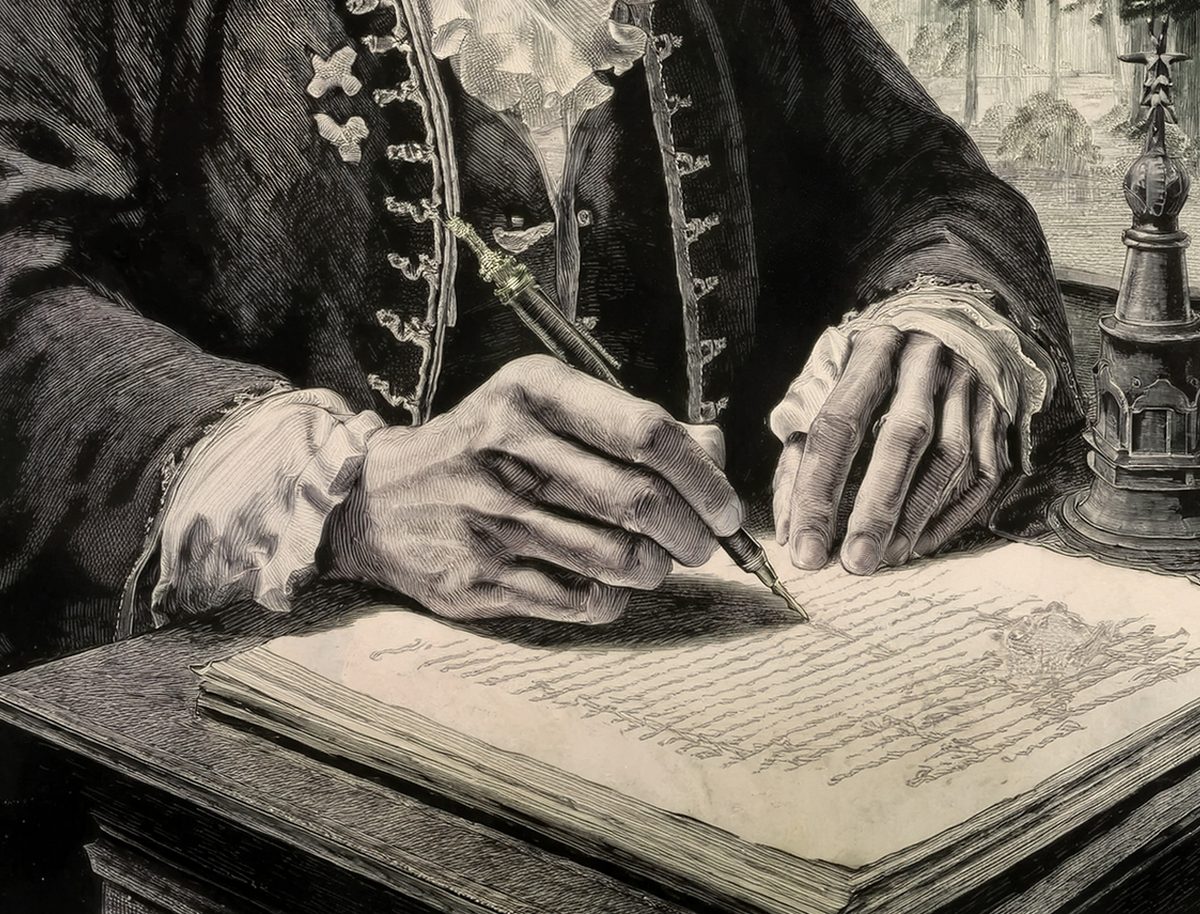
Twenty-seven articles, five titles, a silent revolution: on 12 June 1804 at Saint-Cloud, Napoleon signed the text that transformed the French relationship with death.
The decree of 23 Prairial settled the matter. Article 1 banned any burial “in churches, temples, synagogues, hospitals, public chapels, and generally in any enclosed and closed buildings,” as well as “within the boundaries of towns and boroughs.” Article 2 required cemeteries to be sited at least thirty-five metres from dwellings. Article 4 abolished common graves by requiring a separate grave for each of the dead — a revolution for the poorest, even though Paris, with its five hundred and fifty thousand souls, would still have to keep collective trenches for lack of space. Article 10 created the perpetual plot: in exchange for a donation to the poor and a payment to the commune, any family could establish its own grave. Article 15 required the separation of faiths: each religion was to have its own burial ground. Article 19 went further still: if a minister of religion refused to accompany a funeral procession, the civil authority would appoint another. Actors, Protestants, Jews, the excommunicated, those who died by suicide — all now had the right to a grave.
The paradox of the decree is that it arrived after the fact. The prefect Nicolas Frochot had bought the Mont-Louis estate on 10 January 1804, five months before the text was signed. The Eastern Cemetery — the future Père-Lachaise — opened on 21 May, three weeks before the decree. Frochot had not waited for the law: he got ahead of it, confident Bonaparte would sign. The historian Philippe Ariès sums up the ambition of the text in his 1977 book The Hour of Our Death: the decree of 23 Prairial was not a mere administrative regulation but “a kind of founding act for a new cult, the cult of the dead.” The text did not merely create cemeteries outside the city walls: it invented the right to rest somewhere, under one's own name, in an individual grave, surrounded by one's own. By 1815, Père-Lachaise already counted two thousand monuments, including on the common graves — the poorest families set up a stone, a cross, a wooden border.
The decree of 23 Prairial is still in force today. Amended, expanded and recodified within the General Code of Local Authorities, it remains the foundation of French funerary law. The five-year rule before a grave can be reopened, the requirement that cemeteries be sited away from residential areas, the principle of the perpetual plot: all of it traces back to this 1804 text. Its influence reached beyond France's borders. Extended to the Kingdom of Italy by an edict signed at Saint-Cloud on 5 September 1806, it inspired the poet Ugo Foscolo, who answered it with his long poem Dei Sepolcri, a passionate defence of the dead's right to rest under the gaze of the living. In France, the decree gave rise to the four great Parisian cemeteries — Père-Lachaise, Montmartre, Montparnasse, Passy — and, through imitation, thousands of municipal cemeteries across the country. The text Napoleon signed between two battles outlived every regime that followed him.
What does the 1804 imperial decree on burials say?
Signed on 12 June 1804 at Saint-Cloud, Napoleon's decree banned burials within towns, required cemeteries to stand at least 35 metres from housing, created the perpetual plot, and guaranteed every citizen an individual grave, whatever their religion.
In 1780, the wall of a building next to the Cimetière des Innocents collapsed under the pressure of the corpses packed behind it. The scandal led to the cemetery's closure and the transfer of two million bones to the catacombs. The 1804 decree then banned burials within the city for good.
Yes. The decree of 23 Prairial Year XII remains the foundation of French funerary law. Recodified within the General Code of Local Authorities, it underlies the five-year rule before a grave can be reopened, the requirement that cemeteries stand away from housing, and the principle of the perpetual plot.
What is the connection between Napoleon and Père-Lachaise?
Napoleon signed the decree of 12 June 1804 establishing cemeteries outside city walls. Prefect Frochot, however, had already bought the land and opened Père-Lachaise before the decree was promulgated. In 1806, Napoleon ordered Louise de Lorraine's remains transferred there to bolster imperial prestige.
 History