In March 1817, the City of Paris arranged the transfer of the presumed remains of Molière, La Fontaine, Héloïse and Abelard to the Eastern Cemetery. The publicity stunt was a triumph: thirteen years after a deserted opening, Père-Lachaise became the place to be buried.
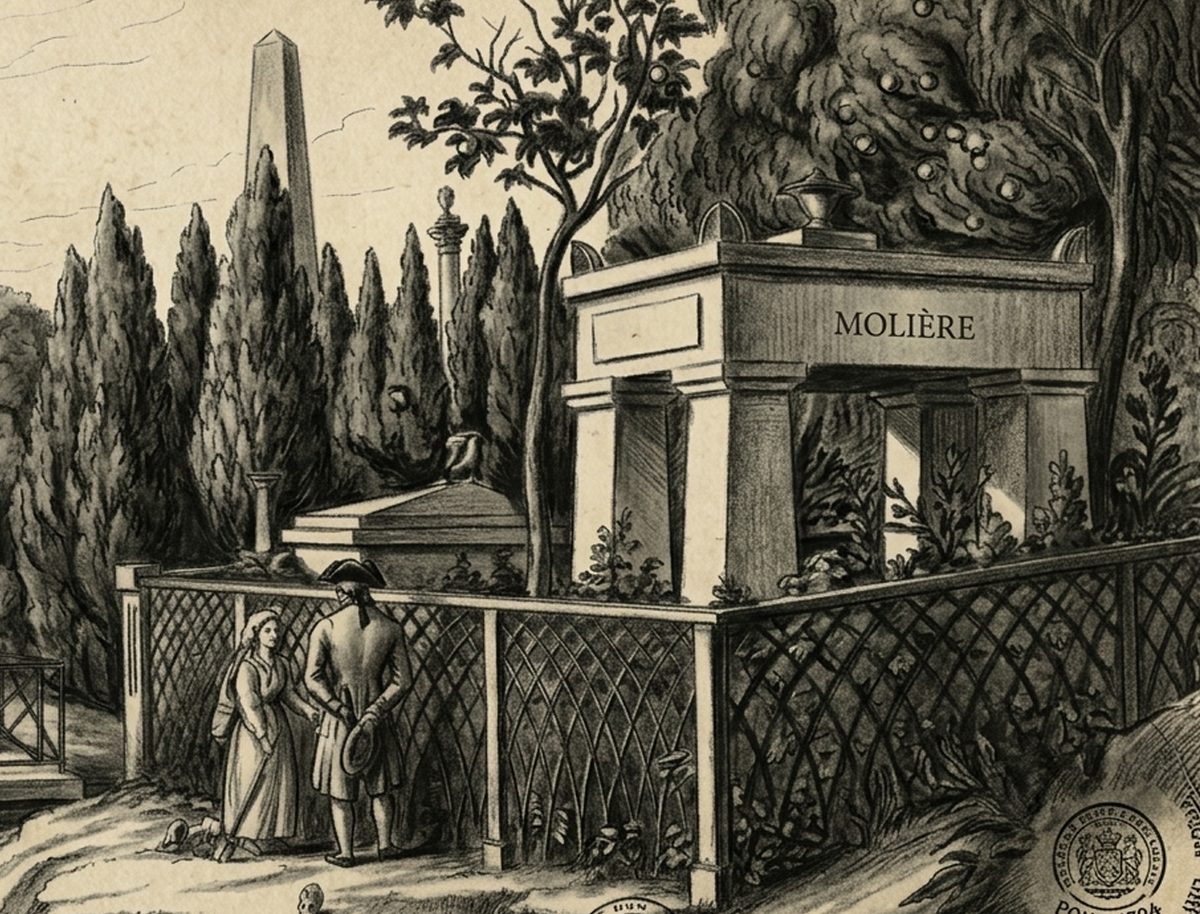
In Division 25, at the junction of the Chemin Molière and the Chemin La Fontaine, two tombs face one another. One bears the playwright's name, the other the fabulist's. The two men, who died twenty-two years apart — Molière in 1673, La Fontaine in 1695 — had never rested side by side in their posthumous existence. It was the City of Paris that brought them together here on 6 March 1817, in the boldest publicity stunt in the history of French funerary practice. Eight months later, on 6 November, a neo-Gothic monument received the remains of Héloïse and Abelard, the legendary lovers of the twelfth century. The result exceeded all expectations: within thirteen years, the cemetery went from six hundred and thirty-five burials to thirty-three thousand plots. But the bones beneath the stones are probably not the ones people think.
When Père-Lachaise opened on 21 May 1804, it was a fiasco. Thirteen graves in the first year. Forty-four in 1805. Forty-nine in 1806. The hill was too far from the city, too isolated, too new: no church, no bell tower, no parish tradition. Parisians preferred the cemeteries they already knew. However much the prefect Frochot created the perpetual plot in 1805 and secured the transfer of a few remains under the Empire — including that of Louise de Lorraine in 1806, on Napoleon's orders — the cemetery remained shunned. When Frochot was forced into retirement after the Malet affair in 1812, his successor Chabrol de Volvic inherited a site that still failed to convince. By 1815, ten years after opening, the cemetery counted only six hundred and thirty-five burials. Something dramatic was needed.
In 1815, ten years after opening, the cemetery counted only six hundred and thirty-five burials. Parisians balked at this distant hill, with neither church nor tradition.
The idea was simple: bring the illustrious dead to the cemetery, since the living would not come on their own. On 6 March 1817, the coffins attributed to Molière and La Fontaine left Alexandre Lenoir's Musée des Monuments Français, on the Rue des Petits-Augustins, following a mass at the church of Saint-Germain-des-Prés. Two sarcophagi were set out in Division 25, one on either side of a path. La Fontaine received a stone stele topped with his bust; Molière, a tomb decorated with theatrical masks. On 6 November, it was the turn of Héloïse and Abelard. Lenoir himself designed their neo-Gothic monument, assembled from medieval fragments salvaged from the Paraclete chapel and the Abbey of Saint-Denis. That same year, the remains of Beaumarchais, first buried in 1799 within an enclosure on his own property, were transferred to Père-Lachaise. The first tourist guidebooks appeared: “Le champ du repos” (“The Field of Rest”), by Roger father and son, in 1816, and C.P. Arnaud's “Guide du visiteur sentimental” (“The Sentimental Visitor's Guide”) in 1817.
The trouble is, the coffins probably do not contain the remains they claim to. Molière died on 17 February 1673, on the Rue de Richelieu. Excommunicated for being an actor, he had no right to a religious burial. Louis XIV intervened personally: Molière was buried by night, without ceremony, in the Cimetière Saint-Joseph, attached to the parish of Saint-Eustache. But in which grave exactly? Parish records mention a second move, to the plot for suicides and stillborn children, the unconsecrated section. In July 1792, Father Fleury, vicar of Saint-Eustache, exhumed bones from this unconsecrated plot. He also opened the neighbouring grave, which he attributed to La Fontaine. Yet the archives confirm that the fabulist was buried in 1695 at the Cimetière des Innocents — never at Saint-Joseph. The remains displayed in the Saint-Joseph chapel were later handled roughly: the coffins were opened, curious onlookers took relics, and the bones may well have been mixed up. Molière and La Fontaine most likely lie in the catacombs, mingled with the thousands of anonymous bones transferred from the Innocents and Saint-Joseph when those cemeteries closed.
Authenticity hardly mattered: the operation was a triumph. In the years that followed, two thousand funerary monuments were erected. Perpetual plots rose from eight hundred and thirty-three in 1812 to thirty-three thousand by 1830. The return of the Pantheon to Catholic worship in 1821 further steered celebrities towards Père-Lachaise: marshals, academicians and artists flocked to the hill. The once-shunned cemetery had become the most fashionable place in Paris. Today, the graves of Molière and La Fontaine, listed as historic monuments on 14 November 1983, remain among the most visited in the cemetery. Flowers are regularly left there. Tourist guides mark them as unmissable. French funerary history's first publicity stunt is still working — two centuries on, and despite the fact that the two sarcophagi in Division 25 are, in all likelihood, cenotaphs.
Why are Molière and La Fontaine buried at Père-Lachaise?
The City of Paris transferred their presumed remains there on 6 March 1817, to revive a cemetery Parisians had shunned since it opened in 1804. The remains had been kept at Alexandre Lenoir's Museum of French Monuments since 1799.
Probably not. The bones exhumed from the Cimetière Saint-Joseph in 1792 are of doubtful authenticity. As for La Fontaine, records confirm he was buried at the Innocents in 1695, never at Saint-Joseph. Their real remains most likely lie in the catacombs.
Who organised the 1817 transfer of famous graves to Père-Lachaise?
The City of Paris, under prefect Chabrol de Volvic, Nicolas Frochot's successor. Alexandre Lenoir, founder of the Museum of French Monuments, designed the neo-Gothic monument to Heloise and Abelard from medieval fragments.
Through an 1817 publicity campaign: the transfer of famous remains (Molière, La Fontaine, Heloise and Abelard). The cemetery grew from 635 burials in 1815 to 33,000 plots by 1830. The Panthéon's return to Catholic worship in 1821 also steered celebrities towards Père-Lachaise.
 History