In 1832, cholera killed 18,402 Parisians in six months. The head of government, Casimir Périer, fell ill after visiting cholera patients at the Hôtel-Dieu and died on 16 May. His bronze monument, in Division 13, dominates the central roundabout of Père-Lachaise.
At the crossroads of the Grand Rond, in Division 13, a white marble pedestal bears a bronze statue two metres ninety tall. The standing figure, his left hand resting on the Charter of 1830, looks out towards the avenue that bears his name. Three bas-reliefs — Eloquence, Justice and Firmness — adorn the sides of the base. It is one of the most imposing monuments at Père-Lachaise, and it occupies the cemetery's most central spot. The man who lies here was neither an imperial marshal nor a writer: he was a banker turned prime minister, killed by a disease no one yet knew how to name. Casimir Périer, infected with cholera after visiting the sick at the Hôtel-Dieu on 6 April 1832, died forty days later, on 16 May, at fifty-four. The monument, erected in 1837 by public subscription at a cost of fifty-eight thousand six hundred and fifty francs, is the work of the sculptor Jean-Pierre Cortot and the architect Achille Leclère. They laboured to glorify a man cut down by an epidemic that, in one hundred and eighty-nine days, killed eighteen thousand four hundred and two Parisians.
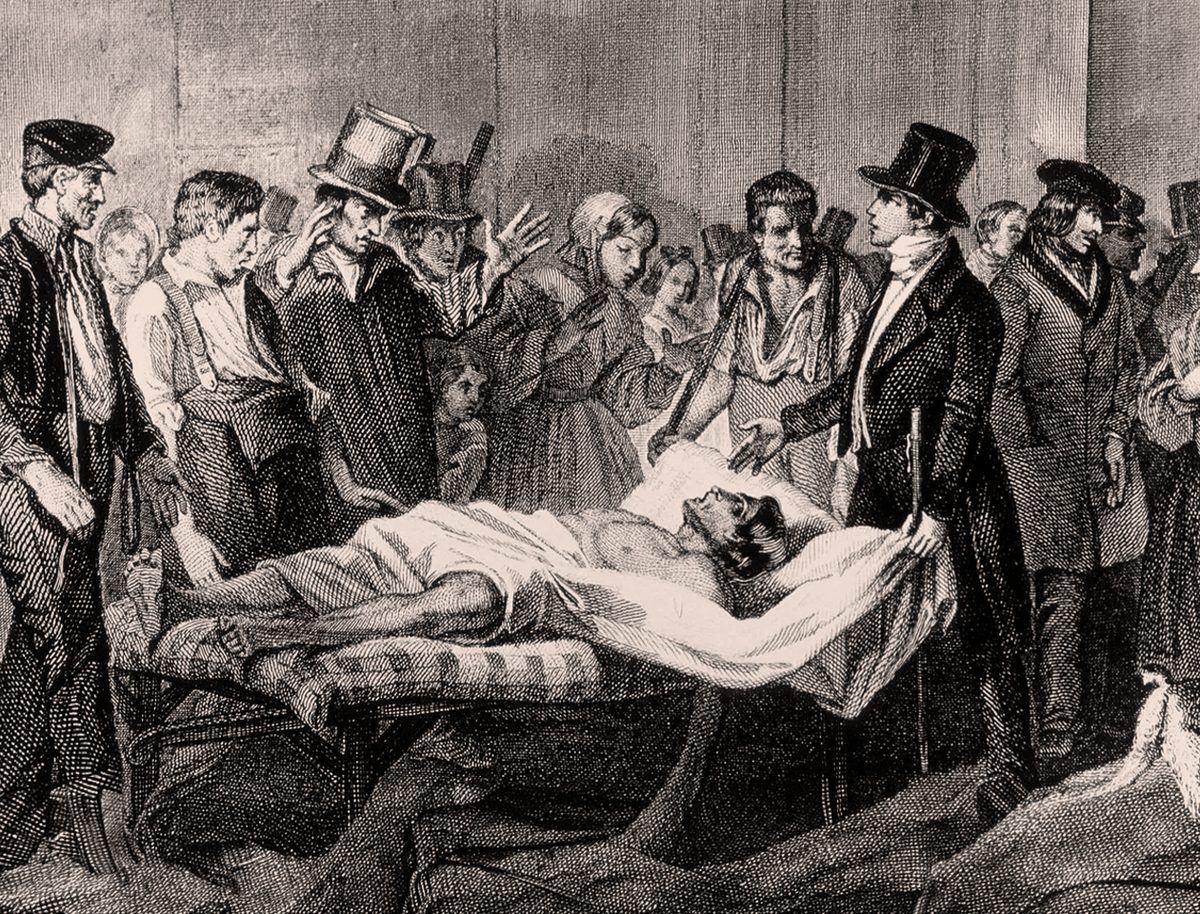
The first case was reported on 26 March 1832. Paris then had seven hundred and eighty-five thousand inhabitants. Cholera — called “cholera-morbus” at the time — had travelled from India via Russia, Poland and England. Within three days, the epidemic reached nine communes in the suburbs. In April it peaked: twelve thousand seven hundred and thirty-three deaths in a month, eight hundred and fourteen in a single day. The common graves at Père-Lachaise overflowed. Hearses no longer sufficed: bodies were carried in market-gardeners' carts. The writer Heinrich Heine, who refused to leave Paris, described the disease as “a masked executioner walking through Paris, escorted by an invisible guillotine.” Fear bred rumour: on 3 and 4 April, passers-by were accused of poisoning the fountains. Crowds lynched several of them — five or six suspected “poisoners” were killed within two days. Working-class districts paid the heaviest price. The public-health reformer Louis-René Villermé showed that mortality struck the poor far more than the rich, who had the means to flee or shut themselves away in their private mansions.
Before entering the cholera ward, Périer was struck by a premonition: “My lord, let us not go in here.” The Duke of Orléans replied: “The die is cast — it must be drunk.”
Casimir Périer did not flee. Born in 1777 at Pont-de-Beauvoisin, in the Isère, the son of a banker who had co-founded the Banque de France, he made his fortune in business before turning to politics. Elected deputy for the Seine in 1817, President of the Chamber in 1830, he was appointed prime minister and Minister of the Interior by Louis-Philippe on 13 March 1831. His programme was summed up in a phrase that became famous: “At home, order without sacrificing liberty; abroad, peace without costing our honour anything.” When the epidemic broke out, he tightened health controls and refused to leave the capital. On 6 April 1832, the king asked him to accompany the Duc d'Orléans to the Hôtel-Dieu to visit cholera patients. Before entering the ward, Périer was seized with a premonition: “Monseigneur, let us not go in here.” Louis-Philippe's son replied: “Monsieur, the die is cast, we must drink the cup.” Périer contracted the disease within hours. Tended by the most renowned doctors in Paris, he lingered for forty days. He died on 16 May. Flags were lowered to half-mast on public buildings.
Périer was not the only figure carried off by cholera in 1832. On 13 May, three days before the prime minister, the naturalist Georges Cuvier died at sixty-two — his grave stands in Division 8 of Père-Lachaise, not far from Brongniart's monument. On 1 June came General Lamarque, a deputy and figure of the republican opposition. His funeral, on 5 June, drew a hundred thousand people into the streets of Paris. The funeral procession turned into an uprising: a red flag inscribed “Liberty or death” was raised, barricades went up in the eastern districts of Paris, shots were exchanged with the National Guard. The revolt was crushed within two days. Victor Hugo, who witnessed the event, would draw on it thirty years later for the central episode of Les Misérables. Within six months, the July Monarchy had lost its prime minister, a popular general, and part of the capital's trust. The cholera epidemic of 1832 was Paris's first modern epidemic — the first the press covered day by day, the first doctors studied statistically, the first to trigger a riot.
Casimir Périer's monument, now restored, has regained its original splendour. Cortot's statue, signed and dated 1837, shows the prime minister standing, his hand on the Charter — the gesture that sums up his politics. The avenue climbing from the main gate towards the Grand Rond bears his name: it is one of the cemetery's busiest thoroughfares. Visitors heading to the graves of Molière, La Fontaine or Chopin walk along it without knowing that the name beneath their feet belongs to a man who died of cholera at fifty-four. Not far away, in Division 8, Cuvier's grave recalls that 1832 was a dark year for science. In Division 18, the Egyptologist Jean-François Champollion, who died on 4 March — three weeks before the first case of cholera — rests beneath an obelisk bearing his own hieroglyphs. The epidemic also hastened the cemetery's third enlargement: with the common graves overflowing, the City had to acquire new land to the east. It was cholera that turned Père-Lachaise from Brongniart's romantic garden into the grid-patterned city of the dead seen today on the Charonne plateau.
The Grand Rond, in Division 13, is dominated by the monument to Casimir Périer, President of the Council under Louis-Philippe, who died of cholera on 16 May 1832. The white marble mausoleum, topped by a 2.9-metre bronze statue by the sculptor Jean-Pierre Cortot, was raised in 1837 by public subscription.
Which notable figures who died in 1832 are buried at Père-Lachaise?
Casimir Périer, President of the Council, died of cholera on 16 May 1832 and lies in Division 13. The naturalist Georges Cuvier, who died on 13 May, is buried in Division 8. The Egyptologist Jean-François Champollion, who died on 4 March 1832, rests in Division 18.
Did the 1832 cholera epidemic spark a revolt in Paris?
Yes. General Lamarque, a deputy and leading figure of the republican opposition, died of cholera on 1 June 1832. His funeral on 5 June turned into an armed uprising in the eastern districts of Paris. Victor Hugo immortalised the episode in Les Misérables.
How did the 1832 cholera epidemic transform Père-Lachaise?
The surge in deaths overwhelmed the common graves and forced a third eastward extension of the cemetery. The epidemic accelerated the crowding of the Divisions and hastened the shift from Brongniart's romantic garden to the urban grid of the Charonne plateau.
 History