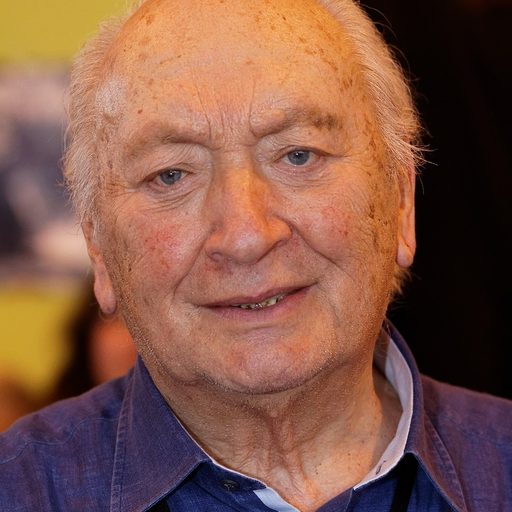
Joffo was the son of a barber in the eighteenth arrondissement, deported to Auschwitz in November 1943 and never seen again. With his brother Maurice he had crossed France to reach the free zone: two children, forged papers, unbelievable luck. He told the story of that flight in 1973 in Un sac de billes — A Bag of Marbles — which would pass twenty million copies. A name and two dates, and that is all that is carved.
The story
Born in Paris on 2 April 1931, Joseph Joffo was the son of Roman Joffo, a barber, and Anna Markoff, a violinist. The family kept a shop in the eighteenth arrondissement.
His father was deported to Auschwitz on convoy no. 62, on 20 November 1943. He did not come back. Joseph and his brother Maurice had crossed France to reach the unoccupied zone: two children, one set of forged papers, and outrageous luck.
In 1973 he told the story of that flight in Un sac de billes, published by Lattès and reworked with the novelist Claude Klotz. The Académie française gave it the Broquette-Gonin prize in 1974, and the book went on to pass twenty million copies in more than twenty languages.
Anna et son orchestre, in 1975, won the prix RTL grand public. The success lasted, and the family had detours of its own: his brother Maurice stood trial in Paris in 1986 over a traffic in stolen jewels.
He died at Saint-Laurent-du-Var on 6 December 2018 and rests in Division 62, on Chemin Luzarraga, first row, beneath a stone that carries nothing but his name.
The grave
An inscription reduced to the essentials: “Joseph JOFFO 1931-2018”. Nothing of the Sac de billes, nothing of the twenty million copies, nothing of the barber's shop in the eighteenth. Nor does the name of his father Roman, deported to Auschwitz on convoy no. 62 of 20 November 1943, appear: he has no grave, and his son's book long stood in for one.
On site, do not miss
A stone bearing only a name and two dates. The father, Roman Joffo, deported on convoy no. 62 in November 1943, has no grave: his son's book stands in for one.
Visitors' questions
Where is Joseph Joffo's grave?
In Division 62, chemin Luzarraga, first row, beneath a stone that bears nothing but “Joseph JOFFO 1931-2018”. The Division is also home to the Kurdish film-maker Yılmaz Güney, who died in exile in 1984: two men the twentieth century had forced to flee.
Yılmaz GüneyWhat is “A Bag of Marbles”?
The story of his flight as a Jewish child across occupied France with his brother Maurice, published in 1973 as “Un sac de billes”. Twenty million copies, more than twenty languages, two film adaptations — one of the greatest successes in French publishing.
Adolfo KaminskyWhat became of his father?
Roman Joffo, a hairdresser in the eighteenth arrondissement, was deported to Auschwitz on convoy No. 62 of 20 November 1943 and never came back. That absence is what the book recounts, without ever explaining it.
Daniel CordierHas “A Bag of Marbles” been filmed?
Twice: in 1975 by Jacques Doillon, then in 2017 by Christian Duguay. French schoolchildren still study the book, as they did decades ago — which explains its enduring readership and its twenty million copies sold.
Léon MiloAudio guide to Père Lachaise: the best unusual guided tour!
Discover the secrets of the most astonishing tombs
the audio guidefrom€6.99