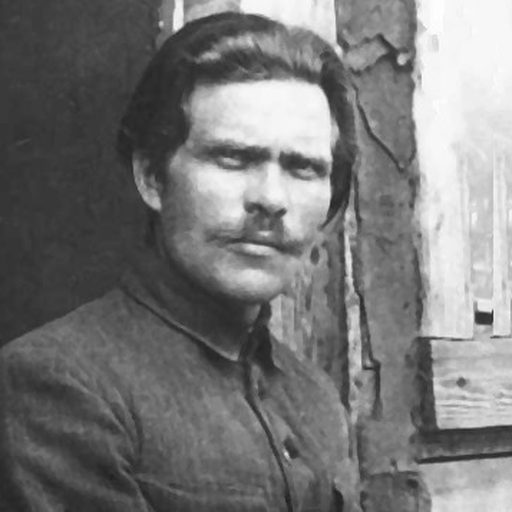
Nestor Makhno, son of Ukrainian peasants, was sentenced to death at twenty for anarchism, reprieved, sent to a penal prison, and freed by the revolution of 1917. Back home, he raised an army of twenty thousand men mounted on machine-gun carts, which fought in turn the Germans, the Whites, then the Red Army. Wounded some twenty times, he ended up a factory worker at Renault, in Boulogne.
The story
Born on 7 November 1888 at Huliaipole, in southern Ukraine, the son of peasants, Makhno was sentenced to death at twenty-one for anarchist activity; the sentence was commuted to hard labour, and the revolution of 1917 set him free.
Back home, he founded a peasants' union, seized the great estates and raised an insurgent army that would number some twenty thousand men, riding on machine-gun carts.
From 1918 to 1921 that army fought in turn the Germans, the White armies of Denikin and Wrangel, and finally the Red Army, an ally of a day that destroyed it. Wounded some twenty times, Makhno fled through Romania and Poland.
He reached Paris in 1925 and lived there on odd jobs, among them the Renault works at Boulogne-Billancourt, in a poverty that anarchist solidarity barely eased. He wrote his memoirs between spells in hospital.
He died of tuberculosis at the Tenon hospital on 25 July 1934, aged forty-five. His ashes were placed in the columbarium, niche 6,685, in Division 87: the plaque has become a place of libertarian pilgrimage.
The grave
A columbarium niche, number 6,685, closed by a plaque adorned with a photographic medallion of the revolutionary. Nothing else: no monument, no epitaph recorded in the reference works. The man who commanded twenty thousand horsemen occupies one of the smallest spots in the cemetery, and it is one of the most visited in the columbarium.
On site, do not miss
The columbarium holds thousands of niches: note the number, 6,685. The plaque bears a photographic medallion, and almost always flowers left by visitors who never knew him.
Visitors' questions
Where are Nestor Makhno's ashes?
In the columbarium of Père-Lachaise, niche 6,685, Division 87. The plaque, set with a photographic medallion, is regularly decked with flowers: it is one of the anarchist pilgrimage sites of Paris. Note the number before you go in — the niches run into the thousands.
The crematorium and the columbariumWho was Nestor Makhno?
A Ukrainian anarchist revolutionary who, from 1918 to 1921, led an insurgent peasant army, fighting in turn the Germans, the White armies and the Red Army. Sentenced to death at twenty, he died in Paris in 1934.
Louis-Auguste BlanquiHow did Makhno end his days?
In exile in Paris, where he arrived in 1925 after fleeing through Romania and Poland. He scraped a living from odd jobs, including a spell at the Renault factory in Boulogne, and died of tuberculosis at the Tenon hospital in July 1934.
Jules GuesdeWhich other revolutionary figures rest at Père-Lachaise?
The Communards' Wall, Auguste Blanqui, Jules Guesde, Paul Lafargue and Jean-Baptiste Clément make the cemetery one of the densest sites of working-class memory in France. Makhno is its only anarchist army commander.
The Communards' WallAudio guide to Père Lachaise: the best unusual guided tour!
Discover the secrets of the most astonishing tombs
the audio guidefrom€6.99