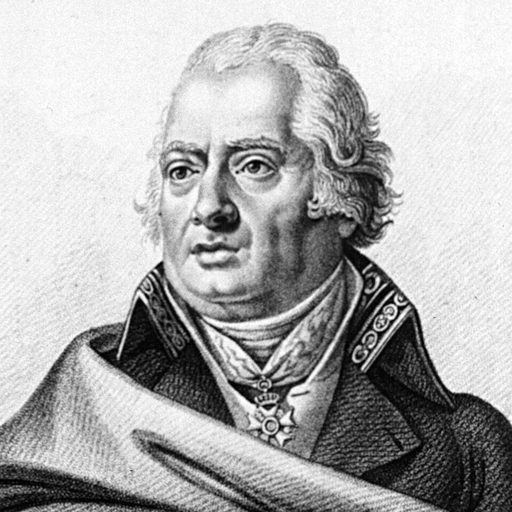
Until him, one waited for the end of the fighting to pick up the wounded, who died where they lay. Surgeon-in-chief of the Grande Armée, he designed surgical ambulances able to follow the troops and created the corps of stretcher-bearers, charged with gathering up the men under fire.
The story
Born in 1754 at Montagney, the son of a surgeon, Pierre-François Percy entered the service of the armies and spent his life there. Military surgery under the old monarchy meant waiting for the fighting to end before gathering up what could be saved: the wounded died on the ground, of haemorrhage and cold, and a bullet wound left twelve hours without care left almost no chance. Armies lost more men after a battle than during it.
Percy reversed the principle. He designed mobile surgical ambulances — the “wurst”, a long wagon carrying surgeons and instruments — able to follow the troops and to work close to the line. With Larrey, who was developing flying ambulances of his own, he established the idea that help must go to the wounded man and not the reverse. The principle seems obvious today; it meant then bringing non-combatants and heavy equipment into the zone of fire.
He created the corps of surgeon stretcher-bearers, charged with lifting men under fire, and gave it an organisation, equipment of its own and a recognised place in the order of battle — the direct ancestor of the stretcher-bearers every army keeps today. He served through the campaigns of the Revolution and then of the Empire, operating on every front, and became surgeon-in-chief of the Grande Armée and then a baron of the Empire. He left a Manuel du chirurgien d'armée.
He died in 1825, at seventy. His name is carved on the Arc de Triomphe among the great servants of the Empire, and a military hospital at Clamart bears it. The idea he imposed — treat during the battle, not after it — passed into every army in the world and still shapes civilian trauma care, from road accidents to terror attacks. His epitaph, in Division 18, holds in a single line: “Il fut le père des chirurgiens militaires” — he was the father of military surgeons.
On site, do not miss
His name is elsewhere, and in large letters: carved on the Arc de Triomphe, among a list made up almost entirely of generals.
Visitors' questions
Where is Pierre-François Percy's grave?
In Division 18 of Père-Lachaise, the one where the mathematician Hachette lies, at the carrefour du Grand Rond. His epitaph runs to a single sentence: “Il fut le père des chirurgiens militaires” — he was the father of military surgeons.
Jean Nicolas Pierre HachetteWhat did he change in military medicine?
The principle itself: before him, you waited for the fighting to stop before picking up the wounded, who died where they lay. He designed mobile ambulances that followed the troops and a corps of stretcher-bearers who lifted men under fire.
François MagendieWhat was his connection with Larrey?
They carried the same revolution by two roads: Larrey was developing his flying ambulances while Percy designed the “wurst”, a long wagon carrying surgeons and instruments. Between them they established that help must go to the wounded man.
Xavier BichatIs his name on the Arc de Triomphe?
It is, among those of the great servants of the Empire — a rare thing for a doctor, on a list made up almost entirely of generals. A military hospital at Clamart also carries his name. He was made a Baron of the Empire for these services.
Louis François LejeuneAudio guide to Père Lachaise: the best unusual guided tour!
Discover the secrets of the most astonishing tombs
the audio guidefrom€6.99