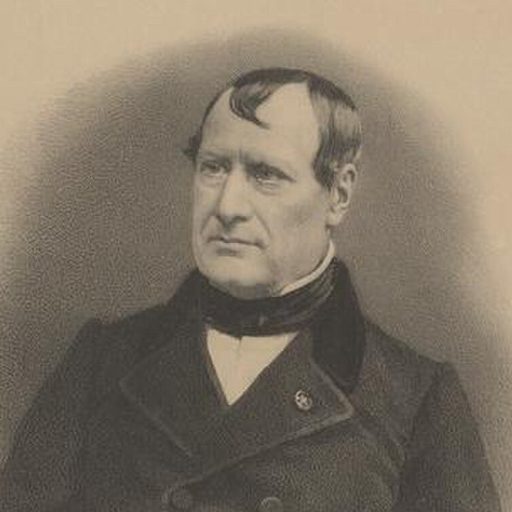
Pierre FLOURENS
See onthe map
Physician and physiologist, founder of experimental neuroscience.
Flourens chose experiment over system. By ablations performed on living animals, he showed that the cerebellum governs balance and the medulla the vital functions: experimental neurophysiology begins there. The same work served him to ruin phrenology, which claimed to read a character in the bumps of a skull. He succeeded Cuvier at the Collège de France.
The story
Born on 13 April 1794, Marie Jean Pierre Flourens read medicine at Montpellier and then in Paris, and settled on a method: experiment rather than system.
By removing precise parts of the brain in living animals he established the role of the cerebellum in balance and coordination, and that of the medulla in the vital functions. Experimental neurophysiology begins there.
The same work let him demolish Gall's phrenology, then in fashion, which claimed to read character in the bumps of the skull: Flourens showed that the functions were not laid out as the doctrine claimed.
He succeeded Cuvier at the Collège de France and became permanent secretary of the Académie des sciences — the most central position in institutional French science.
He died on 6 December 1867 and rests in Division 66, chemin d'Ornano, first row, with his son Gustave Flourens (1838-1871), killed during the Paris Commune.
The grave
An inscription of remarkable brevity for a permanent secretary of the Académie des sciences: “Pierre FLOURENS, physiologist, born on 13 April 1794, died on 6 December 1867.” A single word of trade, and not the most glorious of his titles. The tomb also shelters his son Paul Gustave Flourens (1838-1871), a revolutionary killed during the Commune: the father refuted phrenology, the son died with weapons in his hands.
On site, do not miss
The epitaph keeps only one word of trade — “physiologist” — neither the Collège de France nor the Académie. Look for the second name: that of his son Gustave, killed during the Commune.
Visitors' questions
Where is Pierre Flourens's grave?
In Division 66, chemin d'Ornano, first row. The inscription is brief: “Pierre FLOURENS, physiologue, né le 13 avril 1794, mort le 6 décembre 1867.” His son Gustave, killed during the Commune, rests with him.
François-Jules SimonWhat did Flourens do to phrenology?
He refuted it by experiment. By removing precise parts of the brains of living animals, he showed that the functions were not laid out as Gall claimed — and Gall's doctrine was the rage of the salons at the time.
Georges CuvierWho was Gustave Flourens, buried with him?
His son, a revolutionary and a member of the Paris Commune, killed in April 1871 at Rueil during the fighting. The physiologist, dead four years earlier, never knew: it was the son who joined the father.
The Communards' WallWhat offices did Pierre Flourens hold?
He succeeded Cuvier at the Collège de France and was Perpetual Secretary of the Academy of Sciences, a post that made him one of the most influential men in French science under the Second Empire.
Claude BernardAudio guide to Père Lachaise: the best unusual guided tour!
Discover the secrets of the most astonishing tombs
the audio guidefrom€6.99