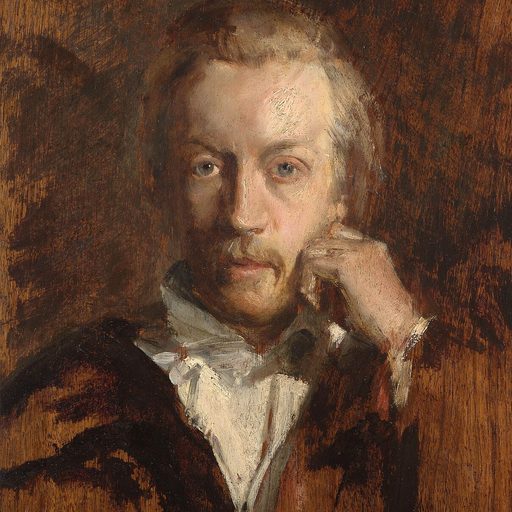
Félix Ziem, born in Beaune in 1821, was headed for architecture before setting off in search of light around Marseille, then the Orient. Venice would be his subject as much as his fortune: he returned dozens of times to paint its canals, its domes and its twilights, and his canvases sold as few others did at the time. A winged lion of bronze keeps company with this Burgundian painter.
The story
Born at Beaune in 1821, to a tailor who had come from Prussia and a Burgundian mother, Ziem trained first as an architect before choosing painting, and set off after the light: Marseilles, the Mediterranean, the East.
Venice became his subject and his fortune. He went back dozens of times, painting the canals, the domes and the sunsets over the lagoon; his Venetian series form the heart of his work and sold, in his lifetime, as few canvases then sold.
Close to the Barbizon school without ever merging into it, he settled in Montmartre around 1860 and gave many canvases to provincial museums. In 1910 the Chauchard bequest brought his painting into the Louvre: he was the first painter shown there in his own lifetime.
A commander of the Légion d'honneur in 1905, he died on 10 November 1911, at ninety.
He lies in Division 93, avenue Transversale n°3, first row, under one of the most worked monuments of that quarter: four columns, a gothic arch, Renaissance ornament, and a marble effigy signed by Victor Ségoffin. On the ground, a bronze takes up the winged lion of Venice, the city that had kept him.
The grave
One of the most ambitious monuments in Division 93: four columns bearing a Gothic arch with Renaissance ornaments, a white marble recumbent effigy by the sculptor Victor Ségoffin dated 1912, and a bronze bas-relief depicting the winged lion of Venice. The inscription, for its part, is reduced to a name between two dates in Roman numerals: “MDCCCXXI ZIEM MCMXI”. The painter took with him the emblem of the city he had chosen.
On site, do not miss
The winged lion of Venice, cast in bronze on the monument of a painter born in Beaune: it is the city he chose that keeps him company, not his own. The dates are in Roman numerals, MDCCCXXI-MCMXI.
Visitors' questions
Where is Félix Ziem's grave?
In Division 93, Avenue Transversale No. 3, first row. There is no mistaking the monument: four columns, a Gothic arch, a white marble recumbent effigy and the winged lion of Venice cast in bronze. The dates are carved in Roman numerals.
FoottitWhy is Félix Ziem the painter of Venice?
Because he went back dozens of times and never stopped painting its canals and its sunsets. His Venetian series form the heart of his work, and earned him, in his lifetime, a prosperity rare among painters.
Camille CorotWhat can be seen on Ziem's monument?
A white marble recumbent effigy by the sculptor Victor Ségoffin, dated 1912, beneath a Gothic arch carried by four columns with Renaissance ornament — and, in bronze, the winged lion of Saint Mark, emblem of the city he painted all his life.
Tony NoëlDid Félix Ziem give his works to museums?
Yes, to many provincial museums in France, which is why his canvases turn up all over the country. Close to the Barbizon school, settled in Montmartre in 1860, he was one of the best-selling painters of his day.
Charles-François DaubignyAudio guide to Père Lachaise: the best unusual guided tour!
Discover the secrets of the most astonishing tombs
the audio guidefrom€6.99