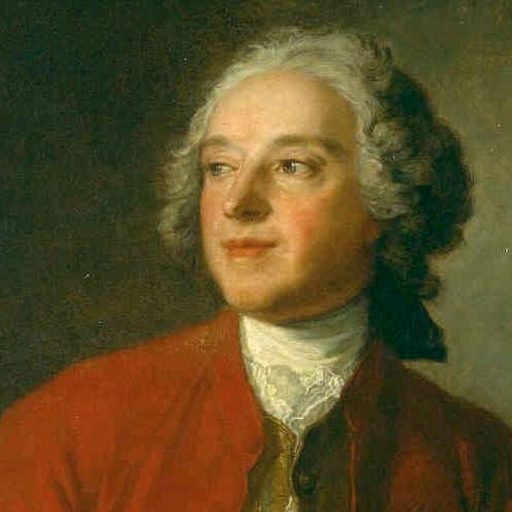
Beaumarchais was born Pierre Augustin Caron, a watchmaker's son, and at twenty-one invented a watch escapement that the king's own watchmaker tried to steal from him: it took the Académie des sciences to give it back. He taught the harp to the daughters of Louis XV, did business, served as a secret agent, ran guns to the American insurgents. The Marriage of Figaro, premiered in 1784, was played sixty-eight times in eight months. On his slab you read the names of two families; his own is behind, on the wall, among a score of others.
The story
Pierre Augustin Caron was born in Paris on 24 January 1732, a watchmaker's son, and at twenty-one invented a watch escapement — which the king's watchmaker promptly claimed as his own, and which it took the Académie des sciences to give back to him. In 1757 he took the name of the Bosc Marchais, a fief that had come from his wife's first husband: Beaumarchais. Harp master to the daughters of Louis XV, man of business, secret agent, he led several lives before that of an author.
“Eugénie”, in 1767, was no better than a half-success at the Comédie-Française. “The Barber of Seville”, in 1775, installed Figaro — a servant who reasons better than his master.
“La Folle Journée, or The Marriage of Figaro” was first staged on 27 April 1784, after years of prohibition: Louis XVI had judged it “execrable” and warned that “the Bastille would have to be pulled down” before it could be played. It ran sixty-eight performances in eight months. Napoleon would later say: “That is the Revolution already in action!”
Between 1783 and 1790 he published the complete works of Voltaire, printing them at Kehl, outside France, to escape the censors — and ruining himself in the process. He ran guns to the American insurgents, was imprisoned and then exiled. “The Guilty Mother”, the last part of the trilogy, was given at the Théâtre du Marais in 1792.
He died in Paris on 18 May 1799, all but forgotten, and was buried in the garden of his own house, on the boulevard that now bears his name — Père-Lachaise would not open for another five years. The City bought the house from his heirs, and his remains reached the cemetery in 1818, in Division 28, in a vault where a score of Delarue de Beaumarchais have since joined him.
The grave
It is a family vault, and the author is almost drowned in it. The slab reads, in full, “Sépulture des familles Caron Beaumarchais et Delarue” — with no particle — and the wall behind lines up a score of names in columns: his third wife Marie Thérèse Willermaulaz, his daughter Amélie Eugénie, who married André Toussaint Delarue in 1796, then generations of “Delarue de Beaumarchais”, among them a French ambassador who died in 1979 and an inscription from 2005. Nothing in the architecture signals the writer — no bust, no quotation, no Figaro, and the central cross is bare. You have to know he is there to find him, and to remember that he only arrived in 1818, the property where he had been buried having been bought up by the City.
On site, do not miss
The slab carries only the two family names. Walk round behind it: the wall lines up a score of names in columns, nearly all of them “Delarue de Beaumarchais” — the playwright's name survived through his daughter, grafted onto her husband's. One of them is a French ambassador who died in 1979.
Visitors' questions
Where is Beaumarchais's grave?
In Division 28, at the crossing of the chemins Suchet and Masséna, in the upper, older part of the cemetery — the Division of Brillat-Savarin, Marshal Masséna and Paul Barras. Look for a long white slab set against a wall covered in names: there are a score of them, nearly all “Delarue de Beaumarchais”.
Paul BarrasWas Beaumarchais always at Père-Lachaise?
No. When he died in 1799 he was first buried in the garden of his own house, on what is now the boulevard Beaumarchais: the cemetery would not open for another five years. The City bought the house from his heirs in 1818, and it was that year that his remains reached Père-Lachaise — a year after Molière and La Fontaine.
MolièreWhat are his most famous plays?
“The Barber of Seville”, first performed in 1775, and “The Marriage of Figaro”, first staged on 27 April 1784 after years of prohibition — Louis XVI thought it “execrable”. The play ran sixty-eight performances in eight months. “The Guilty Mother”, given at the Théâtre du Marais in 1792, closes the Figaro trilogy.
François-Joseph TalmaWhat did he do outside the theatre?
A watchmaker's son, at twenty-one he invented a new watch escapement — the king's watchmaker took the credit for it, and it took the Académie des sciences to give it back to him. He went on to teach the harp to the daughters of Louis XV, to work as a secret agent, to run arms to the American insurgents, and to publish the complete works of Voltaire between 1783 and 1790.
Jean de La FontaineAudio guide to Père Lachaise: the best unusual guided tour!
Discover the secrets of the most astonishing tombs
the audio guidefrom€6.99