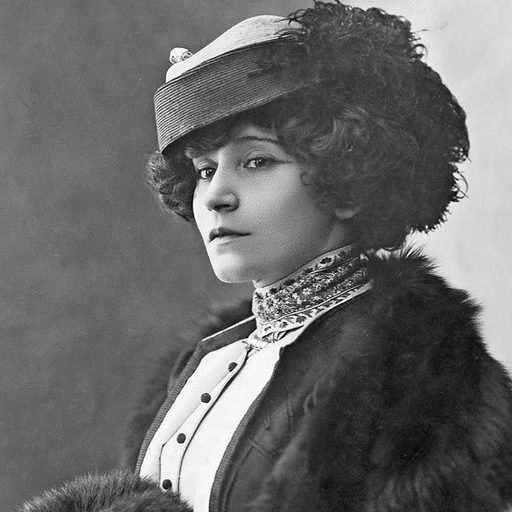
The “Claudine” novels appeared under the sole signature of her husband Willy, and the question of their author was settled only after the divorce. Music hall, pantomime, a kiss with Missy at the Moulin Rouge that set off a riot: on her death, in 1954, she became the first woman in France to be given a state funeral.
The story
Sidonie Gabrielle Colette was born on 28 January 1873 at Saint-Sauveur-en-Puisaye, in the Yonne. In 1893 she married Henri Gauthier-Villars, known as Willy, and came up to Paris; the Claudine novels appeared under the husband's name alone, and who had written them was not settled until after the divorce.
Separated from Willy in 1906 and divorced in 1910, she lived by the stage: music hall, mime, very little clothing. Her affair with Mathilde de Morny, known as Missy, daughter of Napoleon III's half-brother born out of wedlock, made a scandal that reached the newspapers; a kiss at the Moulin-Rouge set off a riot.
She became one of the great writers of her century without ever taking the expected road: novels, columns, journalism, film dialogue. In 1935 she married Maurice Goudeket, her third husband, and settled at the Palais-Royal, where she would write to the end, held still by arthritis.
The honours followed: Chevalier of the Legion of Honour in 1920, Officier in 1928, Commandeur in 1936, Grand Officier in 1953. She was also a member of the Académie Goncourt and of the Belgian Royal Academy of French Language and Literature.
She died in Paris on 3 August 1954, at the height of her fame. Her catafalque stood in the courtyard of the Palais-Royal and the Republic gave her a state funeral — the first ever granted to a woman in France. She lies in Division 4 with her daughter, the writer Colette de Jouvenel, who died in 1981.
The grave
The monument is by the architect Jean-Charles Moreux, put up in 1955: a slab of pink granite set against a stele of black marble, and the whole effect lies in that contrast of materials. The front is brief — “Here lies Colette, 1873-1954”, followed by the name of her daughter, the writer Colette de Jouvenel, who died in 1981. The back, for its part, gives the full civil status: “Sidonie Gabrielle Colette, wife of Maurice Goudeket, born at Saint-Sauveur-en-Puisaye on 28 January 1873, woman of letters, Grand Officer of the Légion d'honneur, member of the Académie Goncourt and of the Royal Academy of French Language and Literature of Belgium”. Twenty years earlier, Moreux had designed for her the shopfront of her cosmetics business.
On site, do not miss
The back of the stele, where her civil status unfolds in eight lines of titles — and the contrast between pink granite and black marble.
Visitors' questions
Where is Colette's grave?
In Division 4, Avenue Circulaire, first row, a few minutes from the main entrance. The pink granite slab and black marble stele make it easy to recognise: it is one of the most visited graves in the cemetery.
Albert BartholoméWho designed her grave?
The architect Jean-Charles Moreux, in 1955, playing on the contrast between the pink granite of the slab and the black marble of the stele. He had already designed for her, in 1936, the shopfront of her cosmetics business.
Paul BaudryDid Colette have a state funeral?
Yes, in August 1954: she was the first woman in France to receive one. Her catafalque had been displayed in the courtyard of the Palais-Royal, where she had lived since 1935 and where she wrote her last books.
Claude BernardWho rests with her?
Her daughter, the writer Colette de Jouvenel, who died in 1981, born of her marriage to Henry de Jouvenel des Ursins. Both names appear on the front of the stele; the novelist's full civil record is on the back.
Marcel ProustAudio guide to Père Lachaise: the best unusual guided tour!
Discover the secrets of the most astonishing tombs
the audio guidefrom€6.99