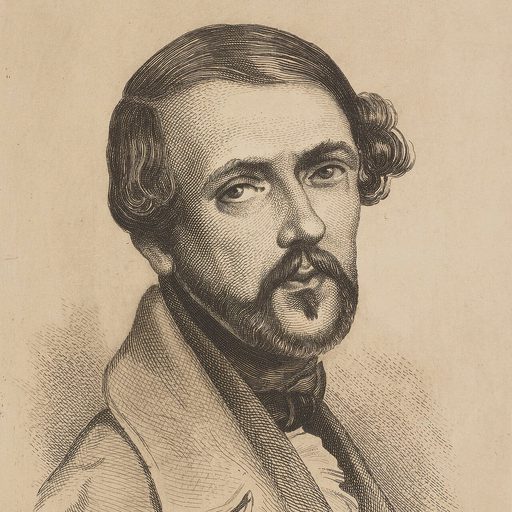
Pradier left his mark all over Paris: the Fames of the Arc de Triomphe, the twelve Victories that watch over Napoleon at the Invalides, the fountain of the Palais-Royal. His studio was one of the haunts of Romantic Paris, where one met Hugo, Flaubert, Musset. Juliette Drouet, who posed for him and bore him a daughter, would become Hugo's companion for half a century. He was born Jean-Jacques.
The story
His Fames fill the spandrels of the Arc de Triomphe, his twelve Victories keep watch over Napoleon's tomb at the Invalides, and the figures of Lille and Strasbourg on the place de la Concorde are his. Few sculptors are as present as this in the Paris landscape.
Born in Geneva on 23 May 1790, a pupil of Lemot, Jean-Jacques Pradier took the Prix de Rome in 1813 and made himself the official sculptor of the July Monarchy. His work joins antique classicism to sensuality; his studio was among the most frequented places in Romantic Paris, where Hugo, Flaubert and Musset all came.
His model Juliette Drouet, by whom he had a daughter in 1826, would become Victor Hugo's companion for nearly fifty years. He died at Bougival on 4 June 1852, at sixty-two.
Two sculptors are attached to his grave in Division 24: Antoine Etex and Eugène Louis Lequesne, his own pupils, who made the marble bust and nine bas-reliefs. His name was Jean-Jacques; “James” was the name he signed with, and it is the one the stone carries. The tomb holds three generations: the sculptor, his son Jean-Jacques known as John, a painter, and his grandson James Louis Francis, a chemical engineer, who died in 1901.
The grave
A grave with which two sculptors are associated — Antoine Etex (1808-1888) and Eugène Louis Lequesne (1815-1887) — and whose inscription poses a small riddle: “PRADIER James Louis François”, followed by his descendants. None of these three first names is the one on his birth record: he was born Jean-Jacques, and “James” was the name he signed with. Nothing of the Fames of the Arc de Triomphe nor of the Victories of the Invalides.
On site, do not miss
The inscription names him “PRADIER James Louis François” — three first names, none of them the one on his birth record. He was born Jean-Jacques.
Visitors' questions
Where is James Pradier's grave?
In Division 24, chemin Molière-et-La-Fontaine, first row — the Division of Corot and Daumier. Two sculptors are associated with the monument: Antoine Etex and Eugène Louis Lequesne. He died at Bougival on 4 June 1852.
Honoré DaumierWhat did James Pradier sculpt?
The Fames on the Arc de Triomphe, the twelve Victories around Napoleon's tomb at Les Invalides and the fountain of the Palais-Royal. A pupil of Lemot and winner of the Prix de Rome in 1813, he married classical antiquity with eroticism.
Pierre CartellierWhat connects Pradier and Victor Hugo?
An indirect but powerful one: he was Juliette Drouet's lover — she bore him a daughter, Claire, in 1826 — before she became, in 1833, Victor Hugo's companion for fifty years. He also sculpted Louise Colet, Flaubert's future mistress, who met the writer in his studio in 1846.
Camille CorotWhat name does his inscription bear?
“PRADIER James Louis François”, followed by his descendants. Three forenames that are not the ones on his birth certificate: his name was Jean-Jacques, and “James” was his name as an artist. He died at Bougival on 4 June 1852.
Charles CrozatierAudio guide to Père Lachaise: the best unusual guided tour!
Discover the secrets of the most astonishing tombs
the audio guidefrom€6.99