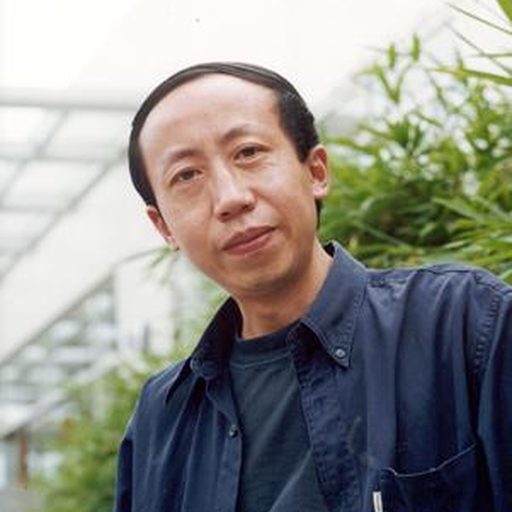
Founder of the Xiamen Dada movement in 1986, he saw his works banned by the Chinese government and had to leave the country. In 1999, it was France he represented at the Venice Biennale. His Serpent d'océan rises from the Loire estuary at every low tide.
The story
At the Venice Biennale of 1999 he represented France. Not China — which had banned his works, and which he had had to leave.
Born at Xiamen, in Fujian, on 19 February 1954, in 1986 he founded the Xiamen Dada movement, whose formula fits in one sentence: “Zen is Dada, Dada is Zen.” The Chinese avant-garde of the 1980s ran into a censorship that left no way out but departure.
In 1989 the exhibition “Magiciens de la terre” at the Centre Pompidou revealed him to Paris. He settled there, then established himself at Ivry-sur-Seine. Ten years later he was in Venice under the French flag, with Jean-Pierre Bertrand.
He leaves monumental works: the Serpent d'océan at Saint-Brevin-les-Pins, a hundred-and-thirty-metre skeleton beached on the foreshore at the mouth of the Loire and uncovered at every low tide; the Tête d'or set on the roof of the museum of contemporary art in Lyon; One man, nine animals, made for the French pavilion of 1999 and installed since 2007 at the castle of Caen. He died in Paris on 19 October 2019 and rests in Division 86. His stone carries a name and two dates.
The grave
A sober grave, whose inscription is a name and two dates: “HUANG Yong Ping, 1954-2019”. Neither the Chinese nationality, nor the Xiamen Dada movement he founded in 1986, nor the censorship that drove him away, nor the Venice Biennale where he represented France in 1999. His Serpent d'océan at Saint-Brevin, for its part, can be seen from the shore at every low tide.
On site, do not miss
An inscription of three elements: “HUANG Yong Ping, 1954-2019.” Nothing of Xiamen Dada, nothing of the Venice Biennale where he represented France.
Visitors' questions
Where is Huang Yong Ping's grave?
In Division 86, Avenue Transversale No. 2, seventh row, beneath an inscription of three elements: “HUANG Yong Ping, 1954-2019”. The Division is also that of Apollinaire, of the singer Nicolas Ker and of Pezon the lion-tamer.
Jean-Baptiste PezonWhat was the Xiamen Dada movement?
The avant-garde he founded in 1986 in his home city, summed up in a single line: “Zen is Dada, Dada is Zen”. The Chinese government banned his work, and that is what drove him out of the country.
Carlos Cruz-DiezWhich country did he represent in Venice?
France, at the 1999 Biennale, alongside Jean-Pierre Bertrand — ten years after he landed in Paris. It was the Pompidou Centre's 1989 exhibition “Magiciens de la terre” that had made his name in Europe.
Geneviève ClaisseWhich of his works are easiest to see?
The Serpent d'océan at Saint-Brevin-les-Pins (2012), a monumental skeleton beached on the foreshore at the mouth of the Loire, the Tête d'or — the golden head — at Lyon's museum of contemporary art (2004), and One man, nine animals, made for the French pavilion in Venice in 1999 and installed at the château of Caen.
Gérard FromangerAudio guide to Père Lachaise: the best unusual guided tour!
Discover the secrets of the most astonishing tombs
the audio guidefrom€6.99